111Obmen
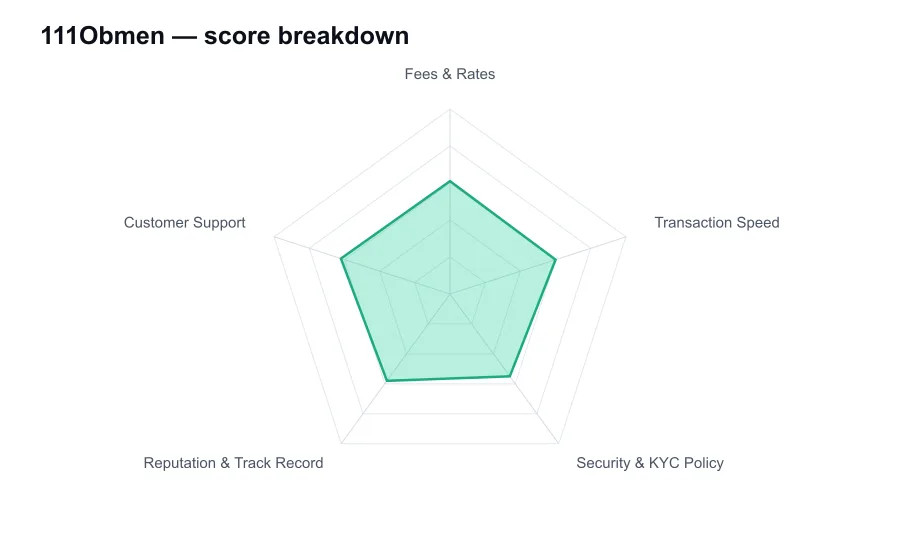
111Obmen scores 5.9/10 overall in our independent review, measured against every other provider we've compared, strongest on Customer Support (6.2/10) and weakest on Security & KYC Policy (5.5/10).
Score: 5.9 How we score → Visit official siteEditorial independence: our scores and rankings are produced using the fixed criteria above and are not influenced by advertisers. This is an independent ranking site and is not operated by, or affiliated with, any provider we list.
Affiliate disclosure: some links on this page may earn us a commission at no extra cost to you. This does not affect our rankings.
| Criterion | Score | Note |
|---|---|---|
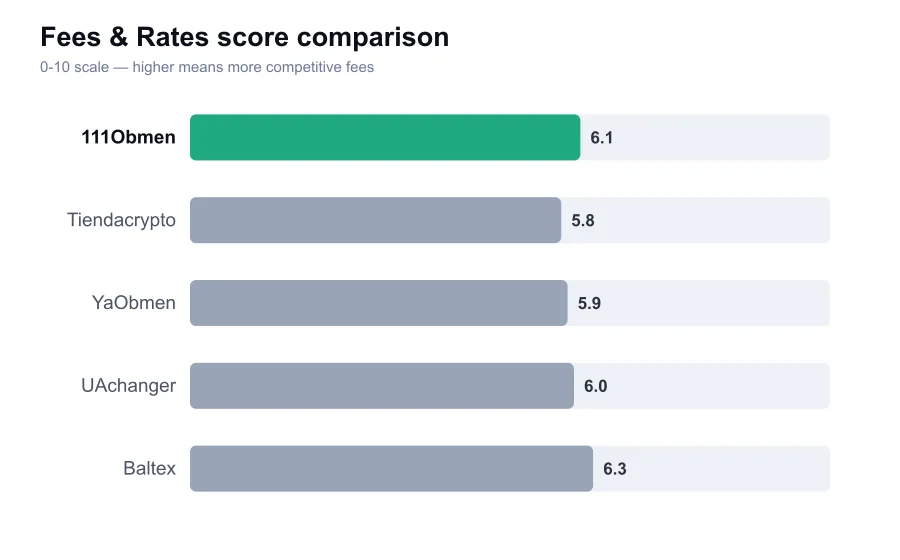
| Fees & Rates | 6.1 | Can be competitive on selected local routes, compare final payout. |
| Transaction Speed | 6.0 | Route-dependent, with manual processing likely on some orders. |
| Security & KYC Policy | 5.5 | Operational checks matter most, and KYC terms should be read first. |
| Reputation & Track Record | 5.8 | Assess through current independent monitor feedback, not site claims. |
| Customer Support | 6.2 | Human support is important for local payment directions. |
| Pros | Cons |
|---|---|
| Useful for localized exchange directions | — |
| Can suit bank and payment-system conversions | — |
| More practical than a full exchange for one-off transfers | — |
| Order-level support can help with manual routes | — |
111Obmen sits in the Russian-speaking online exchanger market, a part of crypto that works very differently from a global trading platform. These services commonly focus on direct exchange directions, local payment methods, bank transfers, electronic money systems, cash options, and cryptocurrency payouts. The appeal is obvious: a user can find one specific route and execute it without learning a complex exchange interface. The downside is that the market rewards careful verification far more than brand recognition alone.
A local exchanger can be genuinely useful where large international platforms do not support a payment rail, currency, or region. It can also be more convenient for someone converting a modest amount of USDT into a local bank payment than sending funds through a full exchange. But convenience is not a substitute for controls. The customer is often making an irreversible payment to an operator and waiting for manual or semi-manual processing. That is a much more trust-dependent transaction than a card purchase.
111Obmen should therefore be judged primarily on the exact exchange direction, the reserve information shown before payment, and its standing on independent exchanger-monitoring sites. A favorable rate is only meaningful if the service can actually fulfill the order at that rate. Users should check whether the monitor listing, domain, contact details, and exchange-page details match. Clone sites and lookalike payment instructions are a persistent problem in this sector, particularly for brands with names that are easy to imitate.
Rates are often the headline attraction. 111Obmen may show a competitive headline price on selected directions, but the real comparison has to include every component: the send amount, the receive amount, any bank-side charge, the required minimum, the maximum, and the reserve. Some local exchangers post a low rate but recover margin through a small reserve, an unfavorable cashout rate, or a condition buried in the exchange rules. The final amount on the order page is the number that deserves attention.
I am not impressed by providers that make customers calculate costs after payment. A good exchanger shows the payout clearly and locks the order conditions for a sensible period. If 111Obmen uses floating rates for a particular route, that should be explicit. Cryptocurrency prices can move quickly, but a customer should not be left guessing whether a reduced payout resulted from normal market movement or from the operator repricing an order after receiving funds.
Processing time at 111Obmen will depend heavily on what is being exchanged. Crypto transfers require blockchain confirmations, while card, bank, and cash directions may need manual review. A straightforward USDT transfer on a low-fee network can settle much faster than a Bitcoin order awaiting confirmations. Local bank payments also have their own schedules, limits, and compliance checks. Anyone promising instant completion across every route is selling a fantasy. The realistic expectation is that some orders will be prompt and others will require operator intervention.
That makes working-hours information and order status especially important. A service handling local payment rails should state whether its operators are available around the clock or only during listed hours. A ticket created on a weekend can become frustrating if a transfer has already been sent but the operator is unavailable until the next business day. Before paying, users should read the current exchange rules and take a screenshot of the rate, reserve, order number, and promised processing period.
Security here is less about advanced trading-custody architecture and more about operational discipline. Does the service publish a real legal identity or at least consistent business details? Does it protect its site with HTTPS? Does it explain anti-fraud checks? Can a customer reach a real operator if payment details change? Those basics sound mundane, but they are the foundation of a local exchanger. A slick interface cannot compensate for weak accountability.
KYC is another point where users should avoid assumptions. Many exchangers advertise a simple process, yet reserve the right to request identity documents for suspicious payments, bank-card transactions, or larger amounts. That is common in the industry. The meaningful question is whether 111Obmen explains the process before funds are sent. Customers should know what happens if verification is requested, whether the order is paused, what data is retained, and whether a refund can be made if the customer declines verification.
111Obmen has a more understandable market position than an anonymous global swap widget because it appears oriented toward practical exchange directions rather than grand claims about being a universal crypto platform. Still, a narrower focus does not erase counterparty risk. Its reputation needs to be assessed through current, independent monitoring references and recent customer feedback, not by old reviews or a badge displayed on its own site. In this category, recent complaints about delayed payouts matter more than years-old praise.
I would also be cautious about bank-transfer directions. Banks can freeze, reverse, or investigate payments, and both the sender and operator may be affected by fraud-screening systems. Never use an exchanger to receive third-party money or to route funds for someone else. Do not send a payment from an account in another person's name. Those behaviors can trigger a compliance hold even at an honest provider, and they make a later dispute much harder to resolve.
Support is a central part of the 111Obmen experience rather than an afterthought. With local payment routes, an operator may need to confirm a transfer, request a receipt, or explain an incorrect payment reference. A responsive chat channel can be more useful than a sophisticated help center in that situation. Still, support quality should be judged by whether it provides specific order-level answers, not by fast generic messages. Keep all communication in the official channels shown on the confirmed site.
I would consider 111Obmen for a modest, clearly understood local exchange route only after checking current reserve and independent monitoring feedback. It could be practical for users who already understand payment-system risks and know exactly which network and payout method they need. I would not use it as a storage platform, a trading venue, or a shortcut for moving high-value funds. It belongs in the utility-exchanger category, and should be treated accordingly.
My final view is more positive than for a completely opaque instant-swap brand, but it is still cautious. 111Obmen may offer useful local exchange functionality, and that has real value for the right customer. Yet local exchangers live or die by current execution, transparent rules, and human support. Compare the actual payout, verify the domain through independent sources, start small, and avoid it altogether if the rate looks implausibly better than every competing service.
How should I compare 111Obmen rates?
Compare the exact final payout, not the headline rate. Check the minimum, maximum, reserve, network, payment-system charges, and any conditions shown on the order page.
Can 111Obmen ask for identity documents?
Many local exchangers reserve the right to request verification for certain transactions. Read the current rules before payment and avoid sending from someone else's bank account.
How fast are 111Obmen exchanges?
Timing depends on blockchain confirmations, reserve availability, payment method, and manual review. Do not assume every direction is instant, especially outside listed working hours.
Editorial independence: our scores and rankings are produced using the fixed criteria above and are not influenced by advertisers. This is an independent ranking site and is not operated by, or affiliated with, any provider we list.
Affiliate disclosure: some links on this page may earn us a commission at no extra cost to you. This does not affect our rankings.