Maple
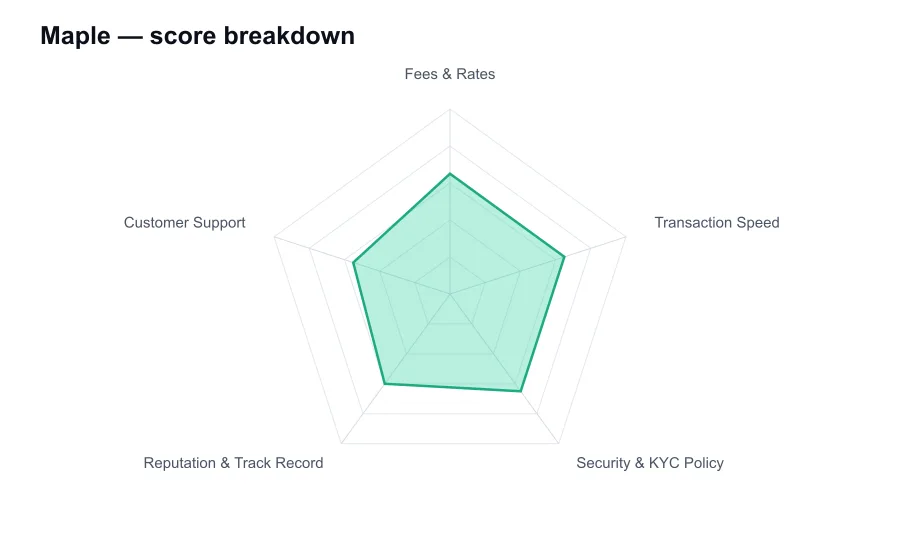
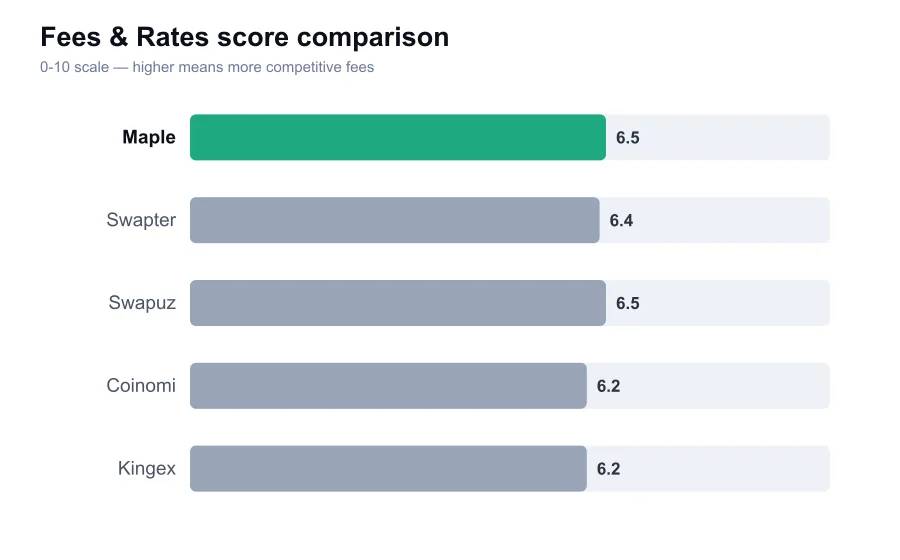
Maple scores 6.3/10 overall in our independent review, measured against every other provider we've compared, strongest on Fees & Rates (6.5/10) and weakest on Customer Support (5.5/10).
Score: 6.3 How we score → Status: active (checked 2026-10-13T19:18:35.579Z) Visit official siteEditorial independence: our scores and rankings are produced using the fixed criteria above and are not influenced by advertisers. This is an independent ranking site and is not operated by, or affiliated with, any provider we list.
Affiliate disclosure: some links on this page may earn us a commission at no extra cost to you. This does not affect our rankings.
| Criterion | Score | Note |
|---|---|---|
| Fees & Rates | 6.5 | Product economics are clear enough, but not a simple exchange fee table |
| Transaction Speed | 6.5 | Fast on-chain actions, with liquidity-dependent lending exits |
| Security & KYC Policy | 6.5 | Mature DeFi design, but credit and smart-contract risk are real |
| Reputation & Track Record | 6.0 | Established DeFi credit name, marked by the 2022 Orthogonal default |
| Customer Support | 5.5 | Useful documentation, limited personal recourse |
| Fact | Value |
|---|---|
| Founded | 2019 |
| Protocol type | On-chain credit and lending |
| Retail product | Syrup |
| Primary lending asset | USDC |
| Orthogonal default | About $36 million in 2022 |
| Custody model | Wallet and smart contracts |
| Pros | Cons |
|---|---|
| Specialized on-chain credit protocol | — |
| Syrup gives access to USDC lending | — |
| Non-custodial wallet interaction | — |
| More substantial history than typical yield farms | — |
What is Maple?
How Maple Works
- Choose a Maple or Syrup lending product
- Read its asset, yield, and withdrawal terms
- Connect a compatible self-custody wallet
- Approve and deposit the stated asset, commonly USDC
- Receive the product's tokenized lending position
- Request redemption according to the product's liquidity rules
KYC
| Requirement | tiered |
|---|---|
| Notes | Permissionless wallet-based products can be available without standard retail KYC. Institutional borrowing and certain credit arrangements involve formal onboarding and legal checks. |
Supported Assets
| Notable Coins | USDC, MPL |
|---|
How to Use Maple Safely
- Read the exact product withdrawal terms before depositing
- Treat yield as compensation for risk, not guaranteed income
- Use the official Maple or Syrup domain only
- Keep emergency funds outside lending positions
- Check the asset and network before approving a deposit
- Do not share wallet recovery phrases with support accounts
Maple is a DeFi credit protocol, not an exchange in the retail trading sense. Its purpose is to connect capital providers with borrowers through on-chain lending pools, and its current public face increasingly centers on Syrup, Maple's permissionless USDC lending product. That distinction matters. You are not opening an order book and speculating on short-term price moves. You are supplying capital to a lending system and accepting a mix of borrower, smart-contract, liquidity, and stablecoin risk in return for yield.
Maple occupies an unusual spot in crypto finance. Aave and Compound made overcollateralized on-chain lending familiar to ordinary DeFi users. Maple's original identity was institutional and credit-focused, with delegated pool management and loans that could be undercollateralized. That model can produce better capital efficiency, but it depends heavily on credit judgment. The protocol is therefore more interesting than a basic lending market, and also harder to assess responsibly. A high displayed yield should prompt questions about who is borrowing, on what terms, and what happens if repayment fails.
The fee question is less simple here than on a spot exchange. There is no standard retail maker-taker table where every user can quickly calculate the cost of a trade. A lender deposits USDC into a product, receives a tokenized position, and earns a variable rate after applicable protocol and pool economics. Borrowers negotiate or accept loan terms that may include interest, establishment costs, and other deal-specific conditions. The number a depositor sees is a yield estimate, not a fixed savings-account rate.
Syrup made Maple more accessible by giving DeFi users a clearer USDC lending route than the older institutional pool structure. The mechanics are still lending mechanics. Returns derive from credit activity and available deployment, and withdrawal timing can depend on the product's liquidity and withdrawal rules. That is a better fit for someone who understands stablecoin lending than for a person who merely wants to hold cash-like funds. USDC is designed to track the dollar, but it is not a bank deposit and carries issuer, blockchain, and counterparty exposure.
Maple has a meaningful historical scar that should not be brushed aside. In late 2022, the collapse of crypto lender Orthogonal Trading resulted in a major default affecting Maple lending pools, reported at roughly $36 million. That episode exposed exactly why undercollateralized crypto credit is different from lending against excess collateral that can be liquidated automatically. Maple did not cause the wider market contagion, but the event proved that borrower due diligence and legal recovery structures can fail under stress.
To Maple's credit, that experience forced a more sober approach. The protocol shifted attention toward secured lending, clearer product structures, and rebuilding trust around capital management. Still, a redesign does not delete history. A lender evaluating Maple should read the current pool documentation rather than assuming every product has the same protections as every other product. One pool's collateral arrangement, borrower set, or withdrawal process may differ materially from another. Treat each opportunity as a separate credit decision.
Transaction speed is good at the blockchain level. Deposits and token transfers settle as quickly as the underlying supported network confirms them, usually within minutes or less under normal conditions. Borrowing, loan deployment, redemptions, and withdrawal requests are another matter. Credit products cannot always promise instant liquidity because the supplied capital may be deployed. A user who needs immediate access to emergency funds should not allocate those funds to a lending position that can use queues, windows, or liquidity-dependent redemptions.
This is where Maple compares poorly with a simple centralized exchange balance and differently from an overcollateralized lending market. On an exchange, you can often sell a liquid asset instantly, though withdrawal can be delayed by compliance checks. On Aave, liquidity is generally available if the pool has sufficient assets. Maple's lending model can ask depositors to accept a more deliberate exit process in exchange for its yield design. That is not inherently bad. It is a product characteristic users must price properly.
Maple is non-custodial in the sense that users interact with smart contracts through their own wallets, but that should not be confused with risk-free self-custody. The protocol relies on code, oracle and operational assumptions, stablecoin contracts, governance decisions, pool managers, and borrower behavior. Security reviews and audits matter, but audits are evidence, not insurance. A smart contract can work exactly as designed while the economic model still loses money because a borrower defaults or withdrawal liquidity vanishes during a rush for the exit.
KYC is product-dependent rather than a simple universal answer. Permissionless DeFi access through Syrup-style products is built for wallet users, while institutional borrowing and some credit arrangements necessarily involve more extensive onboarding and legal checks. That split is sensible. It lets ordinary users access a defined on-chain product while keeping institutional credit from pretending that anonymous lending is adequate due diligence. Users should not infer that a permissionless deposit gives them the protections or information rights of a direct institutional lender.
Maple's reputation is stronger than many small DeFi projects because it has survived a severe credit event, attracted serious industry attention, and continued to develop rather than disappearing after the 2022 turmoil. I would still call its reputation mixed, not pristine. The Orthogonal default is central to its story. Anyone marketing Maple as a simple safe-yield protocol is being careless. Its record is better understood as a live experiment in bringing real credit discipline into a market that often learned credit discipline only after losses.
Support is adequate for a technical DeFi protocol, though it is not the kind of support retail exchange users expect. Documentation, community channels, and product materials can help a user understand a transaction. They cannot undo a wallet signature or guarantee personal guidance during a market panic. This is one reason Maple suits informed users who can read pool terms and monitor positions. If you want a phone line, account recovery, and someone responsible for every operational mistake, DeFi lending is the wrong category.
The practical way to use Maple is to begin small. Connect a fresh wallet, confirm the official application URL, inspect the specific product's withdrawal process, and understand what asset you will receive when you deposit. If the position is represented by a receipt token, learn whether it can be redeemed directly, transferred, or sold, and under what conditions. Do not fund it with money needed for bills or a near-term purchase. Yield is payment for accepting risk and reduced flexibility.
My judgment is that Maple is one of the more intellectually serious names in DeFi credit, but it is not a conservative cash alternative. The team and product direction deserve more credit than a fly-by-night farm, while the default history demands more skepticism than fans sometimes show. It can fit sophisticated stablecoin holders who want on-chain credit exposure and can tolerate liquidity constraints. For most newcomers, a simpler product with transparent collateralization and easier exits is the better first step.
Is Maple a crypto exchange?
No. Maple is primarily a DeFi credit and lending protocol. Users supply capital to lending products rather than placing ordinary spot buy and sell orders.
What happened with Orthogonal Trading?
Orthogonal Trading defaulted in late 2022, affecting Maple pools by roughly $36 million. The event showed the risk of undercollateralized crypto credit.
Does Maple require KYC?
It depends on the product. Permissionless DeFi lending products can be wallet-based, while institutional borrowing and credit arrangements require more formal onboarding.
Can I always withdraw USDC immediately?
No. Withdrawal timing depends on the specific Maple or Syrup product, available liquidity, and its redemption rules. Read those terms before depositing.
Is a displayed Maple yield guaranteed?
No. Lending yields are variable and involve borrower, liquidity, smart-contract, and stablecoin risks. They are not equivalent to a bank interest guarantee.
What is Syrup?
Syrup is Maple's DeFi-oriented lending product line that gives wallet users access to USDC lending exposure through tokenized on-chain positions.
Editorial independence: our scores and rankings are produced using the fixed criteria above and are not influenced by advertisers. This is an independent ranking site and is not operated by, or affiliated with, any provider we list.
Affiliate disclosure: some links on this page may earn us a commission at no extra cost to you. This does not affect our rankings.