Swapter
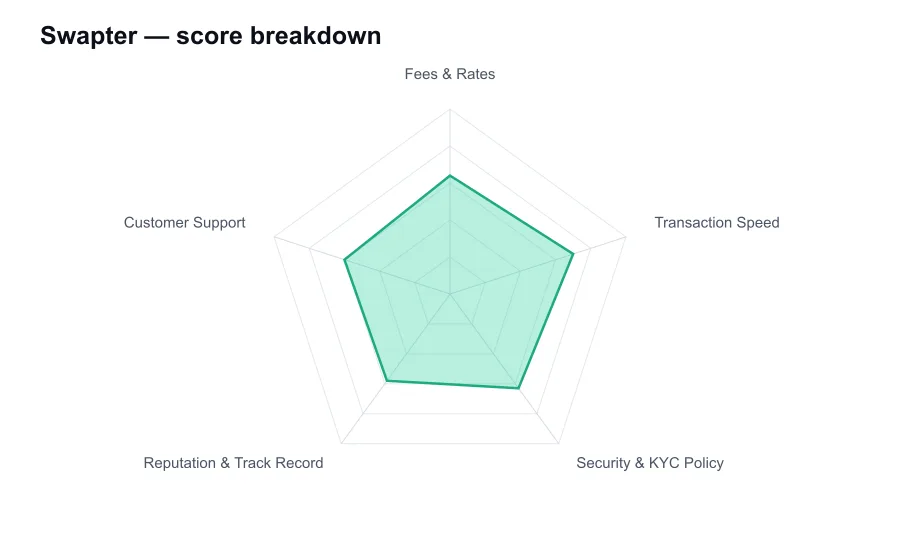
Swapter scores 6.3/10 overall in our independent review, measured against every other provider we've compared, strongest on Transaction Speed (7.0/10) and weakest on Reputation & Track Record (5.8/10).
Score: 6.3 How we score → Status: active (checked 2026-10-13T19:27:51.986Z) Visit official siteEditorial independence: our scores and rankings are produced using the fixed criteria above and are not influenced by advertisers. This is an independent ranking site and is not operated by, or affiliated with, any provider we list.
Affiliate disclosure: some links on this page may earn us a commission at no extra cost to you. This does not affect our rankings.
| Criterion | Score | Note |
|---|---|---|
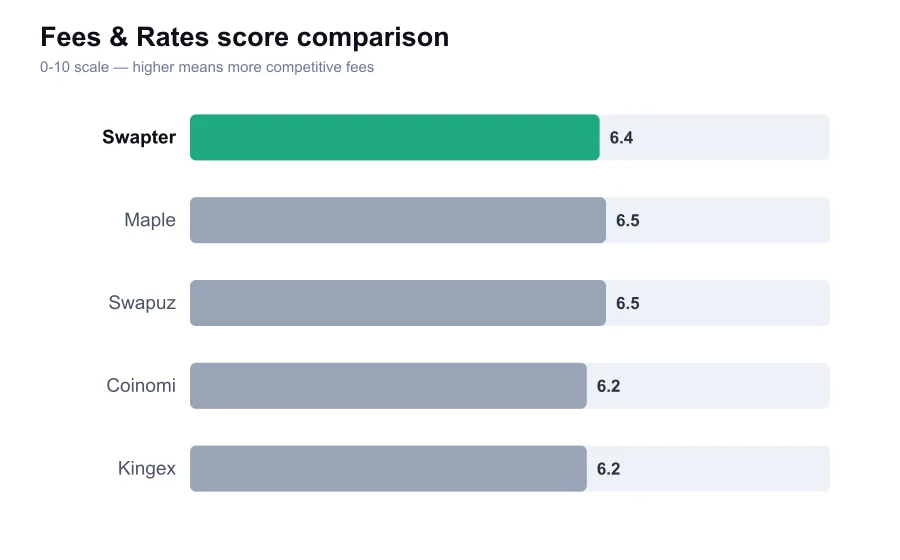
| Fees & Rates | 6.4 | Quote-based pricing can vary by pair and network |
| Transaction Speed | 7.0 | Fast on clear networks, confirmation delays remain |
| Security & KYC Policy | 6.3 | No account for basic swaps, AML reviews remain possible |
| Reputation & Track Record | 5.8 | Smaller public track record than leading rivals |
| Customer Support | 6.0 | Order ID and transaction hash are essential for help |
| Fact | Value |
|---|---|
| Service model | Instant crypto exchange |
| Account requirement | Not required for basic swaps |
| Rate options | Floating and fixed quotes |
| Settlement method | Crypto wallet payout |
| Verification policy | Possible AML review |
| Pros | Cons |
|---|---|
| No account needed for a basic swap | — |
| Simple wallet-to-wallet conversion flow | — |
| Fixed and floating quote styles | — |
| Useful for one-off asset conversions | — |
What is Swapter?
How Swapter Works
- Choose the input and output crypto assets
- Pick a floating or fixed rate quote if available
- Enter the receiving wallet address
- Send the exact deposit amount to the generated address
- Wait for confirmations and receive the payout
KYC
| Requirement | optional |
|---|---|
| Notes | Basic swaps do not generally require pre-registration, but AML screening can lead to an identity or source-of-funds request after a deposit is received. |
How to Use Swapter Safely
- Run a small test transaction for a new token or network
- Match the deposit network exactly to your sending wallet
- Send the exact amount shown for a fixed quote
- Save the order ID and both transaction hashes
- Do not send funds from sources likely to trigger AML screening
Swapter is an instant crypto exchange service aimed at the user who wants to convert one asset into another without opening a conventional trading account. You choose a pair, send coins to a generated address, and receive the output asset at your wallet. That model is convenient, but it is important to understand what it is not: Swapter is not an order-book exchange where you control execution minute by minute.
The service sits in a crowded category beside SimpleSwap, ChangeNOW, LetsExchange and similar conversion platforms. Most users will care about three things: whether the quote is competitive, whether the transaction completes without delay, and what happens if compliance systems flag it. Swapter can handle straightforward swaps neatly, but it does not have the public operating history or independent scrutiny of the largest names in that group.
Pricing is quote-based. There is no reason to assume that the rate shown is the pure market rate plus one clearly stated percentage. The displayed output reflects liquidity-provider pricing, network costs, the service's margin, and the risk of market movement. That is normal for an instant exchanger, but it means a comparison against at least one rival takes less than a minute and can save a surprising amount.
The floating-rate option is usually the better choice when markets are calm and the transaction is small. It may deliver more favorable pricing because the exchange can complete at the market rate available after your deposit arrives. It also exposes you to movement between the moment you see the quote and the moment providers fill the order. Bitcoin or Ethereum congestion can turn that interval into a material pricing issue.
A fixed-rate quote gives more certainty, but it is rarely free certainty. The quote may contain a wider spread or an expiry window. Send the wrong amount, use a fee mode that leaves the deposit short, or let the quote expire and the transaction can be recalculated. That isn't necessarily misconduct. It is the operational reality of fixed-rate swaps, and users should read the deposit instructions carefully.
Speed depends on the input chain first. A swap funded with a fast, low-cost network can move through quickly once sufficient confirmations arrive. Bitcoin deposits may take much longer during congestion, and tokens on Ethereum can become expensive or delayed. Swapter itself cannot make a blockchain confirm faster, although a well-run service should explain what stage the order has reached.
The most common frustration with this category is not a failed swap but a pending one. A customer sees funds leave their wallet, then waits while a deposit confirms, liquidity is sourced, and the payout is broadcast. On a good day this is a short process. On a difficult day, especially with a low-fee deposit or a thinly traded asset, support quality becomes more important than the initial quote.
Swapter markets a low-friction experience and does not require account creation for a basic swap. That is useful for privacy and convenience, but it should never be read as a guarantee that no verification can occur. Like other centralized instant exchangers, it can apply anti-money-laundering screening and request documents or transaction context if activity triggers its controls.
This is the uncomfortable part of using no-registration exchangers. You may not be asked for identity before sending funds, yet a transaction can still be paused afterward. If your funds came from a sanctioned service, gambling operation, mixer, stolen-wallet cluster, or another high-risk source, the service may require a review. Anyone who cannot tolerate that possibility should use a regulated venue with verification completed before depositing.
Security is largely split between Swapter and the user. The service handles temporary conversion flow, while you provide the destination address. There is no password to protect on a simple non-custodial-style swap, but there is also little room to reverse an error. A wrong network or an incorrect recipient address can create a support case that has no easy resolution.
Swapter's reputation is adequate for a smaller instant exchanger, but it does not carry the decade-long credibility of an older specialist or the visibility of a top centralized exchange. I would not call that a reason to avoid it outright. I would call it a reason to start with a modest amount, save the order ID and transaction hashes, and avoid using it as a place to route life-changing sums.
Support is generally the deciding factor when something goes wrong. The practical test is whether staff can identify a transaction by its order ID and hash, explain the confirmation status, and provide a realistic next step. A generic response about network congestion is not enough if a transaction has been pending for many hours. Keep screenshots of the quote before sending funds.
Swapter makes most sense as a convenience tool, not as a primary exchange relationship. Use it for converting a wallet balance, consolidating assets, or getting into a supported chain without opening an account. Do not use it for leveraged trading, recurring large purchases, or a transaction where a few percentage points of slippage would hurt.
My view is straightforward. Swapter can be useful if you value a direct wallet-to-wallet flow and accept the limits of an intermediary quote service. Check the rate, confirm the network, and use a test amount for an unfamiliar pair. It is a practical tool, but it has not earned the blind trust that some users give to better-known exchanges.
Do I need to create a Swapter account?
A basic swap is designed to work without creating a conventional trading account. You still need to provide a receiving wallet address.
Why can a Swapter transaction stay pending?
The input transaction may still need blockchain confirmations, the chosen pair may need liquidity sourcing, or the order may require a compliance review.
What happens if I send less than the quoted deposit amount?
A fixed quote may no longer apply if the received amount is short. The order can be recalculated or require support review, so send the exact requested amount.
Can Swapter request KYC after I send crypto?
Yes. Its basic flow is low-friction, but anti-money-laundering screening can trigger a request for identity or source-of-funds information.
Should I use fixed or floating rate on Swapter?
Floating rates can be better in stable markets. Fixed rates give more certainty but may include a wider spread and have a limited quote-validity period.
What should I save before contacting Swapter support?
Save the order ID, deposit transaction hash, receiving address, selected network, amount sent, and a screenshot of the original quote.
Editorial independence: our scores and rankings are produced using the fixed criteria above and are not influenced by advertisers. This is an independent ranking site and is not operated by, or affiliated with, any provider we list.
Affiliate disclosure: some links on this page may earn us a commission at no extra cost to you. This does not affect our rankings.