Coinomi
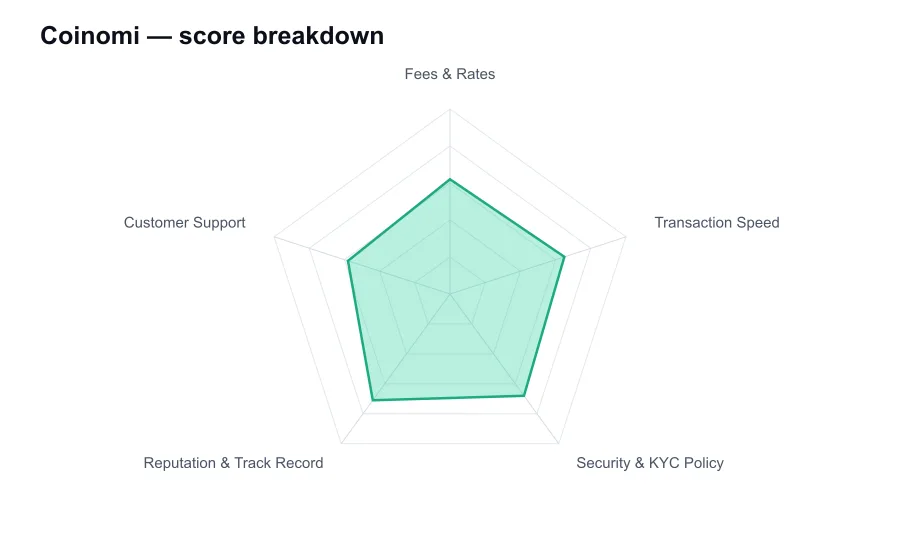
Coinomi scores 6.6/10 overall in our independent review, measured against every other provider we've compared, strongest on Reputation & Track Record (7.1/10) and weakest on Customer Support (5.8/10).
Score: 6.6 How we score → Status: active (checked 2026-10-13T19:42:54.250Z) Visit official siteEditorial independence: our scores and rankings are produced using the fixed criteria above and are not influenced by advertisers. This is an independent ranking site and is not operated by, or affiliated with, any provider we list.
Affiliate disclosure: some links on this page may earn us a commission at no extra cost to you. This does not affect our rankings.
| Criterion | Score | Note |
|---|---|---|
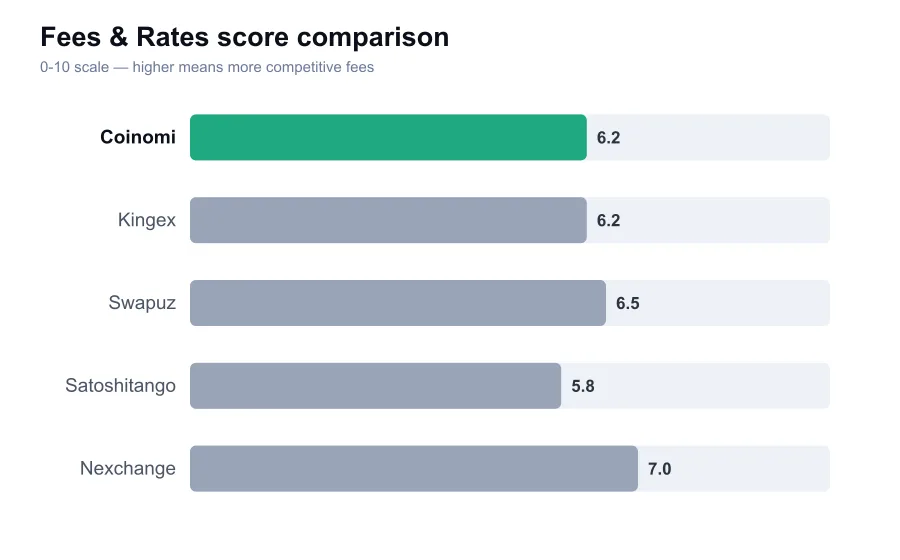
| Fees & Rates | 6.2 | Wallet use is free, but swap partner spreads vary. |
| Transaction Speed | 6.5 | Direct broadcasts are fast, swaps depend on networks and partners. |
| Security & KYC Policy | 6.8 | Non-custodial control, but mobile-wallet and closed-source tradeoffs. |
| Reputation & Track Record | 7.1 | Operating since 2014 with a long multi-asset wallet record. |
| Customer Support | 5.8 | Useful documentation, mixed reports on ticket responsiveness. |
| Fact | Value |
|---|---|
| Founded | 2014 |
| Custody model | Non-custodial |
| Wallet software | Free to download and use |
| Platforms | Android, iOS, Windows, macOS, Linux |
| Wallet recovery | Recovery phrase |
| Swap model | Third-party providers |
| Pros | Cons |
|---|---|
| Non-custodial wallet with user-controlled recovery phrase | — |
| Wide support for coins, tokens, and blockchain networks | — |
| Built-in third-party swaps and purchase options | — |
| Available on Android, iOS, Windows, macOS, and Linux | — |
What is Coinomi?
How Coinomi Works
- Download Coinomi and create a new wallet or restore an existing one
- Write down the recovery phrase and store it offline
- Add the relevant coin or token wallet
- Receive funds to the displayed address or send funds from the wallet
- Use the exchange tab if you want a third-party swap quote
KYC
| Requirement | optional |
|---|---|
| Notes | Creating and using a Coinomi wallet does not require KYC. External purchase and swap partners can request verification under their own policies. |
Supported Assets
| Notable Coins | Bitcoin, Ethereum, Litecoin, Bitcoin Cash, Dogecoin, USDT, USDC |
|---|---|
| Networks | Bitcoin, Ethereum, BNB Smart Chain, Polygon, Tron |
How to Use Coinomi Safely
- Write the recovery phrase on paper and keep it offline
- Never share the recovery phrase with support or anyone else
- Verify the destination network before sending tokens
- Use a hardware wallet for large long-term holdings
- Install updates only from official app stores or Coinomi links
Mobile App
| iOS | Yes |
|---|---|
| Android | Yes |
| Notes | Coinomi offers mobile applications for iOS and Android. |
Coinomi is a long-running non-custodial cryptocurrency wallet, not an exchange in the conventional sense. It sits somewhere between a basic multi-chain wallet and an exchange gateway: users hold their own keys, then can access third-party swap and purchase services from inside the application. That distinction matters. Coinomi is useful for managing assets and making occasional swaps, but it should not be judged as if it offers the execution, fiat rails, or market depth of Coinbase, Kraken, or Binance.
The wallet launched in 2014, which gives it more history than many mobile crypto wallets that appeared during the 2021 retail boom. Coinomi's appeal has always been breadth. It supports major assets such as Bitcoin, Ethereum, Litecoin, Bitcoin Cash, Dogecoin, and many token standards, while also accommodating a considerable number of less familiar chains. For someone with old altcoin holdings or a wallet spread across several networks, that broad compatibility is genuinely useful.
The interface is functional rather than polished. Coinomi has improved since its earlier Android-focused years, but it still feels like a wallet built by crypto veterans for people who already understand addresses, recovery phrases, derivation paths, and network fees. New users can send funds, receive funds, and use the exchange tab without much trouble. The difficult part begins when a transaction is delayed, a token does not display correctly, or a swap partner asks for identification.
Fees are the area where Coinomi's marketing can confuse people. Downloading and using the wallet is free, and Coinomi does not charge a traditional custody or account fee. Sending cryptocurrency still requires the network fee charged by the relevant blockchain. Bitcoin fees, Ethereum gas, and fees on other chains are not Coinomi revenue. Users can often adjust transaction fees, which is helpful when a network is congested, though choosing too low a fee can leave a transaction waiting for a long time.
The in-app exchange function is different. Coinomi routes swaps through external providers, and the quoted rate includes the provider's spread and service charge. The exact cost changes by pair, amount, liquidity, and whether the user selects a fixed or floating quote. That makes Coinomi more expensive and less transparent than placing a limit order on a major centralized exchange. A quick BTC to ETH conversion might be convenient, but it is rarely the cheapest route for a user who is comfortable depositing to Kraken or Coinbase Advanced.
The purchase function has the same problem. Card and bank-transfer partners set the terms, availability, identification rules, limits, and charges. Coinomi is essentially the front end. This is normal for a wallet product, but users should not assume that Coinomi's no-account approach carries through to every service inside it. A third-party fiat provider may require full identity verification, source-of-funds information, or a selfie check before releasing purchased coins.
Transaction speed is mostly outside Coinomi's control. A Bitcoin payment is confirmed according to Bitcoin's mempool and chosen fee. Ethereum transfers depend on gas settings and network activity. A swap can take minutes or longer because the provider needs to receive the deposit, execute the conversion, and send the output. Fixed-rate swaps can be especially frustrating if the deposit arrives after the allowed window or with insufficient network fees.
Coinomi has an advantage over exchange accounts for ordinary wallet transfers because there is no internal withdrawal review queue. Once a user signs and broadcasts a transaction, it goes directly to the network. There is no support agent deciding whether a withdrawal is safe. That is good for control and speed, but it also means an error is usually irreversible. Send coins to the wrong network or address and Coinomi cannot retrieve them.
Security starts with the wallet model. Coinomi is non-custodial, so it does not hold customer balances or control the recovery phrase. The seed phrase is generated on the user's device and remains the key to the funds. This reduces the familiar exchange risk of a platform freezing withdrawals or losing pooled customer assets. It does not remove risk. Anyone who obtains the recovery phrase can drain the wallet, and Coinomi cannot restore a compromised wallet.
The application offers password protection and biometric options on supported devices, but a wallet is only as secure as the device and backup practices around it. Coinomi's software is not fully open source, which remains a valid criticism. Trust Wallet and many hardware-wallet ecosystems offer a more transparent development model, while hardware wallets such as Ledger and Trezor keep signing keys off a general-purpose phone or computer. For substantial holdings, Coinomi should be treated as a spending wallet rather than a vault.
Coinomi has faced security criticism in the past. In 2019, a researcher disclosed an Android clipboard-related vulnerability that could potentially expose wallet passphrases on affected versions. Coinomi said it addressed the issue, but the episode damaged the claim that a mobile wallet can be treated as carefree storage. The relevant lesson is not that Coinomi is uniquely unsafe. It is that entering a recovery phrase into a phone app has risks that many casual users underestimate.
The company's record is respectable by wallet-industry standards. Coinomi has remained operating through several crypto cycles and has not suffered the kind of custodial insolvency that destroyed centralized platforms such as FTX. Still, longevity should not be confused with an institutional guarantee. There is limited public visibility into the company compared with a listed firm or a heavily regulated exchange, and users should not expect bank-style protections.
Support is available through Coinomi's help center and ticket system. The documentation covers common restoration, transaction, and network questions fairly well. Support cannot reverse on-chain payments, reveal a lost seed phrase, or force a swap provider to ignore its compliance process. Reports from users are mixed, which is common for wallet support, especially during periods when third-party exchange or purchase partners have delays.
Coinomi is strongest for an experienced user who wants one wallet for a diverse range of coins, wants direct control of keys, and understands that in-app swaps trade price efficiency for convenience. It is weaker for people buying crypto with fiat for the first time, active traders, or anyone storing life-changing amounts without hardware-wallet protection. My view is straightforward: Coinomi remains capable and useful, but its exchange tools are an add-on, not a reason to choose it over a dedicated trading venue.
Does Coinomi charge a wallet fee?
Coinomi does not charge a standard wallet account fee. Blockchain network fees still apply to sends, and third-party swap or purchase providers include their own rates and spreads.
Does Coinomi require KYC?
The Coinomi wallet itself does not require KYC to create or use a wallet. Identity checks can be required by third-party providers used for card purchases, bank purchases, or certain swaps.
Can Coinomi recover a lost recovery phrase?
No. Coinomi is non-custodial, so the recovery phrase controls the wallet. If every copy of the phrase is lost, Coinomi support cannot recover the assets.
Why can a Coinomi swap take longer than expected?
The swap provider must first receive enough blockchain confirmations, complete the conversion, and send the output. Bitcoin and Ethereum congestion can extend that process significantly.
Did Coinomi have a security incident?
A 2019 disclosure described an Android clipboard-related passphrase exposure issue on affected versions. Coinomi said it fixed the issue, but users should always keep recovery phrases away from internet-connected devices.
Can Coinomi reverse a transaction sent to the wrong address?
No. Once a crypto transaction is confirmed on its blockchain, Coinomi cannot reverse it. Check the address and network carefully before confirming.
Editorial independence: our scores and rankings are produced using the fixed criteria above and are not influenced by advertisers. This is an independent ranking site and is not operated by, or affiliated with, any provider we list.
Affiliate disclosure: some links on this page may earn us a commission at no extra cost to you. This does not affect our rankings.