Nexchange
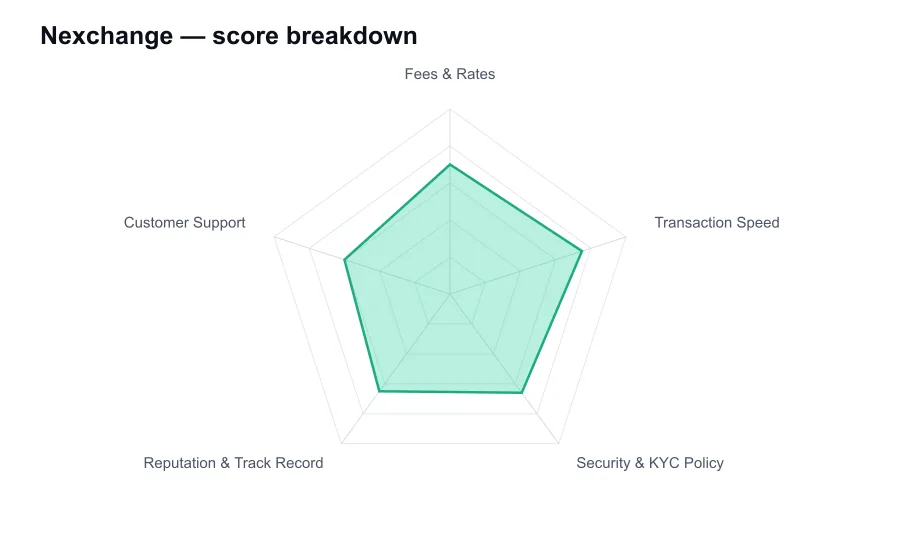
Nexchange scores 6.8/10 overall in our independent review, measured against every other provider we've compared, strongest on Transaction Speed (7.5/10) and weakest on Customer Support (6.0/10).
Score: 6.8 How we score → Status: active (checked 2026-10-13T19:23:21.673Z) Visit official siteEditorial independence: our scores and rankings are produced using the fixed criteria above and are not influenced by advertisers. This is an independent ranking site and is not operated by, or affiliated with, any provider we list.
Affiliate disclosure: some links on this page may earn us a commission at no extra cost to you. This does not affect our rankings.
| Criterion | Score | Note |
|---|---|---|
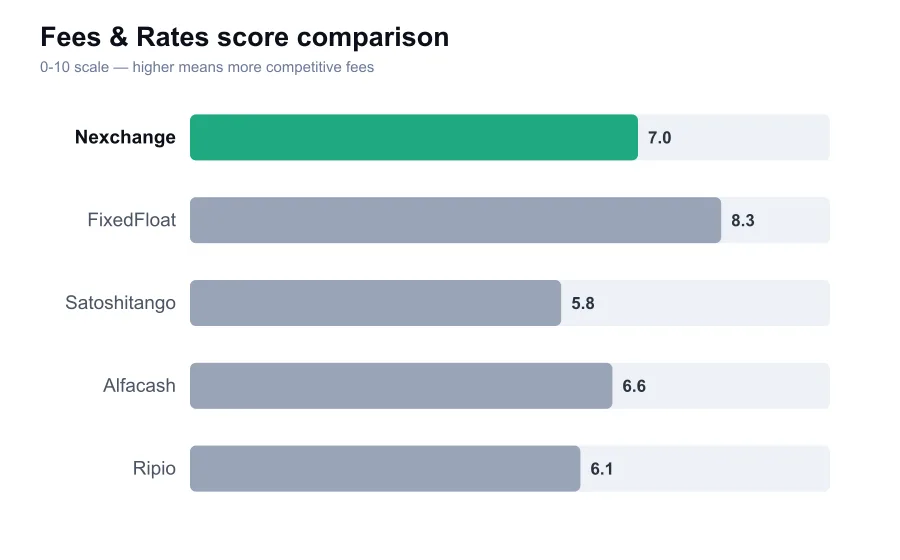
| Fees & Rates | 7.0 | Historically 0.5% floating fee, but quotes include execution costs. |
| Transaction Speed | 7.5 | Quick after deposit confirmations, slower on congested chains. |
| Security & KYC Policy | 6.6 | Wallet-to-wallet flow, yet swaps still require temporary trust. |
| Reputation & Track Record | 6.5 | Established niche infrastructure provider, not a major exchange brand. |
| Customer Support | 6.0 | Transaction support exists, but exceptions can require manual review. |
| Fact | Value |
|---|---|
| Floating-rate fee | 0.5% |
| Service type | Instant crypto exchange |
| Rate options | Floating and fixed quotes |
| Account model | Swap flow without trading account |
| Business tools | API and white-label services |
| Settlement | On-chain deposit and payout |
| Pros | Cons |
|---|---|
| Direct wallet-to-wallet swap flow | — |
| No conventional trading account needed for basic swaps | — |
| Historically transparent 0.5% floating service fee | — |
| API and white-label exchange infrastructure | — |
What is Nexchange?
How Nexchange Works
- Choose the asset pair and the amount to exchange
- Select a floating or fixed quote if available
- Enter and verify the destination wallet address
- Send the exact asset on the exact network shown
- Wait for deposit confirmations and conversion
- Receive the output asset at the destination address
KYC
| Requirement | optional |
|---|---|
| Notes | A full account-style onboarding is not always required for standard swaps, but Nexchange may request verification where compliance or risk controls require it. |
Supported Assets
| Notable Coins | Bitcoin, Ethereum, USDT, USDC, Litecoin, Monero |
|---|---|
| Networks | Bitcoin, Ethereum |
Limits
| Notes | Minimum and maximum amounts vary by pair, liquidity, and selected rate type. Review the live quote before sending. |
|---|
How to Use Nexchange Safely
- Copy the deposit address directly from the active order
- Match the token and network exactly
- Use a small test swap before a large conversion
- Save the order ID and transaction hash
- Do not send a late or partial fixed-rate deposit
Nexchange, commonly styled as n.exchange, is not a typical retail exchange with a big social-media presence and a screen full of speculative products. It is better understood as an instant exchange and liquidity infrastructure service. A customer selects an asset pair, receives a quoted amount and deposit address, sends funds, and receives the converted asset at a destination address. The company has also positioned itself as a provider of exchange APIs and white-label services, which explains why many people may encounter its infrastructure without treating it as their main crypto brand.
That model has a clear appeal. There is no need to park money in a trading account, learn a traditional order book, or manage limit orders just to swap Bitcoin for Ethereum or exchange one stablecoin for another. For someone who already has coins in a wallet, a non-custodial-style transaction flow can be much less intimidating than opening a full account on a centralised venue. The important distinction is that the service temporarily handles the swap. It is not a decentralised exchange, and it should not be described as trustless.
Nexchange's advertised structure has historically included a 0.5 percent service fee for floating-rate exchanges, with blockchain network costs reflected in the quote. That is competitive with many instant-swap competitors, though the number alone is not enough to judge a transaction. The actual price can move while an order is being processed. A floating quote is exposed to market movement, liquidity conditions, and the rate available through Nexchange's connected sources. The only meaningful comparison is the final amount shown beside a live quote.
This is where instant exchangers routinely disappoint customers who expect a conventional spot trade. A user sees a mid-market price on CoinGecko, calculates what they think they should receive, then finds the final output lower after the service fee, network cost, and execution movement. Nexchange is not unique in this respect, but neither is it excused by industry convention. For small conversions, convenience may easily be worth the difference. For a large swap, the user should request quotes from Nexchange, ChangeNOW, FixedFloat where available, and a liquid centralised exchange before committing.
The service's speed is generally good when the incoming transfer confirms promptly and the selected route is liquid. An Ethereum or Bitcoin transaction cannot be completed until the deposited funds have the confirmations Nexchange requires, so the service is never faster than the chain at its input. After that, the conversion and outbound transfer can be relatively quick. A simple swap may finish in minutes, while a congested Bitcoin deposit, an asset with low liquidity, or an automated risk check can extend the process significantly.
Fixed-rate options deserve special caution. A fixed quote can be valuable because it tells the user exactly what output to expect if they send the stated amount under the stated terms. But it also creates rules around timing and exact deposits. Send too little, send too late, or send an unsupported token variant, and the order may require manual handling. Floating rate is more forgiving operationally but less predictable financially. People should choose the model based on the size and urgency of the transaction rather than assuming one is always safer.
The relative lack of a standing account is a privacy attraction, but it should not be confused with a promise of anonymity. Nexchange has compliance obligations and can request verification where a transaction triggers risk controls or legal requirements. In practical terms, a swap that looks routine may proceed without a full onboarding process, while a flagged transaction can be paused until the user provides documents. That possibility is standard for custodial or semi-custodial instant exchange services, and it is a serious reason never to use one for a time-critical payment.
Security is best judged by the transaction model rather than marketing language. Nexchange does not ask users to maintain a broad portfolio in a conventional exchange account, which reduces the temptation to leave assets on a platform for months. Funds are sent for a defined conversion and output goes to a wallet address supplied by the customer. That is a useful reduction in exposure. Still, the user gives up control during the swap, and a mistake in the payout address is usually irreversible.
The company has been known in the crypto infrastructure niche since the late 2010s. That is a respectable run for a smaller exchange provider, though it has nowhere near the public scale, regulatory footprint, or independently tested resilience of Kraken, Coinbase, or Bitstamp. Nexchange's reputation is therefore practical rather than prestigious. It has a real product and a recognisable API-focused identity, but prospective customers should judge it as a smaller counterparty, not as a household-name financial institution.
Support quality is particularly important for an instant exchanger because there is no margin for vague answers when coins are in transit. Nexchange offers support channels and transaction tracking, but a customer whose order is delayed still needs to provide a transaction ID, sending address, amount, and correct network details. The most common avoidable support cases involve underpayments, chain confusion, or a deposit that has not reached the required confirmation count. Keeping screenshots and transaction hashes is far more useful than repeatedly sending a generic message asking where the funds are.
The platform is strongest for a technically comfortable user who wants a direct wallet-to-wallet swap and understands that the quoted result, not a chart price, is the relevant price. It is less attractive for someone buying crypto with a bank card or local transfer, because those customers are better served by a regulated fiat gateway. It is also a weak choice for a trader who needs exact execution on a large order. An order book on a deep venue offers better visibility, and often better economics.
Network choice can materially alter the experience. Bitcoin and Ethereum remain widely supported standards, but their confirmation times and fee conditions differ sharply from lower-cost chains. Users should never assume that a token ticker alone tells the whole story. USDT on Ethereum, Tron, and other networks may be economically similar assets, yet they are not interchangeable at the transfer level. The deposit instructions generated for an order are authoritative. Sending on another chain because it looked cheaper is one of the quickest ways to turn a simple conversion into a support case.
There is an argument that Nexchange's modest design is a virtue. It does not distract the user with leverage, copy trading, yield claims, or a pile of promotional tokens. The transaction is simple: quote, deposit, receive. But a clean flow does not remove the need for disciplined use. Check the amount, the network, the destination address, and the rate type before sending. For an unfamiliar service or high-value transaction, make a small test swap first.
My assessment is that Nexchange is a credible specialist tool, not a universal exchange. Its fee model is reasonable for convenience-driven swaps and its API roots give it more substance than anonymous instant-swap sites. The limitations are equally clear: quoted execution can be less competitive than a liquid order book, transactions may be subject to compliance review, and support becomes crucial when something deviates from the happy path. Use it for straightforward wallet conversions, not as a substitute for a full trading venue or a bank-like custodian.
What fee does Nexchange charge for floating swaps?
Nexchange has historically stated a 0.5% fee for floating-rate exchanges. The final quote can also reflect network costs and the available execution rate.
Does Nexchange require KYC for every swap?
Not necessarily for every standard transaction, but compliance checks can be requested for activity that triggers risk controls or legal requirements.
Why is my Nexchange swap still pending?
The deposit may still need blockchain confirmations, the network may be congested, or the order may require review. Check the transaction hash and order status first.
Can I send USDT on any network to an Nexchange order?
No. Send only through the exact network shown in the deposit instructions. USDT on different chains is not interchangeable at the transfer layer.
What is the difference between fixed and floating rates?
A fixed rate targets a stated output under its specified conditions. A floating rate can change with market movement between quote and execution.
Is Nexchange a decentralised exchange?
No. It is an instant exchange service. Users send assets to complete a conversion, so the transaction involves counterparty and operational trust.
Editorial independence: our scores and rankings are produced using the fixed criteria above and are not influenced by advertisers. This is an independent ranking site and is not operated by, or affiliated with, any provider we list.
Affiliate disclosure: some links on this page may earn us a commission at no extra cost to you. This does not affect our rankings.