FixedFloat
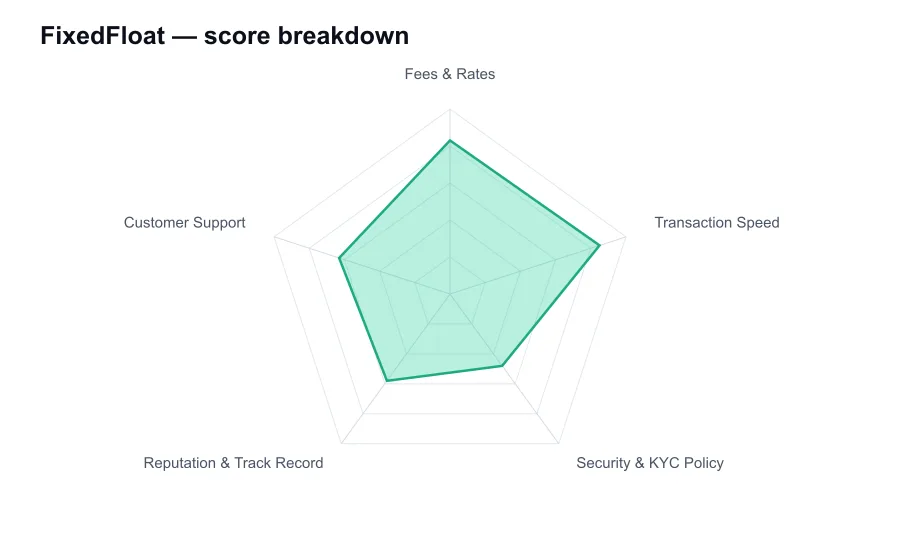
FixedFloat scores 6.8/10 overall in our independent review, measured against every other provider we've compared, strongest on Transaction Speed (8.5/10) and weakest on Security & KYC Policy (4.8/10).
Score: 6.8 How we score → Status: active (checked 2026-10-13T19:32:12.701Z) Visit official siteEditorial independence: our scores and rankings are produced using the fixed criteria above and are not influenced by advertisers. This is an independent ranking site and is not operated by, or affiliated with, any provider we list.
Affiliate disclosure: some links on this page may earn us a commission at no extra cost to you. This does not affect our rankings.
| Criterion | Score | Note |
|---|---|---|
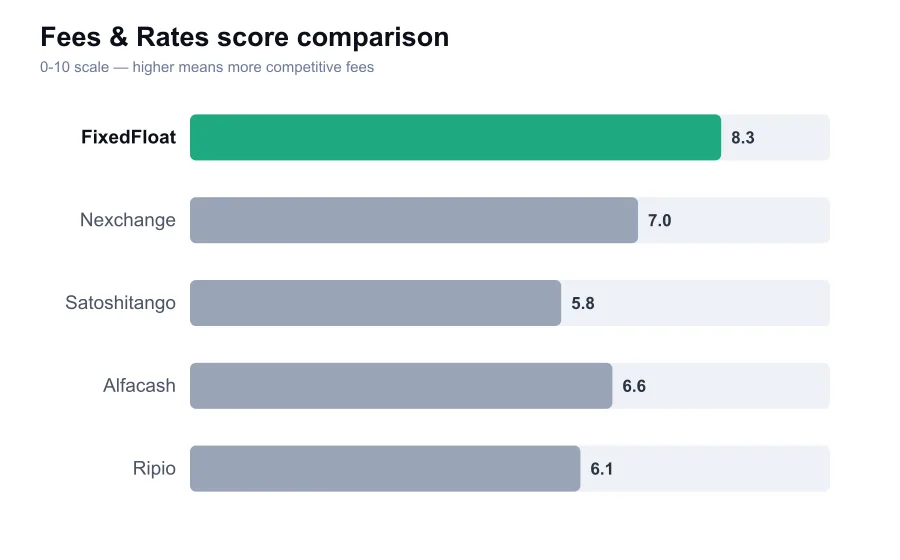
| Fees & Rates | 8.3 | 0.5% Float or 1% Fixed, plus network fees |
| Transaction Speed | 8.5 | Highly automated processing after deposit confirmations |
| Security & KYC Policy | 4.8 | No account custody, but the 2024 hack weighs heavily |
| Reputation & Track Record | 5.8 | Strong automation history damaged by a major 2024 breach |
| Customer Support | 6.3 | Useful for exceptions, but automation is the main model |
| Fact | Value |
|---|---|
| Float service fee | 0.5% plus network fee |
| Fixed service fee | 1% plus network fee |
| Rate options | Float and Fixed |
| Account required | No for routine swaps |
| Reported incident | Hack acknowledged in February 2024 |
| Custody model | Temporary custody during swap |
| Pros | Cons |
|---|---|
| Published 0.5% Float and 1% Fixed service fees | — |
| Fast automated no-account exchange flow | — |
| Fixed-rate option for short-term price certainty | — |
| No routine KYC for standard swaps | — |
What is FixedFloat?
How FixedFloat Works
- Select the coins and amount for the exchange
- Choose Float or Fixed rate mode
- Enter and verify the receiving wallet address
- Send the exact deposit to the generated address
- Wait for required confirmations and outgoing payment
KYC
| Requirement | optional |
|---|---|
| Notes | FixedFloat has historically allowed standard exchanges without registration or routine KYC. Risk and compliance reviews may still apply in exceptional cases. |
Supported Assets
| Notable Coins | Bitcoin, Ethereum, Tether, USD Coin, Litecoin, Monero, TRON, Dogecoin |
|---|---|
| Networks | Bitcoin, Ethereum, TRON, BNB Chain, Polygon, Solana |
How to Use FixedFloat Safely
- Use a small test swap before sending a large amount
- Check current service status before funding an order
- Choose an adequate network fee for the deposit transaction
- Send the exact amount before a Fixed order expires
- Verify the destination address and network character by character
- Keep the order page and deposit hash until completion
FixedFloat is one of the better-known automatic instant exchange services, built for direct crypto-to-crypto swaps without user accounts. Its appeal has always been obvious: choose a pair, paste a receiving address, send funds and let an automated system complete the conversion. It has been particularly popular with technically confident users who prefer speed and minimal account friction.
The company offers two pricing modes that explain its name. Float mode settles according to the market price available during processing, while Fixed mode locks a rate for a limited deposit period. That is a sensible structure. Users who want the best possible estimate can accept float risk, while users making a time-sensitive payment can pay for certainty.
FixedFloat's published service fee structure has historically been unusually clear for this category. Float exchanges are listed at 0.5 percent plus network fee, while Fixed exchanges are listed at 1 percent plus network fee. The transparency is welcome. It means a customer starts with a clearer understanding of the provider's margin than they would at many quote-only competitors.
Those percentages do not tell the whole story. Blockchain fees can be substantial, particularly for Bitcoin and Ethereum during busy periods. The exchange rate can also reflect liquidity conditions. A 0.5 percent service fee sounds cheap, but the final output can still be less attractive than trading on Kraken or Binance and withdrawing funds yourself. Compare output, not just the stated percentage.
For a small to medium conversion, FixedFloat's automated flow can be exceptionally fast. The platform does not require registration, email confirmation or a manual deposit approval for a normal order. Once the incoming transaction receives the needed confirmations and the route has liquidity, the outgoing transfer is generally created promptly.
The phrase "instant exchange" has limits. Bitcoin is not instant, Ethereum can become costly and slow, and a low-fee transaction may wait in a mempool for much longer than expected. FixedFloat can automate its own portion of the process, but it cannot make an underpriced blockchain transaction confirm. Users should choose an appropriate network fee before sending the deposit.
Fixed mode deserves special attention. The rate is fixed only if the customer sends the exact amount before the deadline shown on the order page. A late payment, a short payment or a deposit with a very slow confirmation can turn what looked like a simple swap into a support case. That is not unique to FixedFloat, but its fast automated design leaves less room for casual mistakes.
Privacy is another reason people choose it. FixedFloat has traditionally allowed exchanges without accounts and without routine identity verification. Yet no serious user should read that as a permanent immunity from compliance controls. Services handling crypto still operate under their own risk policies, may screen transactions and can request information or decline activity in exceptional circumstances.
Security is where FixedFloat's history demands more criticism than its polished automation suggests. In February 2024, blockchain security researchers reported suspicious outflows of roughly $26 million linked to FixedFloat wallets. The service later acknowledged a hack. That incident does not mean every current transaction is unsafe, but it changes the trust calculation and makes the provider's operational security record impossible to ignore.
The incident is especially important because instant exchangers take temporary custody of deposits during processing. A customer is not leaving a long-term balance on FixedFloat, which limits exposure in a normal completed swap. But the system still needs to control hot-wallet liquidity and manage automated withdrawals correctly. A compromise at that point can affect active users and disrupt service.
FixedFloat's reputation before the hack was built on reliable automation, transparent stated fees and broad crypto support. After the hack, its reputation is more mixed. A service can recover technically, but trust recovers more slowly, particularly in a category where users have many alternatives and little contractual protection. I would not treat old positive reviews as a complete picture of present risk.
Customer support is functional but not a major selling point. The platform's ideal transaction needs no human help, which is why users like it. The difficult cases are a different matter: wrong amounts, late deposits, missing destination tags and delayed confirmation can require manual intervention. Support documentation is useful, but it cannot make a blockchain error reversible.
FixedFloat remains compelling for users who prioritize a clean automated swap and want a fee structure that is easier to understand than most competitors'. Its 0.5 percent Float rate is competitive for the category. The 2024 security breach, however, prevents me from giving it the benefit of the doubt that I might give to an unblemished service.
My view is blunt. FixedFloat can be useful for a modest, routine conversion after checking its current service availability and testing the route with a small amount. I would avoid using it as a habitual high-value route until its post-incident security practices have been demonstrated over a much longer period. Its convenience is real, but convenience is not enough reason to ignore a major breach.
What are FixedFloat's service fees?
FixedFloat lists a 0.5% service fee for Float exchanges and a 1% service fee for Fixed exchanges. Blockchain network fees are charged separately.
Did FixedFloat suffer a security incident?
Yes. In February 2024, security researchers reported roughly $26 million in suspicious outflows linked to FixedFloat, and the service acknowledged a hack.
What is the difference between Float and Fixed mode?
Float mode settles at the market rate during processing. Fixed mode locks the quoted rate for a limited time, provided you send the exact amount within the deadline.
Does FixedFloat require KYC?
Routine swaps have traditionally been available without account registration or standard KYC. Compliance and risk checks can still affect exceptional transactions.
Why has my FixedFloat order not completed?
Common causes include waiting for blockchain confirmations, a low sender fee, sending an incorrect amount, network congestion or a transaction requiring manual review.
Should I use FixedFloat for a large transaction?
Caution is sensible. The service is automated and convenient, but the February 2024 hack is a serious historical risk factor. Test with a small amount first.
Can a FixedFloat exchange be cancelled after payment?
Usually not once the deposit has been received and processing has begun. Crypto transfers are irreversible, so check the pair, network and receiving address before sending.
Editorial independence: our scores and rankings are produced using the fixed criteria above and are not influenced by advertisers. This is an independent ranking site and is not operated by, or affiliated with, any provider we list.
Affiliate disclosure: some links on this page may earn us a commission at no extra cost to you. This does not affect our rankings.