Satoshitango
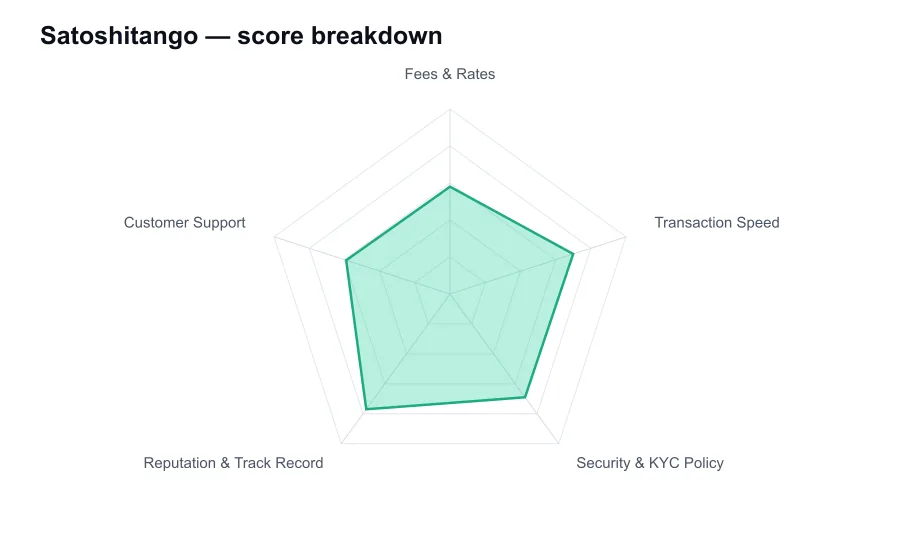
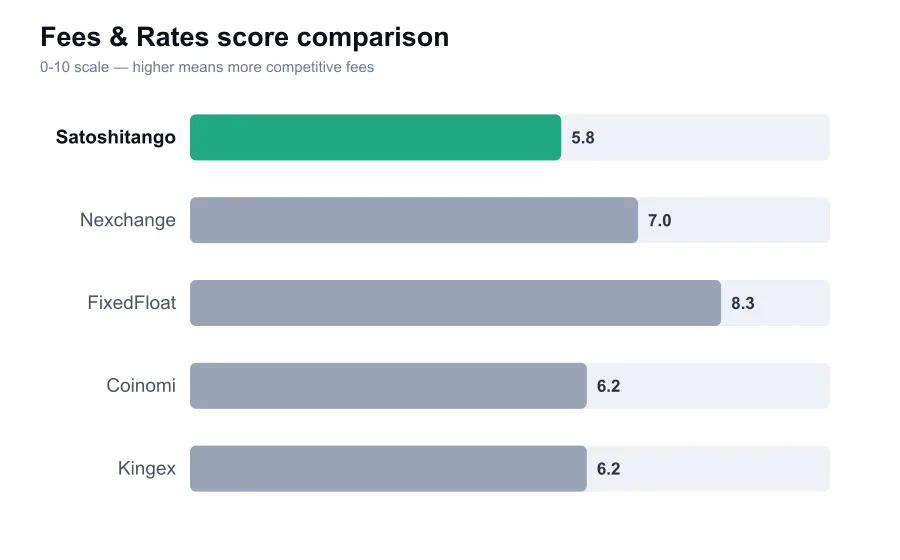
Satoshitango scores 6.7/10 overall in our independent review, measured against every other provider we've compared, strongest on Reputation & Track Record (7.7/10) and weakest on Fees & Rates (5.8/10).
Score: 6.7 How we score → Status: active (checked 2026-10-13T19:23:21.691Z) Visit official siteEditorial independence: our scores and rankings are produced using the fixed criteria above and are not influenced by advertisers. This is an independent ranking site and is not operated by, or affiliated with, any provider we list.
Affiliate disclosure: some links on this page may earn us a commission at no extra cost to you. This does not affect our rankings.
| Criterion | Score | Note |
|---|---|---|
| Fees & Rates | 5.8 | Retail quotes are convenient, but spreads need close comparison. |
| Transaction Speed | 7.0 | Quick account trades, with bank and blockchain dependencies. |
| Security & KYC Policy | 6.9 | KYC-based custodial service, not a self-custody solution. |
| Reputation & Track Record | 7.7 | Argentine provider operating since 2014. |
| Customer Support | 5.9 | Routine help is accessible, exceptions can be slow. |
| Fact | Value |
|---|---|
| Founded | 2014 |
| Service type | Centralised crypto platform |
| Core market | Argentina and Latin America |
| Custody | Custodial |
| Identity checks | Required for normal account use |
| Pricing model | Retail quote and spread |
| Pros | Cons |
|---|---|
| Long-running Argentine crypto brand | — |
| Designed around local payment use cases | — |
| Approachable for first-time buyers | — |
| Consumer wallet and payment-oriented features | — |
What is Satoshitango?
How Satoshitango Works
- Register an account and complete identity verification
- Fund the account through an available local payment route
- Select the cryptoasset and review the quoted amount
- Confirm the purchase or sale
- Keep funds in the account or withdraw crypto to a compatible wallet
KYC
| Requirement | mandatory |
|---|---|
| Notes | SatoshiTango is a custodial service tied to local fiat rails. Identity verification is expected before normal funding and withdrawal activity. |
Supported Assets
| Notable Coins | Bitcoin, Ethereum, USDT, DAI, Litecoin |
|---|---|
| Networks | Bitcoin, Ethereum |
How to Use Satoshitango Safely
- Use a password that is not reused elsewhere
- Protect the email address linked to the account
- Compare the final quoted crypto amount before buying
- Keep bank receipts and blockchain transaction IDs
- Withdraw long-term holdings to self-custody where suitable
Mobile App
| iOS | Yes |
|---|---|
| Android | Yes |
| Notes | SatoshiTango has offered mobile access for consumer account management. |
SatoshiTango is an Argentine crypto platform built around a very practical regional idea: make Bitcoin and other digital assets accessible through familiar payment methods, local currency, and a simple consumer account. Founded in 2014, it has outlasted many smaller Latin American exchanges and has become a recognisable name for users who want crypto without beginning on an international trading venue. Its products have included buying and selling crypto, wallet functions, bill payment features, and card-related services depending on the country and period.
That local orientation is the reason to consider SatoshiTango in the first place. Argentina has a large audience for stablecoins and crypto savings because people understand currency restrictions and inflation in a way that many users in wealthier markets do not. A platform that speaks the language, accepts local funding routes, and understands the practical need for peso-to-crypto conversion can be more useful than a technically superior foreign exchange. SatoshiTango has spent years serving that user rather than chasing professional traders.
It is not the cheapest choice for active dealing. SatoshiTango's pricing is typically expressed through the quote shown to the customer, and the effective cost can include a spread between buy and sell prices. Some services may also carry distinct charges depending on the payment method or withdrawal route. This is a common retail-broker model, but users should not pretend it is the same as paying a transparent 0.1 percent maker or taker fee on a deep exchange. The spread is the fee that matters, even if it is not presented in a single neat percentage.
For someone converting a small sum from pesos into a stablecoin, that cost may be acceptable. Ease, speed, and local support are real value. For regular monthly conversions or a large purchase, the right habit is comparison. Check the final number of USDT, DAI, Bitcoin, or Ether received against a competing local app and a major exchange. A few minutes spent comparing quotes can save more than any promotional referral reward. The same rule applies when selling back into local currency.
The platform's transaction speed is generally shaped by funding method and blockchain conditions. Trades inside a funded account are normally quick. A local transfer may arrive rapidly, though banking cutoffs, anti-fraud checks, and account verification can still interrupt the smooth path. Withdrawals of crypto are then constrained by the chain. A Bitcoin withdrawal can take far longer than an internal balance update, while Ethereum withdrawals can become expensive and slow during high demand.
SatoshiTango has always felt closer to a crypto fintech than a traditional exchange. That is good for newcomers. The user journey is made for people who want to buy, hold, perhaps pay a bill or use a card product, without memorising order types. It is less good for anyone who expects sophisticated charting, deep liquidity information, stop orders, derivatives, or the execution control available on Binance, OKX, Kraken, or a dedicated local brokerage. The platform is best judged as a consumer utility, not as a trading desk.
KYC is not optional for a normal user. SatoshiTango connects crypto activity to fiat payment systems and operates as a custodial provider, so users should expect identity documentation and account checks. Higher activity may draw more scrutiny, particularly where deposits and withdrawals do not match the customer's normal profile. This can frustrate users who expect crypto to bypass ordinary financial controls, but it is a predictable feature of a locally integrated service. Keep proof of payment, use accounts in your own name, and avoid trying to fund a verified account through unrelated third parties.
The custody question deserves more emphasis than it usually gets in local-exchange reviews. Assets shown in a SatoshiTango balance are controlled operationally by the company until withdrawn. That can be convenient for small everyday balances, but it means customers take on platform risk. If the account is under review, access can be delayed. If the user loses account security, recovery depends on the provider's process. For a long-term Bitcoin holder, learning self-custody remains the stronger option once the purchase is complete.
SatoshiTango's age is one of its best arguments. Founded in 2014, it has operated through extreme crypto price cycles and repeated Argentine economic disruptions. That longevity is meaningful in a sector packed with apps that appear during a bull market and fade shortly afterward. It also has a recognisable regional brand rather than the anonymous feel of an instant exchange that offers no visible local identity. Longevity does not guarantee perfect execution, but it should count materially in a trust assessment.
Its reputation is nevertheless uneven in the way many local finance apps are uneven. Happy customers rarely write detailed reviews after a normal purchase. Dissatisfied customers do post when verification takes too long, a transfer is delayed, or support gives a generic response. The public complaint pattern is therefore worth reading as a warning about operational friction rather than as a definitive verdict on the company. A user who needs funds at a precise hour should not rely on any exchange, including SatoshiTango, as the sole payment route.
Support is adequate for ordinary questions but can be frustrating in difficult cases. The help system is useful for basic deposits, account access, and transfer instructions. The test comes when an incoming transaction is missing, a deposit was sent on the wrong network, or an account triggers a review. Like most platforms in this category, SatoshiTango needs time and documentation to resolve those exceptions. The user who has their transaction ID, bank receipt, exact timestamps, and screenshots is in a substantially better position.
One appealing feature of a platform like SatoshiTango is that it can put crypto beside everyday finance. For some users, the ability to make a local payment, use a payment card feature where offered, or treat crypto as part of one mobile balance is genuinely useful. I would still resist turning that convenience into dependency. A consumer wallet should not become a vault for a family's savings. Keep operating funds there, and keep long-term assets in a setup where you control the keys.
The product also rewards a cautious first purchase. Start with a small peso amount, verify the local deposit procedure, buy a modest amount, and test an external withdrawal if self-custody is your eventual plan. This reveals the practical cost, processing time, and interface quality before a high-value transaction. It is far more informative than reading a promotional page. Users who skip this step often discover fee and network details only after they are committed.
SatoshiTango is most attractive to Argentine and regional retail customers who value familiarity over trading sophistication. It is not a venue for price-sensitive professionals. The company has done the difficult work of remaining relevant in a market where local payment access is often more valuable than an elegant trading interface. That earns it respect. But respect should not become a blank cheque on pricing or custody.
My take is that SatoshiTango is a dependable local access point with a real operating history and a useful consumer focus. It loses points because its effective trading cost is less transparent than a conventional order book, its advanced trading offering is limited, and support can feel slow once a case leaves the standard path. For a beginner buying modest amounts and using local rails, it is a reasonable choice. For a serious investor, it works best as the on-ramp before assets move to better-priced execution or self-custody.
When was SatoshiTango founded?
SatoshiTango was founded in 2014 and is one of the longer-running crypto providers associated with the Argentine market.
Does SatoshiTango require KYC?
Yes. As a custodial service connected to fiat payment methods, users should expect identity verification for normal account use.
Why is the SatoshiTango price different from CoinGecko?
CoinGecko commonly shows market reference prices. SatoshiTango presents a retail quote that can include spread, payment-method costs, and execution costs.
Can I use SatoshiTango as a long-term Bitcoin vault?
It is convenient for active balances, but assets held there are custodial. Long-term holders should consider withdrawing to a wallet they control.
What happens if I send crypto on the wrong network?
Recovery may be impossible or require manual review. Always match the deposit network exactly and test unfamiliar routes with a small amount.
Why might a local withdrawal take longer than expected?
Bank processing, fraud controls, account verification, and internal review can all affect fiat withdrawal timing.
Editorial independence: our scores and rankings are produced using the fixed criteria above and are not influenced by advertisers. This is an independent ranking site and is not operated by, or affiliated with, any provider we list.
Affiliate disclosure: some links on this page may earn us a commission at no extra cost to you. This does not affect our rankings.