Symbiosis
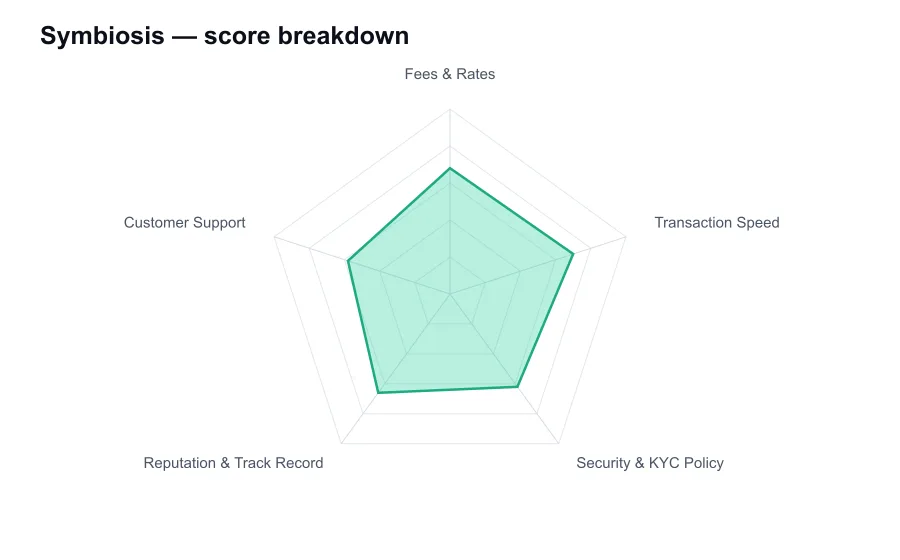
Symbiosis scores 6.6/10 overall in our independent review, measured against every other provider we've compared, strongest on Transaction Speed (7.0/10) and weakest on Customer Support (5.8/10).
Score: 6.6 How we score → Visit official siteEditorial independence: our scores and rankings are produced using the fixed criteria above and are not influenced by advertisers. This is an independent ranking site and is not operated by, or affiliated with, any provider we list.
Affiliate disclosure: some links on this page may earn us a commission at no extra cost to you. This does not affect our rankings.
| Criterion | Score | Note |
|---|---|---|
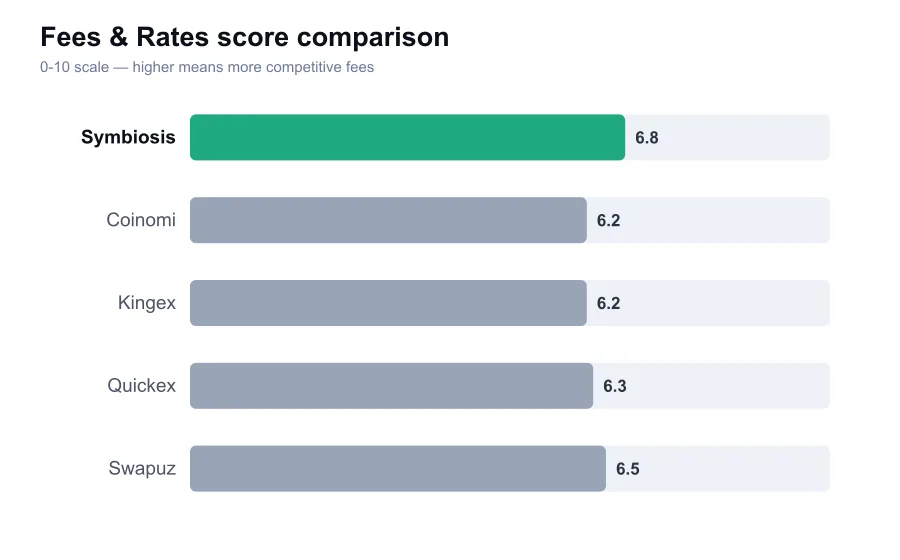
| Fees & Rates | 6.8 | Route costs vary with gas, liquidity, and bridge fees |
| Transaction Speed | 7.0 | Often minutes, but finality and route design matter |
| Security & KYC Policy | 6.2 | Self-custody helps, cross-chain contract risk remains |
| Reputation & Track Record | 6.6 | Recognized DeFi protocol, smaller than top bridge brands |
| Customer Support | 5.8 | Community-led help, not traditional account support |
| Pros | Cons |
|---|---|
| Cross-chain swaps from a connected wallet | — |
| No routine KYC for protocol use | — |
| Reduces multi-step bridge and swap workflows | — |
| Useful for supported low-fee networks | — |
| Self-custody-oriented design | — |
Symbiosis is not a conventional exchange. It is a cross-chain liquidity protocol built to let users swap assets between blockchains without manually juggling bridges, wrapped tokens, and separate decentralized exchanges. In plain terms, it tries to turn a multi-step process, such as moving stablecoins from one chain and swapping into an asset on another, into one transaction flow. That is a useful idea, especially for users moving between Ethereum-compatible networks and other supported ecosystems.
The protocol occupies a crowded and risky corner of crypto. Cross-chain infrastructure is valuable because liquidity is fragmented, but bridges and interoperability systems have also been responsible for some of the industry's largest exploits. Symbiosis should therefore be judged differently from WhiteBIT or ChangeHero. Its appeal is self-custody and composability, but the relevant risks are smart contracts, bridge design, relayers, liquidity pools, and the chains involved.
The user experience is refreshingly direct for a cross-chain product. You connect a compatible wallet, select source and destination assets and networks, approve the transaction, and receive the output in your own wallet. There is no trading account to fund and no usual KYC procedure for standard on-chain use. That is a genuine advantage for DeFi-native users. It also means users themselves carry more responsibility for wallet security, transaction approvals, and destination selection.
Fees are not as simple as a centralized exchange's maker-taker schedule. A Symbiosis transaction can include a liquidity provider fee, protocol fee, gas on the origin chain, gas or relay costs required to complete the destination-side transaction, and price impact in the underlying pools. The displayed quote is more useful than any isolated headline fee. Users should compare the final output against alternatives such as LI.FI-powered routes, Across, Stargate, Socket, or a direct bridge plus DEX trade.
For small swaps, network fees can dominate. Paying Ethereum mainnet gas to move a modest amount is often irrational, even if the protocol fee itself is reasonable. Symbiosis becomes more compelling on lower-cost networks or when its route saves the user from doing multiple separate transactions. The same route may be excellent for a few thousand dollars and poor for fifty dollars. That is not a flaw unique to Symbiosis, but its interface could do more to foreground cost composition for newer users.
Transaction speed depends heavily on the route. A transfer between lower-cost EVM networks can complete quickly, often in minutes if liquidity and relayer operations are smooth. A route involving a slower finality model, congestion, or several bridging components can take longer. Cross-chain swaps do not have the crisp predictability of an order being filled on a centralized exchange. If you need funds at a specific minute to meet a trading deadline, build in a buffer.
The protocol's use of stablecoins and cross-chain liquidity is practical, but it creates another subtle risk. A route may involve wrapped or synthetic representations, pool imbalances, or assets that are technically the same ticker but not equally redeemable in every ecosystem. Sophisticated users understand this. Newer users often do not. Before swapping, inspect the exact token and network that will arrive. USDC on one chain is not automatically interchangeable with every asset called USDC on another.
Symbiosis is generally non-custodial in the everyday sense. Your wallet signs the transaction and the protocol executes through smart contracts rather than holding an account balance under a company login. That is materially different from leaving funds at an exchange. Still, non-custodial does not equal safe by default. A malicious approval, an incorrect wallet connection, a compromised front end, or a smart contract exploit can cost users funds without any support team being able to reverse the result.
The project has published audit and security information over its development history, and that is better than asking users to trust unaudited code. Audits reduce some classes of risk, but they do not insure a protocol or prove that every upgrade, external dependency, and economic edge case is safe. Cross-chain protocols deserve a higher security discount than a simple single-chain swap contract. I would not route my entire portfolio through any bridge, including this one, merely because the interface looks polished.
Symbiosis has been active since the early 2020s and has built a recognizable name among interoperability projects. Its reputation is stronger with DeFi users than with the general public, which is appropriate because the product is technical. It has survived periods when many bridge projects vanished, and it has continued expanding supported routes. Yet its scale, liquidity, and battle-tested record do not put it on the same confidence tier as the largest foundational DeFi protocols.
The native SIS token is relevant to governance and ecosystem incentives, but users should separate the protocol's utility from the token's investment case. Token incentives can attract liquidity and encourage activity, but they can also produce temporary volume that disappears when rewards decline. I would evaluate Symbiosis based on live route quality, supported chains, contract security, and execution reliability, not on token marketing or a high annualized reward figure.
Support is available through documentation, community channels, and social platforms, which is typical for DeFi. The team and community can often help identify a stuck route or explain transaction status. But this is not bank-style customer service. If you sign a bad transaction or send assets to the wrong address, there may be no recovery path. Support responsiveness also varies with community activity, and users should keep transaction hashes and route details ready before asking for help.
The best way to use Symbiosis is cautiously. Start with a small test transfer on a route you have not used before. Confirm the destination token, keep enough native gas on both sides where necessary, and avoid approving unlimited token allowances unless you understand why you are doing so. Those habits are more important than chasing a slightly better quote. DeFi rewards careful users and punishes rushed ones.
Symbiosis is a capable cross-chain tool, not a beginner's substitute for a centralized exchange. Its no-KYC, wallet-first design and single-flow swaps solve a real problem for people who already understand DeFi. Its fees can be efficient on the right networks, while its security profile remains inherently more complex than a normal spot trade. I would use it for measured, well-checked cross-chain activity. I would not recommend it to someone who is still uncertain about networks, token contracts, or wallet approvals.
Does Symbiosis require KYC?
Standard protocol use is wallet-based and does not normally require account registration or KYC. Users still need to follow the laws and restrictions that apply in their jurisdiction.
Why is a Symbiosis swap more expensive than expected?
The final route can include source-chain gas, liquidity and protocol charges, destination execution costs, and price impact. Compare the final receive amount, not only a stated fee.
How long do Symbiosis cross-chain swaps take?
Many routes finish in minutes, but timing depends on the source and destination chains, liquidity, finality, congestion, and relayer processing.
Editorial independence: our scores and rankings are produced using the fixed criteria above and are not influenced by advertisers. This is an independent ranking site and is not operated by, or affiliated with, any provider we list.
Affiliate disclosure: some links on this page may earn us a commission at no extra cost to you. This does not affect our rankings.