Liquity
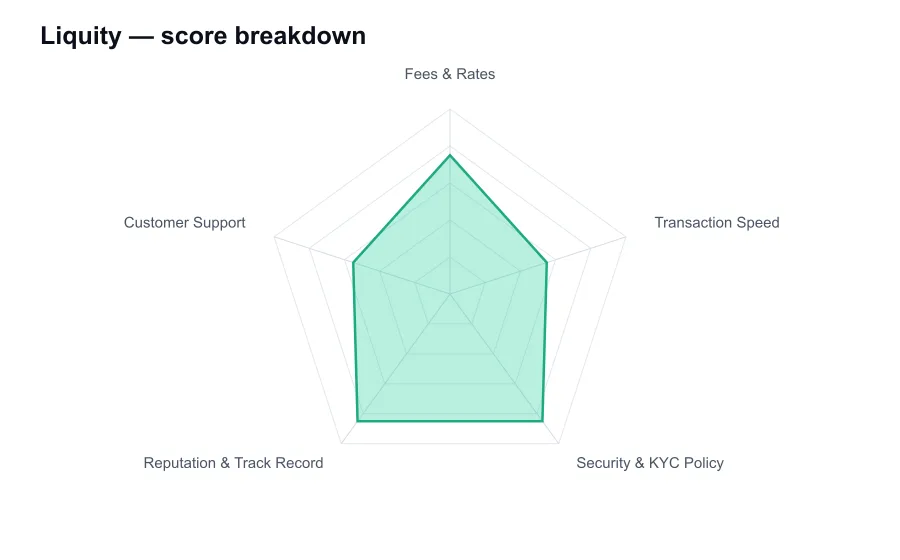
Liquity scores 7.4/10 overall in our independent review, measured against every other provider we've compared, strongest on Security & KYC Policy (8.5/10) and weakest on Customer Support (5.5/10).
Score: 7.4 How we score → Visit official siteEditorial independence: our scores and rankings are produced using the fixed criteria above and are not influenced by advertisers. This is an independent ranking site and is not operated by, or affiliated with, any provider we list.
Affiliate disclosure: some links on this page may earn us a commission at no extra cost to you. This does not affect our rankings.
| Criterion | Score | Note |
|---|---|---|
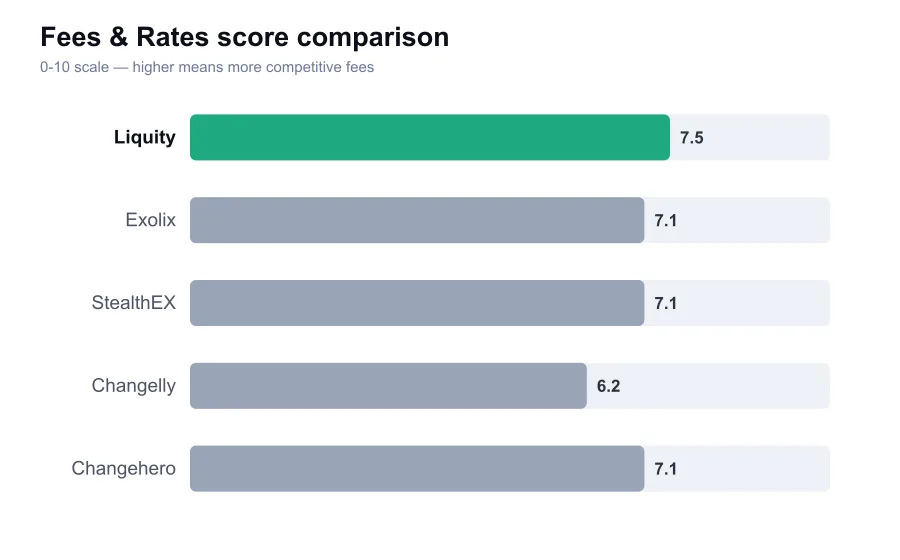
| Fees & Rates | 7.5 | V1 has no ongoing interest, but borrowing and gas costs matter |
| Transaction Speed | 5.5 | Ethereum mainnet settlement and gas can slow urgent actions |
| Security & KYC Policy | 8.5 | Conservative collateral design and a strong audited protocol history |
| Reputation & Track Record | 8.5 | Established Ethereum DeFi protocol since 2021 |
| Customer Support | 5.5 | Useful documentation, but no account-level intervention |
| Pros | Cons |
|---|---|
| V1 offers no ongoing borrowing interest | — |
| Permissionless and noncustodial design | — |
| Strong liquidation and Stability Pool mechanics | — |
| Conservative reputation in Ethereum DeFi | — |
Liquity is one of the few DeFi lending projects with a genuinely distinctive design rather than a familiar money-market interface with a new logo. It began on Ethereum with LUSD, a decentralized stablecoin borrowed against ETH, and built a loyal following by offering interest-free borrowing. Its newer Liquity V2 architecture expands the concept through BOLD, a stablecoin backed by separate collateral branches. The protocol is aimed at technically comfortable users who want to borrow against crypto without opening an account at a centralized lender.
The original Liquity model is deliberately narrow. Users deposit ETH as collateral and borrow LUSD, provided their collateral ratio remains above the required minimum. Unlike a conventional variable-rate lending pool, V1 charges no ongoing interest. Instead, borrowers pay a one-time borrowing fee that is governed by a base rate and cannot fall below 0.5 percent. Redemptions also influence that base rate, so borrowing can become materially more expensive during stressed market conditions.
That detail matters. Calling Liquity free borrowing is technically wrong and commercially misleading. A 0.5 percent entry fee can be attractive for a short or medium-term loan, particularly versus high utilization lending pools. But the fee can rise sharply after redemptions, sometimes making a new loan unattractive. Existing debt does not suddenly accrue interest in V1, which is a meaningful advantage, but users need to check the live rate before assuming the protocol is cheaper than Aave, Spark or a centralized credit line.
Liquity V2 changes the economics. Borrowers choose an annual interest rate for BOLD debt, and the system groups positions with similar rates into sorted collateralized debt positions. The approach is clever because it lets borrowers choose their place in the queue and creates market-driven rates rather than relying solely on a protocol-set curve. It also introduces upfront fees and rate-management decisions that are more complicated than V1's simple one-off borrowing charge. The old version is easier to explain, while the newer design is more flexible.
The Stability Pool is central to Liquity's model. Users deposit LUSD in V1, or BOLD in relevant V2 branches, and their deposits can be used to offset liquidated debt. In return, they receive collateral from liquidations and protocol incentives. This can produce attractive returns, but it is not a passive cash account. Depositors are effectively agreeing to buy collateral during liquidations, and their stablecoin balance may decline while their ETH or other collateral exposure rises.
That mechanism is one reason Liquity has held up better than many yield schemes. The yield has an economic source, liquidation activity and borrowing demand, rather than relying entirely on token emissions. Still, a Stability Pool user needs to understand what they own after a sharp market selloff. If ETH falls rapidly, receiving ETH at a liquidation discount is useful only if the collateral and oracle system behave as intended and the holder can tolerate price volatility.
Transaction speed is the protocol's weak point. Liquity lives on Ethereum, and ordinary interactions settle according to Ethereum block production and network conditions. A routine transaction may confirm in a few minutes, though inclusion can be faster or slower depending on the gas fee chosen. During a volatile market, users compete with liquidators and other borrowers for block space. This is nowhere near the immediate feel of Solana systems such as Kamino, and it can become costly at precisely the worst time.
Ethereum gas is the other unavoidable cost. Opening, adjusting or closing a position can be inexpensive during quiet periods, but gas can dominate the economics of a small loan when mainnet is busy. Liquity's smart contract fees may be elegant, but a user still pays the chain. This makes the protocol best suited to positions large enough that transaction costs are a minor percentage of the collateral, or to users who are happy to wait for calmer gas conditions.
Security is where Liquity earns serious respect. The protocol was designed to minimize governance dependence and avoid routine parameter votes that can change lending rules overnight. V1 is immutable, with clearly defined mechanics, and the project has undergone multiple audits. Its narrow ETH collateral scope was a strength because it reduced exposure to thinly traded collateral assets and unstable collateral pricing. Simple systems can still fail, but Liquity's design philosophy is considerably more conservative than the average DeFi project.
There is no standard KYC requirement because Liquity is permissionless and noncustodial. Users interact from an Ethereum wallet and retain control of their keys. This improves privacy and removes the risk of a centralized platform freezing an account, but it shifts every operational burden onto the user. Phishing sites, malicious approvals, mistyped addresses and weak wallet security are not problems Liquity can solve after the fact. The protocol is not a bank, and neither LUSD nor BOLD is a deposit product.
Liquity's track record is solid. Launched in 2021, it survived several difficult crypto market phases that exposed fragile stablecoin designs and weak lending collateral. LUSD has generally maintained a respectable reputation among decentralized stablecoins, although it is not as liquid or as universally integrated as USDC, USDT or DAI. Liquity's smaller footprint can be a practical drawback. Finding deep liquidity or broad payment use for its stablecoins may take more effort than using the market leaders.
Support is intentionally limited because there are no customer accounts to administer. Documentation, community channels and interface guidance are the main tools available. Users can get help understanding a transaction or finding official contracts, but no support team can reverse an onchain action, protect an unsafe collateral ratio or restore a compromised wallet. That is normal for permissionless DeFi, yet prospective users should view it as a real service limitation, not a charming philosophical feature.
I admire Liquity most when it refuses to imitate a centralized lender. The product has clear rules, collateralized debt and an unusually thoughtful liquidation mechanism. I am less enthusiastic about how easily users can underestimate redemption dynamics, Ethereum gas and Stability Pool exposure. It is a protocol for people willing to read the mechanics, not people chasing a stablecoin yield banner.
For a long-term ETH holder who wants onchain liquidity without selling, Liquity remains one of the more intellectually honest options in DeFi. V1's interest-free debt structure is still compelling in the right conditions, while V2 offers a more adaptable path for the protocol. But it is not cheap by default, not instant, and not beginner friendly. My take is that Liquity deserves its strong reputation, provided users treat it as serious financial infrastructure rather than an app to click through casually.
Is borrowing from Liquity really interest-free?
Liquity V1 does not charge recurring interest, but it charges a one-time borrowing fee that has a 0.5 percent minimum and can rise with the base rate. V2 uses borrower-selected annual rates.
Does Liquity require KYC?
No standard KYC process is required for direct protocol use. Users connect an Ethereum wallet and interact with smart contracts at their own responsibility.
What happens if my Liquity position is liquidated?
If your collateral ratio falls below the relevant minimum, the position can be liquidated. Your debt is offset and collateral is distributed through the liquidation mechanism, with penalties applying.
Editorial independence: our scores and rankings are produced using the fixed criteria above and are not influenced by advertisers. This is an independent ranking site and is not operated by, or affiliated with, any provider we list.
Affiliate disclosure: some links on this page may earn us a commission at no extra cost to you. This does not affect our rankings.