Trocador
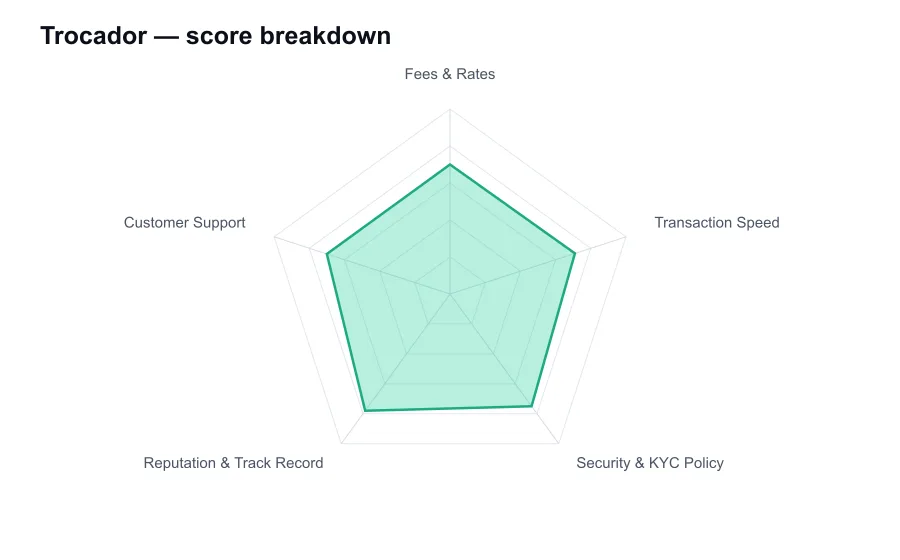
Trocador scores 7.3/10 overall in our independent review, measured against every other provider we've compared, strongest on Reputation & Track Record (7.8/10) and weakest on Customer Support (7.0/10).
Score: 7.3 How we score → Status: active (checked 2026-10-13T19:40:42.014Z) Visit official siteEditorial independence: our scores and rankings are produced using the fixed criteria above and are not influenced by advertisers. This is an independent ranking site and is not operated by, or affiliated with, any provider we list.
Affiliate disclosure: some links on this page may earn us a commission at no extra cost to you. This does not affect our rankings.
| Criterion | Score | Note |
|---|---|---|
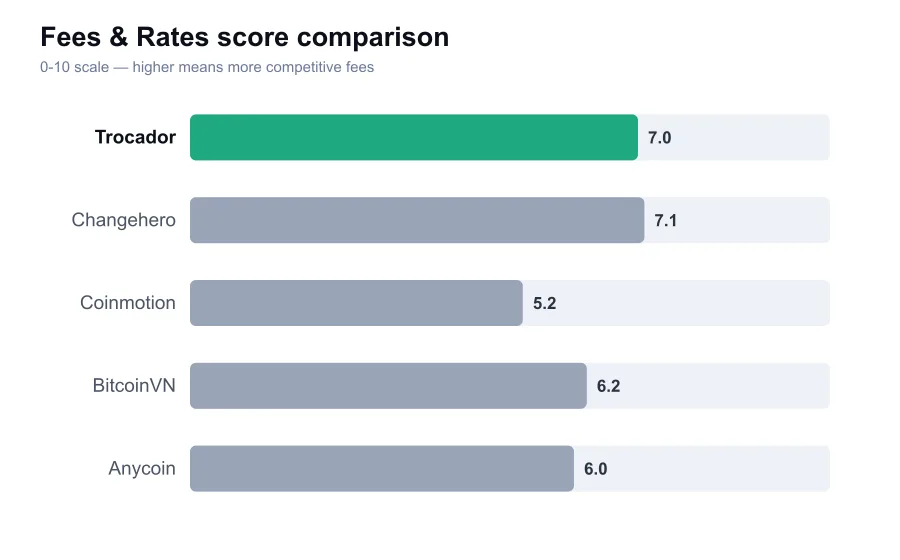
| Fees & Rates | 7.0 | 0.5% stated platform fee, plus route spread and network costs. |
| Transaction Speed | 7.1 | Speed depends heavily on the selected partner and network. |
| Security & KYC Policy | 7.5 | Privacy route data helps, but partners control final execution. |
| Reputation & Track Record | 7.8 | Established privacy-focused aggregator operating since 2017. |
| Customer Support | 7.0 | Can mediate partner cases, but cannot control every payout. |
| Fact | Value |
|---|---|
| Founded | 2017 |
| Platform fee | 0.5% |
| Service model | Third-party exchange aggregator |
| Account requirement | No account for standard swaps |
| Route information | Rate, provider and privacy score |
| Pros | Cons |
|---|---|
| Compares multiple instant exchange providers | — |
| 0.5% platform fee is clearly stated | — |
| Privacy scoring for exchange routes | — |
| Well known among Monero users | — |
What is Trocador?
How Trocador Works
- Select the assets and amount you want to exchange
- Review partner quotes, rate type and route information
- Choose a provider and enter your destination wallet address
- Send the required deposit to the generated address
- Track the order until the partner sends the payout
KYC
| Requirement | none |
|---|---|
| Notes | Trocador does not generally require an account or routine KYC. The underlying provider chosen for a route may apply its own compliance review and request information. |
Supported Assets
| Notable Coins | Bitcoin, Monero, Ethereum, Litecoin, Tether, USD Coin, Dash |
|---|
How to Use Trocador Safely
- Read the selected partner's route details before funding
- Compare final receive amounts, not just percentage fees
- Use a small test transaction with a new provider
- Confirm token chain, memo and destination address
- Keep the provider name and full order record
Trocador is not simply another instant crypto exchange. It is an exchange aggregator, a service that compares quotes from a network of third-party swap providers and sends the user to the route it considers most suitable. That makes it closer in spirit to a travel comparison site than to a conventional exchange. Its strongest appeal is obvious: instead of manually opening five instant-exchange tabs, users can compare results, privacy characteristics and estimated processing details from one interface.
The project has roots in the privacy-oriented crypto community and has made that identity central to its product. Monero users in particular will recognize Trocador as one of the more familiar swap comparison tools. The site includes a privacy score for providers and seeks to make the KYC practices of its partners more visible than many competitors do. That is a worthwhile service. Plenty of instant exchangers advertise privacy until a transaction is already in progress, which is precisely when the customer has the least ability to change course.
Trocador does not normally hold a customer balance or execute every swap itself. You select a route, then send funds to an address generated for that order by a partner exchange. The partner handles the actual conversion and payout. This division of responsibility needs to be understood before use. Trocador can help coordinate support and provide order information, but the underlying exchanger's liquidity, compliance process and operational quality still matter. An aggregator can improve route selection. It cannot erase third-party risk.
Its pricing structure is more transparent than many instant-exchange sites. Trocador states a 0.5% platform fee on regular transactions, with the partner's rate and network costs also affecting the final quote. The fee is not the whole economic picture, because a route with a lower stated fee can still return less due to spread or poor liquidity. Still, having a stated platform charge is preferable to the vague claim that fees are somehow invisible. Compare the actual output, but at least users know that Trocador takes a cut.
For small swaps, 0.5% is a fair price for convenience if the aggregator finds a good route. For large transactions, it becomes material. A $10,000 exchange carries a $50 Trocador charge before the underlying provider's economics and chain fees are considered. Traders who can use an order-book exchange, a decentralized exchange or direct cross-chain liquidity should not assume the aggregator is cheapest. Trocador is strongest where privacy, token availability and route comparison matter more than extracting the final few basis points.
The quote screen is where Trocador distinguishes itself. It can show multiple providers, estimated receive amounts, fixed and floating options, and its own privacy-oriented indicators. A user can choose a route rather than blindly accepting a supposedly best offer. That choice is valuable because different exchanges have very different rules around identity checks, refunds and deposits from screened addresses. I would favor a slightly less generous quote from a well-known route over an unfamiliar provider promising a suspiciously high payout.
Settlement speed varies by partner and blockchain. Trocador itself does not make Bitcoin confirm faster or solve Ethereum gas congestion. A simple Litecoin to Monero conversion may clear quickly once confirmed, while a Bitcoin transaction routed through a slower partner can take much longer. The site should be read as an estimate engine, not a delivery guarantee. Fixed-rate offers are particularly useful for users who care about certainty, but they often require sending the exact amount before an expiry period ends.
The platform's privacy focus is real, but it should not be romanticized. Trocador does not generally require an account or routine KYC from the user. A selected partner may have different procedures, though, and a transaction can be paused if that provider's risk controls trigger. The privacy score is useful context, not insurance against a hold. Anyone whose transaction must avoid potential identification checks should understand that an aggregator has less control over the final policy decision than a provider running its own liquidity stack.
Trocador deserves credit for being more candid about this limitation than many rivals. It has published material about KYC risk and provider behavior rather than pretending every route is equally private. That said, the added information creates a responsibility for the user. Read the route details before funding it. Do not pick a provider based purely on the largest number in the receive field, then act surprised if its conditions are stricter than a privacy-focused route that paid marginally less.
Its record since 2017 has made it one of the more recognizable independent names in privacy-minded exchange aggregation. It has survived long enough to build trust in a category full of short-lived brands. The reputation is not flawless. User reports around instant exchange services naturally include delayed orders, confusing rate outcomes and difficult refund cases. Trocador's role as intermediary can make those incidents more frustrating, because the customer may feel caught between the aggregator and the provider actually holding the transaction.
Support is one of the harder areas to score. Trocador offers support channels and actively presents itself as an advocate for users dealing with partner exchanges, which is better than being abandoned with a deposit address. But it cannot always force a third party to release funds or reverse a completed blockchain payout. A responsive support conversation is helpful. It is not the same thing as a contractual guarantee. Keep the Trocador order record, provider name and transaction hash, because those details matter if a case needs escalation.
Trocador's strength is also its weakness. It offers breadth and choice, but that means users must make more judgments. A beginner can use the interface, yet a beginner may not understand why one quote is fixed, another floats, one route needs a tag, and another has a different privacy score. The site is not a substitute for basic wallet competence. If you are sending a stablecoin, confirm the exact chain. USDT on Tron, Ethereum and other networks are not interchangeable deposits.
For Monero swaps, Trocador remains more compelling than a generic instant exchanger because it has a clear community reputation and puts route information in front of the customer. For mainstream BTC to ETH conversions, its advantage is narrower. A person with a verified Kraken, Coinbase Advanced or Binance account may obtain better execution through spot trading, assuming those platforms are available and their identity requirements are acceptable. Trocador is about preserving choice and reducing search time, not defeating the economics of deep centralized liquidity.
I like Trocador more than opaque one-provider instant exchanges because it gives users a genuine basis for comparison and does not hide its own 0.5% fee. It is still an aggregator in a sector where execution risk can migrate to outside partners. Use it for route discovery, privacy-conscious swaps and assets that are awkward to trade elsewhere. Do not mistake its interface for a guarantee that every underlying exchanger will behave identically. The sensible user compares the routes, starts small and keeps records until the payout is safely received.
What fee does Trocador charge?
Trocador states a 0.5% platform fee for regular transactions. The final result also reflects the selected provider's rate, liquidity spread and blockchain network costs.
Does Trocador require KYC?
Trocador generally has no account or routine KYC requirement. Its partner exchanges have their own policies, and a selected route can still request information or pause a flagged transaction.
Why does Trocador show several exchanges for one swap?
Trocador aggregates third-party instant exchangers. The choices can differ in estimated output, fixed or floating rate availability, expected speed and privacy score.
Who receives my deposit during a Trocador swap?
The deposit normally goes to the address generated for the selected underlying exchange partner. Trocador compares and coordinates routes, but does not execute every conversion itself.
What is Trocador's privacy score?
It is Trocador's route information intended to help users assess a provider's privacy and KYC behavior. It is a useful signal, not a promise that a transaction cannot be reviewed.
Can I use Trocador for Monero swaps?
Yes. Monero is one of the assets closely associated with Trocador's privacy-focused user base. Check the chosen route's stated conditions and send only through the specified network.
What should I save if a swap is delayed?
Keep the Trocador order details, the selected provider name, the deposit transaction hash and screenshots of the quote. Those records make a support escalation far easier.
Editorial independence: our scores and rankings are produced using the fixed criteria above and are not influenced by advertisers. This is an independent ranking site and is not operated by, or affiliated with, any provider we list.
Affiliate disclosure: some links on this page may earn us a commission at no extra cost to you. This does not affect our rankings.