EasyBit
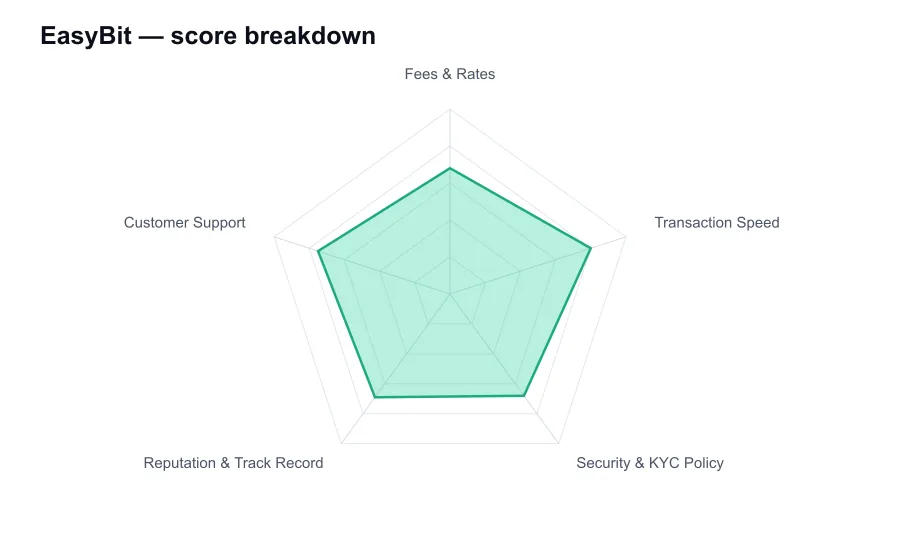
EasyBit scores 7.1/10 overall in our independent review, measured against every other provider we've compared, strongest on Transaction Speed (8.0/10) and weakest on Security & KYC Policy (6.8/10).
Score: 7.1 How we score → Status: active (checked 2026-10-13T19:32:12.648Z) Visit official siteEditorial independence: our scores and rankings are produced using the fixed criteria above and are not influenced by advertisers. This is an independent ranking site and is not operated by, or affiliated with, any provider we list.
Affiliate disclosure: some links on this page may earn us a commission at no extra cost to you. This does not affect our rankings.
| Criterion | Score | Note |
|---|---|---|
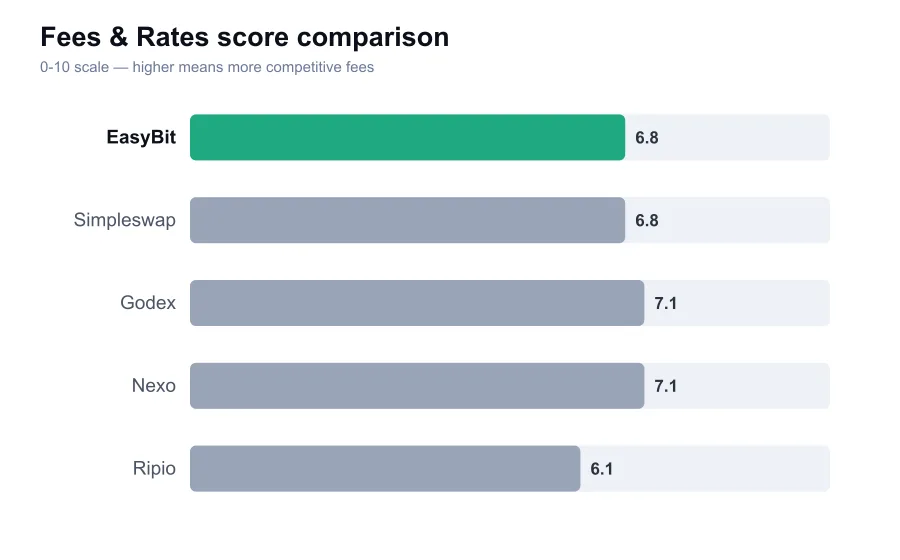
| Fees & Rates | 6.8 | Quote-based pricing can vary materially by pair and network |
| Transaction Speed | 8.0 | Fast for liquid pairs after required confirmations |
| Security & KYC Policy | 6.8 | No standing custody, but AML reviews remain possible |
| Reputation & Track Record | 6.9 | Known instant exchanger, with less depth than major CEXs |
| Customer Support | 7.5 | 24/7 chat and email are useful for swap issues |
| Fact | Value |
|---|---|
| Rate options | Fixed and floating |
| Account required | No for routine swaps |
| Support | 24/7 chat and email |
| Custody model | Non-custodial exchange flow |
| Pricing model | Pair-specific live quote |
| Pros | Cons |
|---|---|
| Simple wallet-to-wallet exchange flow | — |
| Fixed and floating exchange-rate options | — |
| No standard account setup for routine swaps | — |
| Useful support for tracking delayed orders | — |
What is EasyBit?
How EasyBit Works
- Choose the source and destination assets
- Choose fixed or floating rate if both are available
- Enter the destination address and check its network
- Send the requested crypto amount to the generated address
- Follow the order status until the output is delivered
KYC
| Requirement | optional |
|---|---|
| Notes | EasyBit generally permits routine swaps without account registration. It may request information under AML procedures for transactions that require review. |
Supported Assets
| Notable Coins | Bitcoin, Ethereum, Tether, USD Coin, Litecoin, Solana, TRON, Dogecoin |
|---|---|
| Networks | Bitcoin, Ethereum, TRON, Solana, BNB Chain, Polygon |
How to Use EasyBit Safely
- Compare the exact output against another provider before sending
- Confirm the blockchain network, not just the token symbol
- Use a test transaction for a new wallet or token route
- Save the order ID and deposit transaction hash
- Avoid sending funds while a quote or deposit window has expired
EasyBit is a non-custodial instant crypto exchange aimed at users who want a quick wallet-to-wallet conversion without a trading account. It follows a familiar pattern: choose a pair, submit a receiving address, transfer the deposit and wait for the converted asset. The company markets speed and simplicity, and those are its real strengths.
The service is closer to a broker than a traditional exchange. EasyBit sources liquidity and handles the conversion behind the scenes rather than giving the customer access to an order book. That makes the interface less intimidating than Binance or Kraken, but it also means the customer gives up direct control over execution and may pay a wider spread.
EasyBit's best feature is its practical approach to quick swaps. Its order form is uncluttered, rate options are easy to understand and the system supports a broad range of mainstream coins, stablecoins and token networks. For someone holding crypto in a personal wallet, that can be much less frustrating than depositing to a centralized exchange, selling, buying another asset and withdrawing again.
Fees are where instant exchanges deserve skepticism. EasyBit does not present a single permanent fee percentage that applies to every pair. The displayed quote reflects liquidity costs, network fees and its margin, with the actual result varying by asset, amount and rate mode. That is standard for this business model, but it makes lazy comparison shopping expensive.
The service offers fixed-rate and floating-rate exchanges. Fixed rate is the safer choice if you know exactly how much of the destination asset you need. The quoted rate is held for a limited period while you make the deposit, protecting the transaction from a short market swing. It can be slightly more expensive because EasyBit takes on short-term price risk.
Floating rate may look more attractive at the start, but the final output is based on the market rate available while the conversion is processed. In quiet markets this can work well. In a sharp move, the result can disappoint. A floating exchange is suitable for a user who accepts normal trading volatility, not for somebody who expects the initial estimate to be binding.
For major liquid pairs, EasyBit's pricing is usually reasonable enough for a convenience transaction. I would still compare quotes every time. The difference between two instant exchange providers can be larger than expected, especially with smaller tokens, cross-chain stablecoin transfers or tokens whose withdrawal network is costly. The cheapest displayed rate is not automatically the best one if it uses an inconvenient network or carries a high blockchain fee.
Speed is good when the input chain confirms quickly and the liquidity route is uncomplicated. A Litecoin, TRON or Solana transaction may feel almost immediate after confirmation. Bitcoin deposits, congested Ethereum transfers and token swaps involving multiple network steps can take much longer. EasyBit cannot override a backlog caused by the blockchain or a sender who used an inadequate transaction fee.
The company promotes around-the-clock support, which matters because instant exchange problems tend to happen after a deposit has been sent. The useful questions are often technical: whether a payment has enough confirmations, whether a destination memo is needed or why an order has moved to manual review. Live chat and email are useful for these cases, though users should preserve their order ID and transaction hash rather than relying on a vague description.
Like most non-custodial exchangers, EasyBit does not require a conventional customer account for standard transactions. That is appealing for privacy and convenience, but it shouldn't be confused with an absolute promise that identity checks can never happen. Its AML terms permit additional information requests in suspicious or high-risk cases. A swap can therefore become less private precisely when the funds are already in motion.
The non-custodial label is helpful but needs limits. EasyBit does not operate a standing retail balance in the way a centralized exchange does, so there is less reason to leave funds exposed on its platform. During the swap, however, the service and its liquidity providers still have a role in completing the transaction. The customer must trust the operator, use the correct address and accept that blockchain transfers are final.
EasyBit has a decent reputation among smaller instant exchange services, with public user feedback focused heavily on transaction speed and interface simplicity. It does not have the institutional history or regulatory profile of Coinbase, Kraken or Bitstamp. That is not automatically disqualifying, but it should affect the amount you are willing to send in one transaction.
I would also be cautious with obscure assets. A long list of supported coins is useful, but a listed asset is not necessarily liquid at all times. Thin liquidity can mean a poor quote, a longer processing time or a route that depends on a third party. Stick to established networks where possible and verify that the receiving wallet supports the exact token standard being sent.
EasyBit is a solid convenience tool, not a venue for serious price discovery. It works well for modest wallet-to-wallet swaps and is easier to use than a full exchange for that task. Its weak points are the same ones that affect the category: quote opacity, potential compliance checks and no reversal path after a mistake. I would trust it more for a routine conversion than for a large urgent trade.
Does EasyBit require KYC?
Routine exchanges can generally be started without an account or standard KYC. EasyBit may ask for documents if a transaction triggers its AML or risk controls.
Does EasyBit offer fixed-rate swaps?
Yes. EasyBit offers fixed-rate and floating-rate options. Fixed rate protects the quoted output during the stated deposit window, while floating output can change with the market.
Why is my EasyBit swap still pending?
A delayed deposit confirmation, congested blockchain, insufficient sender fee, thin liquidity or a manual review can delay completion. Use your order ID and transaction hash with support.
Can I use the wrong token network for an EasyBit order?
You should not. Sending an asset over a network different from the order instructions can lead to delays or loss. Confirm both the ticker and network before sending.
Can EasyBit return a sent deposit?
A return is not guaranteed after a deposit arrives because conversion may have started. Contact support immediately and provide the transaction hash if you made an error.
Are EasyBit quotes cheaper than centralized exchanges?
Not consistently. EasyBit includes its service margin and network costs in the quote. For larger liquid trades, an order-book exchange can often provide a better execution price.
Editorial independence: our scores and rankings are produced using the fixed criteria above and are not influenced by advertisers. This is an independent ranking site and is not operated by, or affiliated with, any provider we list.
Affiliate disclosure: some links on this page may earn us a commission at no extra cost to you. This does not affect our rankings.