Godex
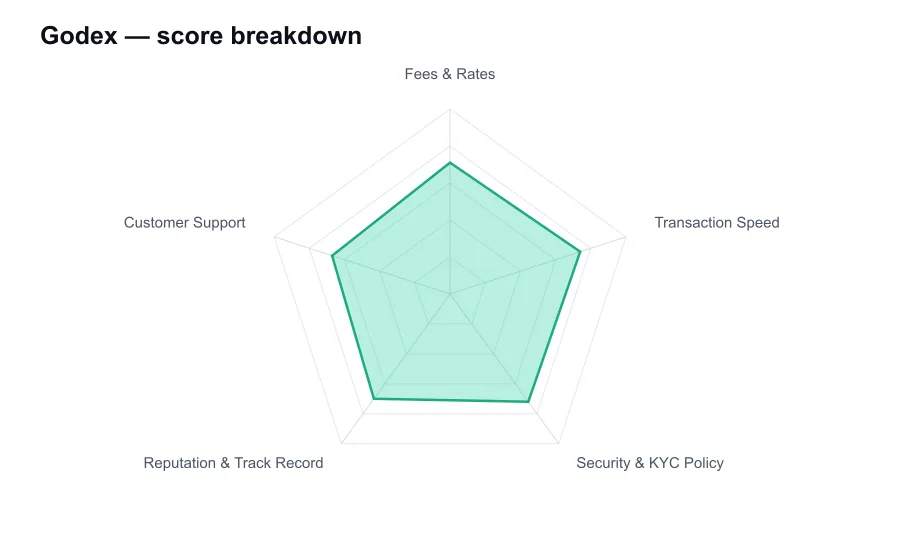
Godex scores 7.1/10 overall in our independent review, measured against every other provider we've compared, strongest on Transaction Speed (7.4/10) and weakest on Customer Support (6.7/10).
Score: 7.1 How we score → Status: active (checked 2026-10-13T19:40:41.956Z) Visit official siteEditorial independence: our scores and rankings are produced using the fixed criteria above and are not influenced by advertisers. This is an independent ranking site and is not operated by, or affiliated with, any provider we list.
Affiliate disclosure: some links on this page may earn us a commission at no extra cost to you. This does not affect our rankings.
| Criterion | Score | Note |
|---|---|---|
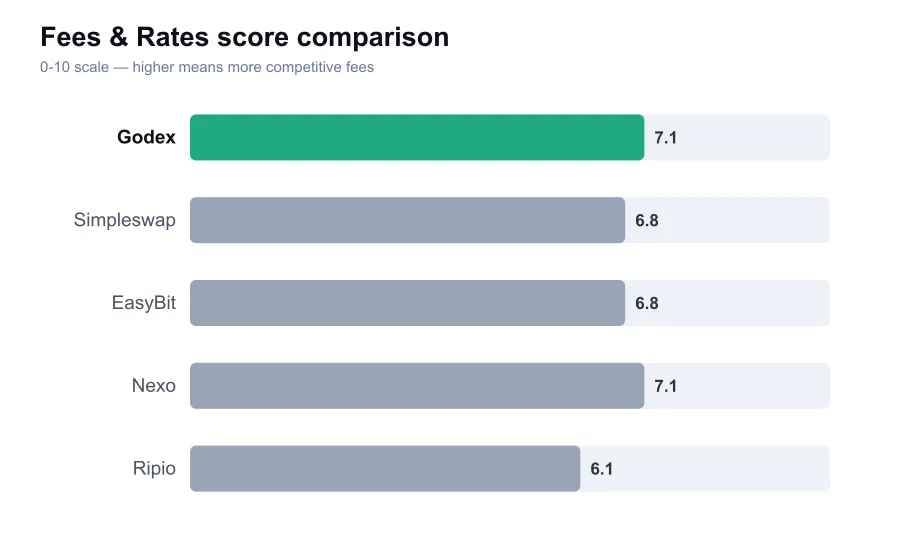
| Fees & Rates | 7.1 | Rate includes the service margin, so compare final output. |
| Transaction Speed | 7.4 | Fast for common pairs after required network confirmations. |
| Security & KYC Policy | 7.2 | No account custody, but execution still requires temporary trust. |
| Reputation & Track Record | 7.0 | Operating since 2018 with a meaningful public user record. |
| Customer Support | 6.7 | Live chat and email, but no formal dispute channel. |
| Fact | Value |
|---|---|
| Founded | 2018 |
| Registration | Not required |
| Rate modes | Fixed and floating |
| Custody model | Instant exchange, no user balance |
| Support channels | Live chat and email |
| Pros | Cons |
|---|---|
| No registration for normal swaps | — |
| Fixed-rate and floating-rate exchange modes | — |
| Broad selection of coins and tokens | — |
| Non-custodial user flow | — |
What is Godex?
How Godex Works
- Choose the asset you are sending and the asset you want to receive
- Select fixed or floating rate where available
- Enter and carefully verify the destination wallet address
- Send the exact requested amount to the generated deposit address
- Track confirmations and receive the converted asset
KYC
| Requirement | none |
|---|---|
| Notes | Godex advertises a registration-free, no-KYC standard exchange flow. It may still review or delay a transaction that triggers compliance or risk checks. |
Supported Assets
| Notable Coins | Bitcoin, Ethereum, Monero, Litecoin, XRP, Tether, USD Coin |
|---|---|
| Networks | Bitcoin, Ethereum, Tron, BNB Smart Chain, Solana |
How to Use Godex Safely
- Verify the destination address and network before sending
- Use a small test transfer for an unfamiliar token route
- Choose fixed rate for volatile or time-sensitive swaps
- Save the exchange ID and deposit transaction hash
- Do not send funds from a wallet or network not selected in the order
Godex is a non-custodial instant exchange service aimed at people who want to swap crypto without opening a trading account. It sits in the same broad category as ChangeNOW, SimpleSwap and StealthEX, but its pitch has always been especially direct: no registration, no account dashboard, and no stated KYC requirement for a normal exchange. You choose a pair, enter a receiving address, send funds, and wait for the destination asset to arrive. That simplicity is its best feature, though it also means Godex asks users to accept the usual instant-exchange trade-off, limited control once a swap has started.
The service supports a large menu of coins and tokens, including Bitcoin, Ethereum, Monero, Litecoin, USDT and many smaller assets. That range is useful, particularly for cross-chain conversions that would otherwise require several transactions and a centralized exchange account. Godex is not an order-book venue. You cannot place a limit order, see market depth, or park funds in an account. It is a routing service that arranges a conversion at the quoted terms, so it works best for one-off swaps rather than active trading.
Godex markets both floating-rate and fixed-rate exchanges. The distinction matters. A floating swap is quoted using current liquidity conditions, but the final amount can change before the provider completes the conversion. A fixed-rate swap locks the displayed output subject to the provider receiving the correct amount within its stated time window. For a volatile pair, fixed rate is usually the sensible choice if the premium is reasonable. It removes the nasty surprise of receiving materially less than the estimate because Bitcoin or the destination token moved during confirmation.
The fee presentation is decent, but it is not as transparent as using a liquid exchange with a visible maker and taker schedule. Godex says its service fee is included in the displayed rate, rather than billed as a clean line item. That is common among instant exchangers, yet it makes meaningful comparison harder. The number that matters is the final amount you receive. Before confirming, compare that output with ChangeNOW, FixedFloat, StealthEX, Trocador and, for major assets, a direct swap through a reputable decentralized exchange.
For popular pairs, Godex's quotes can be competitive enough to justify the convenience. For less liquid assets, the spread can widen sharply. This is not unique to Godex, but users should not treat its quoted amount as a universal market price. A $100 conversion of BTC to ETH might be close to a major exchange after withdrawal costs. A thin token to Monero route may include several layers of liquidity cost. The platform's no-account convenience has value, but it is never free.
Speed depends more on the asset pair and network than on the page itself. A swap involving Litecoin, XRP or a fast Ethereum layer can often complete within minutes once the deposit is detected. Bitcoin deposits need confirmations, and Ethereum transactions can slow down during expensive or congested periods. Godex also has to execute the conversion through its liquidity partners before it can send the output. The site may show an estimated duration, but treat that as a guide rather than a promise.
The most common cause of a frustrating exchange is user error. Sending an unsupported token standard, using the wrong network for USDT, failing to include a required destination tag, or sending below the listed minimum can leave a transaction needing manual support. Godex gives users an order page and exchange ID, so keep both until the funds arrive. The receiving address should be checked character by character, especially for coins where a wrong address cannot be reversed.
Godex's privacy position is attractive to users who do not want to submit a passport merely to exchange one asset for another. There is no ordinary account signup and no stated default KYC flow. That should not be read as a guarantee that every transaction is untouchable. Like other exchange services, Godex can screen addresses and may seek information or pause a transaction where compliance systems flag unusual activity. No-KYC means the standard path avoids identity collection. It does not mean an exchange is outside legal, technical or blockchain-analysis constraints.
Security here is mostly a custody question. Godex does not operate like a conventional exchange where a customer leaves a long-term balance under the company's control. That reduces exposure to an account takeover or a large resident balance sitting on the platform. But it introduces a different trust point. For the time between your deposit and payout, Godex and its counterparties control execution. There is no on-chain smart contract that guarantees the advertised output, and there is no trading account with a self-service cancellation button.
The provider has been operating since 2018, which gives it a longer record than many anonymous-looking instant swap brands that appear and disappear within a year. It has also accumulated a sizeable base of public user reviews. That history is reassuring, though it is not equivalent to the public financial disclosures, licensing footprint or institutional controls expected from a large centralized exchange. Godex has remained a fairly opaque private service. Readers should judge it as a practical tool, not as a place to hold significant value.
Its reputation is strongest among users who value a straightforward, registration-free flow. Complaints tend to follow a familiar instant-exchange pattern: rate movement on floating orders, delays while a provider waits for confirmations or liquidity, and requests for transaction details after a swap does not proceed normally. Those complaints do not automatically establish bad faith, but they expose the weak point of this business model. The customer has little leverage while a transaction is pending. A competitive quote is not much comfort if support becomes slow during a time-sensitive market move.
Support is available through the site's live chat and email channels, with 24/7 availability advertised. In routine cases, an exchange ID, transaction hash and screenshots are usually enough to resolve a missing payout question. I would not call support a reason to choose Godex over a regulated exchange. There is no phone desk, no local branch, and no formal dispute mechanism comparable to a financial institution. Still, chat access is much better than a service that only exposes a generic contact form after something goes wrong.
Godex is best used carefully and in modest sizes. Start with a small test when using an unfamiliar chain or token. Read the quote before sending, select fixed rate where certainty matters, and avoid using it for a payment with a hard deadline. If you are converting a five-figure sum, split the transaction or compare the net result against a liquid exchange where execution, trading fees and withdrawal costs are plainly stated. Instant exchanges are built for convenience, not for price discovery.
My view is that Godex is a credible option for simple no-account swaps, particularly for users who already understand wallet addresses, confirmations and network selection. Its fixed-rate option is a meaningful advantage over services that expose customers entirely to market movement. Still, the lack of a transparent itemized fee schedule and the limited recourse during a stalled order keep it below the standard of a strong exchange for large or urgent transactions. Use it as a transaction tool, not as your primary crypto venue.
Does Godex require KYC?
Godex states that it does not require registration or KYC for its standard exchange flow. Transactions can still be reviewed if compliance or risk systems flag them.
What is the difference between Godex fixed and floating rates?
A floating-rate swap can settle at a changed market rate. A fixed-rate order aims to lock the displayed output if Godex receives the correct deposit within the stated order window.
Can I keep a balance on Godex?
No. Godex is an instant exchange, not a custodial trading account. Send funds from your wallet and receive the converted asset at your destination wallet.
Why is my Godex exchange taking longer than expected?
Bitcoin confirmations, Ethereum congestion, a delayed liquidity route or an incorrect deposit can extend processing. Keep the exchange ID and deposit transaction hash for support.
How are Godex fees charged?
Godex includes its service cost in the displayed exchange rate rather than showing a separate universal percentage. Compare the exact receive amount with other providers.
What happens if I use the wrong USDT network?
The order may not process automatically. Token network mismatches often require manual investigation and may be unrecoverable, so match the selected network exactly before sending.
Editorial independence: our scores and rankings are produced using the fixed criteria above and are not influenced by advertisers. This is an independent ranking site and is not operated by, or affiliated with, any provider we list.
Affiliate disclosure: some links on this page may earn us a commission at no extra cost to you. This does not affect our rankings.