Explace
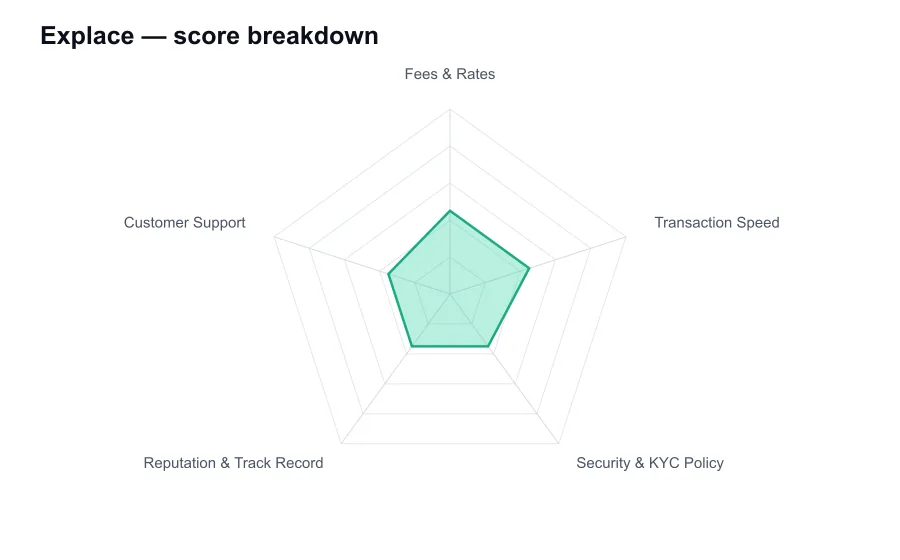
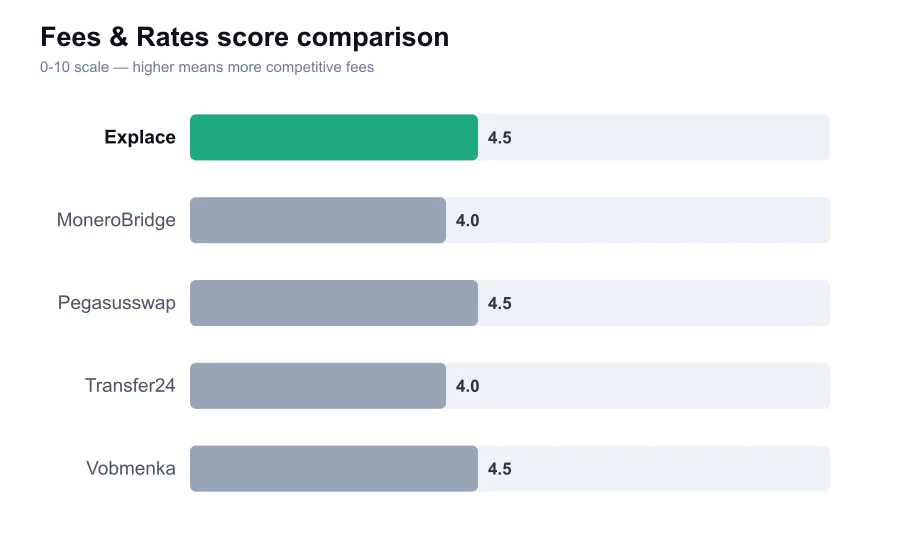
Explace scores 4.0/10 overall in our independent review, measured against every other provider we've compared, strongest on Fees & Rates (4.5/10) and weakest on Customer Support (3.5/10).
Score: 4.0 How we score → Status: active (checked 2026-10-13T19:34:19.240Z) Visit official siteEditorial independence: our scores and rankings are produced using the fixed criteria above and are not influenced by advertisers. This is an independent ranking site and is not operated by, or affiliated with, any provider we list.
Affiliate disclosure: some links on this page may earn us a commission at no extra cost to you. This does not affect our rankings.
| Criterion | Score | Note |
|---|---|---|
| Fees & Rates | 4.5 | Compare quote spreads, as fee disclosure is limited |
| Transaction Speed | 4.5 | Chain settlement is the main timing variable |
| Security & KYC Policy | 3.5 | Public security and verification detail is limited |
| Reputation & Track Record | 3.5 | A modest public record, not a proven long-term one |
| Customer Support | 3.5 | Exception-handling quality is hard to verify |
| Fact | Value |
|---|---|
| Service model | Instant cryptocurrency conversion |
| Execution method | Quote-based swap order |
| Published fee schedule | Not clearly verifiable |
| Recovery policy detail | Limited public detail |
| Recommended use | Small, non-urgent test swaps |
| Pros | Cons |
|---|---|
| Simple direct-conversion format | — |
| Potentially useful for small routine swaps | — |
| No conventional trading terminal | — |
| — | No easily verified standard fee schedule |
| — | Unproven handling of transaction exceptions |
| — | Short visible reputation compared with major rivals |
What is Explace?
How Explace Works
- Choose a deposit and receiving asset
- Enter the receiving wallet address
- Review the quoted payout and order conditions
- Send the deposit asset on the specified network
- Wait for confirmations and the outgoing transfer
KYC
| Requirement | optional |
|---|---|
| Notes | Public documentation is not detailed enough to treat Explace as guaranteed no-KYC. Users should expect that a screened transaction could be paused for verification. |
How to Use Explace Safely
- Run a small test before increasing the amount
- Verify the network and token standard twice
- Use a wallet you control for both sides of the swap
- Keep the order page and transaction hash
- Do not use it for deadline-sensitive transfers
Explace appears to operate in the instant-exchange corner of crypto, a market built for people who want to convert one asset into another without using a full centralized exchange. The attraction is obvious. Pick a pair, supply a wallet address, send the deposit, and wait for the return transfer. For routine swaps, that can be less intimidating than a trading platform. Explace's challenge is that the business has not established enough publicly verifiable depth to justify the same confidence readers might place in long-running competitors.
The name itself is not the issue. Crypto has plenty of new brands, and a new company can offer a useful service. The question is whether customers can inspect the things that matter before handing over an irreversible payment. That means a clear operator identity, terms that explain the transaction relationship, coherent fee disclosure, compliance language, and a proven route to support. Explace does not make enough of those points easy to verify independently.
That leaves the buyer relying heavily on the order quote. In an instant exchange, the quote is central because the true cost may not appear as a separate trading commission. A service can earn through the difference between the market rate and its offered rate, through a partner markup, through network costs, or through a combination. That isn't unusual. It becomes a concern when the customer cannot tell which portion of the difference belongs to the service and which portion is a changing market condition.
I would not use Explace without a direct comparison. Open the same asset pair and amount at two more established services, select the same network where possible, and compare the actual expected receipt. Be wary of a rate that appears unusually generous if the site offers little information about its liquidity sources or settlement process. A favorable number means very little if the order later becomes delayed and there is no dependable support channel to pursue.
The choice between a floating and fixed quote also matters. A floating quote can be reasonable for liquid pairs, especially where the customer accepts that the payout can move with the market. It is a poor fit for someone paying an invoice or converting a specific amount needed on the other side. A fixed quote can offer certainty but often has stricter timing and deposit requirements. Explace users need to read the order screen closely because terminology alone does not tell you how much execution risk you are accepting.
Speed should be assessed as a chain process, not a website feature. Explace can generate an order promptly, but the deposited asset still needs blockchain confirmations. The service or its liquidity partner then processes the swap and broadcasts a withdrawal. The destination chain must confirm it. On a quiet low-fee network, this might feel quick. On Bitcoin or Ethereum during busy periods, it can take far longer than a customer expects. There is not enough robust public reporting to rate Explace's normal service speed highly.
The bigger concern is exception handling. A mature instant exchange will tell users what happens if they send an incorrect amount, choose a wrong network, use an unsupported token contract, or miss a payment window. Some errors are recoverable. Others are not. The distinction has to be explained before deposit, not improvised later. Explace's publicly visible materials do not provide enough clarity to make its operational recovery process a strength.
Non-custodial language can create false confidence. A swap service may avoid holding a customer account balance over time, which is better than leaving coins on a weak custodial platform. But the customer still sends assets into a transaction flow outside their wallet. During that period, the provider's systems, wallet controls, and counterparties matter enormously. A secure-looking browser connection and a clean interface do not tell us whether the service has strong internal governance.
Explace also needs clearer public communication around verification. In crypto exchange practice, a service may accept many orders without registration while reserving the right to request KYC after transaction screening. That is not inherently unreasonable. The unacceptable part is surprising users after deposit with vague conditions, unclear deadlines, or no transparent refund rules. I could not verify a sufficiently detailed public framework for Explace to score its KYC approach above the middle of the range.
For this reason, users should avoid treating an Explace conversion as anonymous, final within minutes, or guaranteed to proceed exactly as estimated. These assumptions are unsafe with any instant exchange, and they are particularly unsafe with one whose policies and reputation are difficult to inspect. If you need regulated account records, clear identity verification in advance, or a known compliance contact, use a mainstream centralized exchange instead.
Reputation is modest rather than nonexistent. Explace has enough of a visible service identity to be discussed as an operating exchange option, but it does not have the deep public history that protects a user from uncertainty. A provider earns trust over years by keeping its promises during market stress, communicating during wallet maintenance, resolving lost-memo cases fairly, and leaving a visible trail of customer experience. Explace has not provided enough evidence on those points.
Support follows the same pattern. A good support team does more than answer pre-sale questions. It traces blockchain transfers, identifies which confirmation stage is pending, explains whether a liquidity partner is delayed, and tells a customer exactly what is needed to fix an address or memo error. There is little independently verifiable material demonstrating that Explace can consistently provide that level of assistance. The practical result is simple, use it only if you can tolerate a delay and potential friction.
Explace might still suit a technically competent person making a small non-urgent swap after the payout has been checked. That is not a ringing endorsement, but it is a realistic use case. Crypto users often need access to a specific pair or network, and small tests can reveal whether a service functions properly for their route. The test should be funded from a self-custody wallet and should never involve money needed for a deadline.
My final assessment is cautious rather than hostile. Explace has the basic structure of an instant exchange, but the service has not earned a strong score on trust, public accountability, or support evidence. Its modest fees score reflects the fact that a quote can be compared, while its lower reputation and security scores reflect information a customer cannot easily recover after a problem starts. There are more established choices for anyone who values predictable resolution as much as a convenient swap form.
Does Explace use an order-book trading interface?
It appears to use an instant-conversion flow, where a customer submits one swap order instead of placing bids and offers on an order book.
How can I check an Explace quote?
Use the exact same coin pair, amount, and network at two other providers. Compare the amount you are expected to receive, not just a displayed rate.
What happens if I send an asset on the wrong network?
Recovery may be impossible or require manual support. Explace's publicly verifiable recovery procedure is limited, so check network details before sending.
Is Explace suitable for a payment with a deadline?
No. Its speed score is 4.5 out of 10 because settlement depends on confirmations, liquidity routing, and a support process that is not well documented.
Can Explace request KYC after I deposit?
Do not assume it cannot. Instant exchange services can screen transfers and request verification, while Explace's public policy detail is limited.
Editorial independence: our scores and rankings are produced using the fixed criteria above and are not influenced by advertisers. This is an independent ranking site and is not operated by, or affiliated with, any provider we list.
Affiliate disclosure: some links on this page may earn us a commission at no extra cost to you. This does not affect our rankings.