Acechange
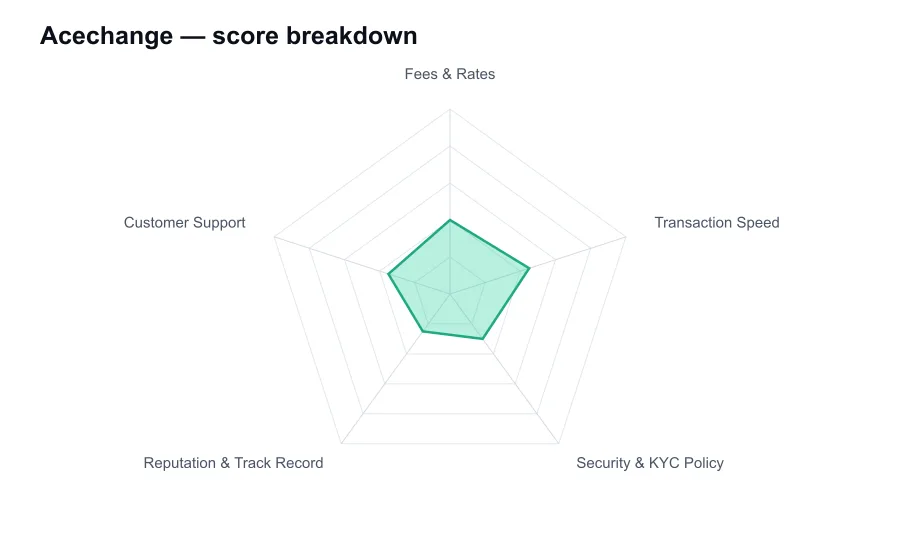
Acechange scores 3.5/10 overall in our independent review, measured against every other provider we've compared, strongest on Transaction Speed (4.5/10) and weakest on Reputation & Track Record (2.5/10).
Score: 3.5 How we score → Status: active (checked 2026-10-13T19:18:35.600Z) Visit official siteEditorial independence: our scores and rankings are produced using the fixed criteria above and are not influenced by advertisers. This is an independent ranking site and is not operated by, or affiliated with, any provider we list.
Affiliate disclosure: some links on this page may earn us a commission at no extra cost to you. This does not affect our rankings.
| Criterion | Score | Note |
|---|---|---|
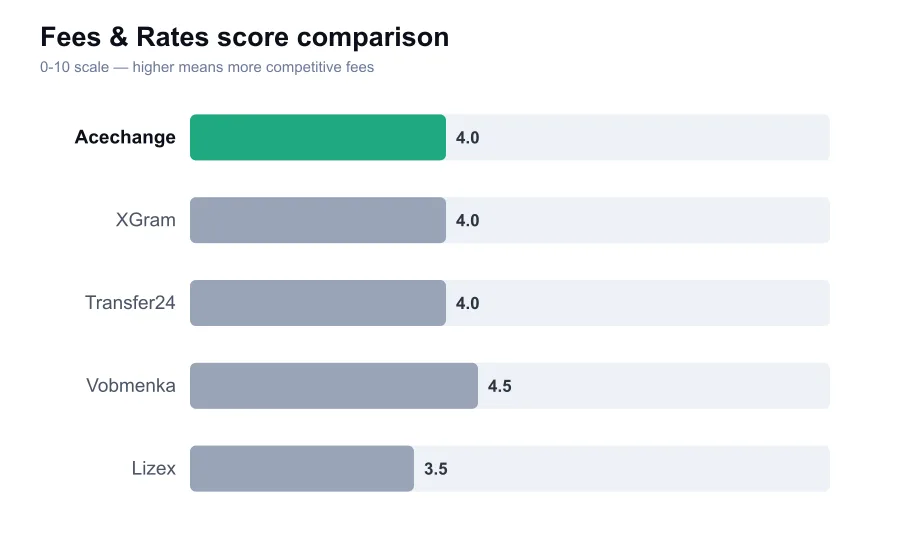
| Fees & Rates | 4.0 | Public pricing transparency is too limited for confidence |
| Transaction Speed | 4.5 | Completion claims need independent verification |
| Security & KYC Policy | 3.0 | Insufficient public evidence on custody and operating controls |
| Reputation & Track Record | 2.5 | Limited independently verifiable operating record |
| Customer Support | 3.5 | Do not rely on chat access as proof of dispute handling |
| Fact | Value |
|---|---|
| Service type | Instant-exchange style service |
| Public-record confidence | Limited |
| High-value use | Not recommended |
| Recommended first use | Small test transaction |
| Key risk | Unclear custody and hold procedures |
| Pros | Cons |
|---|---|
| Simple exchange-oriented proposition | — |
| Potentially useful for tiny test swaps | — |
| May offer a lower-friction flow than major exchanges | — |
| — | Unclear custody and operating controls |
| — | Fee and spread transparency needs improvement |
| — | Poor choice for high-value or urgent transfers |
What is Acechange?
How Acechange Works
- Select the asset to send and the asset to receive
- Enter a receiving wallet address you control
- Review the quoted output and any stated terms
- Send the exact requested asset on the specified network
- Keep the transaction hash and wait for the order to process
- Contact support with the order details if the swap is delayed
KYC
| Requirement | tiered |
|---|---|
| Notes | Do not assume a low-friction exchange flow guarantees no verification. Providers may request identity or source-of-funds information during compliance review. |
How to Use Acechange Safely
- Use only a tiny test amount first
- Save the quote and transaction hash before sending
- Verify the exact asset and network
- Do not send funds needed urgently
- Read the AML and refund terms before payment
- Never send recovery phrases or private keys to support
Acechange is presented as a crypto exchange service, but it is not a provider I can place in the same trust category as established venues with extensive public operating histories, audited reserves, recognizable licensing disclosures, and years of independent coverage. The central issue is not that a smaller exchange is automatically bad. Plenty of legitimate firms began small. The issue is that a user has limited public evidence with which to judge who operates Acechange, how customer assets are protected, and what happens when a transaction does not go smoothly.
That lack of verifiable information changes the review. With WhiteBIT, Coinbase, Kraken, or even a well-known decentralized protocol, there is enough public material to debate fees, specific products, incidents, regional rules, and user experience. With Acechange, a careful reviewer should not fill gaps with comforting assumptions. A polished website, a chat bubble, and a low-rate promise are not evidence of robust custody, liquidity, or a functioning compliance operation. Crypto has produced too many short-lived services that looked professional until withdrawals became difficult.
Fee transparency is the first practical test. A reliable exchange explains whether its quote includes the trading fee, spread, network fee, and any amount retained when an order fails or must be refunded. If a service only offers an attractive final quote without a durable public fee schedule or a clear explanation of floating versus fixed rates, users cannot properly compare it with competitors. The cheapest-looking swap can become expensive through a wide spread or unfavorable execution. That risk is especially acute with small instant-exchange services.
I would never send a meaningful amount to Acechange without first completing a very small transaction and recording the quoted amount, received amount, blockchain fee, and completion time. That sounds cautious because it is. A test transaction is not a full security audit, but it can expose problems with routing, support responsiveness, wallet-address handling, and unexplained deductions. If the service cannot make the costs understandable before payment, that alone is enough reason to use a provider with a more transparent track record.
Transaction speed is similarly hard to score generously without strong independent evidence. Instant exchange services often advertise completion within minutes, but the actual time depends on deposit confirmations, available liquidity, blockchain congestion, partner exchanges, and compliance screening. A Bitcoin deposit can take far longer than a Polygon transfer. A large or unusual transaction can trigger manual review. The word instant describes a user experience goal, not a settlement guarantee. Users should be suspicious of any provider that treats it as one.
The security picture is the biggest concern. A centralized or semi-custodial exchange needs clear information about its legal entity, wallet security, internal controls, custody model, privacy policy, sanctions screening, and the circumstances in which it can hold a transaction. If those details are hard to independently confirm, the user is being asked to trust an unknown counterparty with irreversible assets. That is a poor bargain when mature alternatives offer stronger documentation, security controls, and public accountability.
KYC policy deserves special attention at smaller services. Some instant exchangers market a low-friction flow, then pause a transaction after receiving funds and request identity documents or source-of-funds information. Screening itself is not a red flag. Responsible providers must address fraud and sanctions obligations. The problem is a vague policy that gives the company broad discretion without stating review timelines, refund conditions, or appeal procedures. Never assume a no-registration checkout means a transaction is guaranteed to remain no-KYC.
That point is more than theoretical. If a service freezes a swap after you have sent coins, you may face a choice between submitting sensitive documents to a little-known company or waiting for a refund under rules you had not fully understood. A reputable provider publishes a clear AML policy and explains the process. Before using Acechange, I would read those documents line by line, check whether the entity name is consistent across the terms and privacy policy, and save copies before sending funds.
Reputation is not built by search rankings or affiliate listings. It is built by years of consistent withdrawals, transparent incident handling, named leadership or legal ownership, regulatory disclosures where required, and credible feedback that is not limited to promotional channels. Acechange does not have the public record I would want before recommending it for regular use. That does not prove misconduct. It does mean the burden of proof remains with the provider, and the prudent customer should not volunteer large amounts while that proof is absent.
Support is another area where small services can fail at the worst possible moment. A support agent who answers a pre-sale question quickly is not the same as a team that can trace a stuck deposit, explain a compliance hold, or process a refund during market stress. Look for a ticket number, a documented escalation route, and a public policy that says what happens if an order cannot be completed. Screenshots of chat conversations are not enough protection for a five-figure transaction.
There are operational practices that reduce the danger if someone still chooses to try Acechange. Use a fresh receiving address you control. Send the exact network and asset requested, since sending USDT on the wrong chain can create a costly recovery problem. Start with an amount you can afford to lose or wait for. Do not split a single order across multiple deposits unless the service explicitly instructs you to do so. Keep the transaction hash, quote, address, timestamp, and all correspondence.
Acechange is particularly unsuitable for fiat conversion, business payments, treasury activity, or urgent transfers. Those cases demand predictable settlement, legal clarity, and a reliable escalation path. It is also a poor place for a newcomer to learn crypto. Beginners need clear interfaces, established support, and a platform where basic questions have durable answers. A little more apparent convenience is not worth the loss of recourse that comes with an obscure counterparty.
If what you need is a simple coin-to-coin swap, established instant exchangers and major centralized exchanges provide more evidence to work with. If what you need is self-custody, a liquid decentralized exchange can reduce reliance on a company, though it introduces smart-contract and wallet risks. Acechange occupies an uncomfortable middle ground: it may promise simplicity, yet asks users to trust an operator whose public record is too limited for confidence. That is not a position I would choose voluntarily.
My final view is harsher than it would be for a provider with transparent operations, because crypto users cannot recover from trust mistakes as easily as cardholders can. Acechange may complete small swaps, but I cannot recommend it as a regular or high-value exchange without stronger independently verifiable evidence around ownership, fees, custody, policy enforcement, and support. If you use it at all, treat the transaction as an experiment and keep the amount tiny. For serious money, choose a provider with a record you can actually inspect.
Is Acechange suitable for a large crypto transfer?
No. Its limited independently verifiable record makes it a poor choice for high-value transfers, treasury activity, or funds needed on a deadline.
Are Acechange fees easy to verify?
Public fee and spread transparency is limited. Record the quoted output and test only a small amount before considering any further use.
Can an instant swap be placed on hold?
Yes. Deposit confirmations, liquidity issues, blockchain congestion, or compliance screening can delay an instant-exchange order at services of this type.
Does no account registration mean no KYC?
No. A no-registration flow does not prevent a provider from requesting identity or source-of-funds documents after it receives a transaction.
What should I save if an Acechange order is delayed?
Keep the order ID, original quote, deposit address, transaction hash, timestamp, receiving address, and every support message.
Should I send multiple deposits for one order?
No, unless the service explicitly instructs you to do so. Multiple deposits can complicate automated order matching and support investigations.
Editorial independence: our scores and rankings are produced using the fixed criteria above and are not influenced by advertisers. This is an independent ranking site and is not operated by, or affiliated with, any provider we list.
Affiliate disclosure: some links on this page may earn us a commission at no extra cost to you. This does not affect our rankings.