XGram
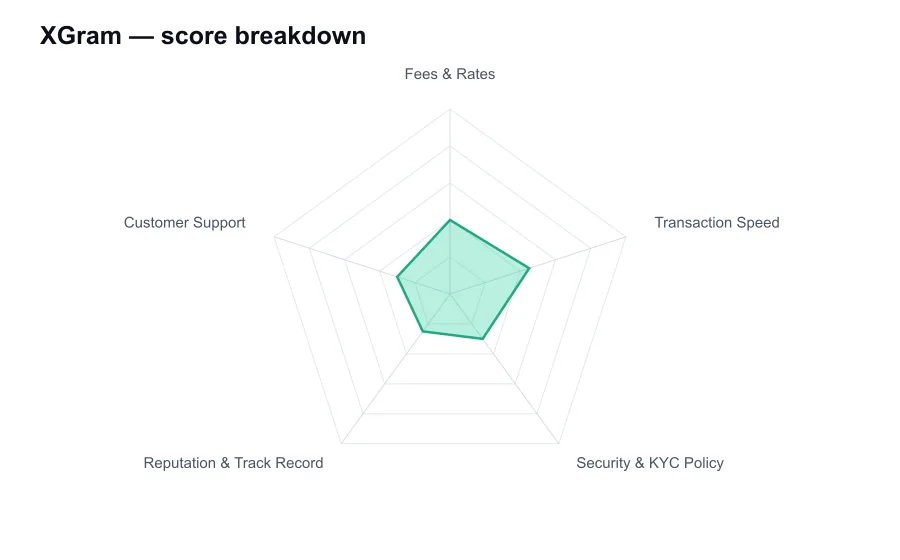
XGram scores 3.5/10 overall in our independent review, measured against every other provider we've compared, strongest on Transaction Speed (4.5/10) and weakest on Reputation & Track Record (2.5/10).
Score: 3.5 How we score → Status: active (checked 2026-10-13T19:34:19.105Z) Visit official siteEditorial independence: our scores and rankings are produced using the fixed criteria above and are not influenced by advertisers. This is an independent ranking site and is not operated by, or affiliated with, any provider we list.
Affiliate disclosure: some links on this page may earn us a commission at no extra cost to you. This does not affect our rankings.
| Criterion | Score | Note |
|---|---|---|
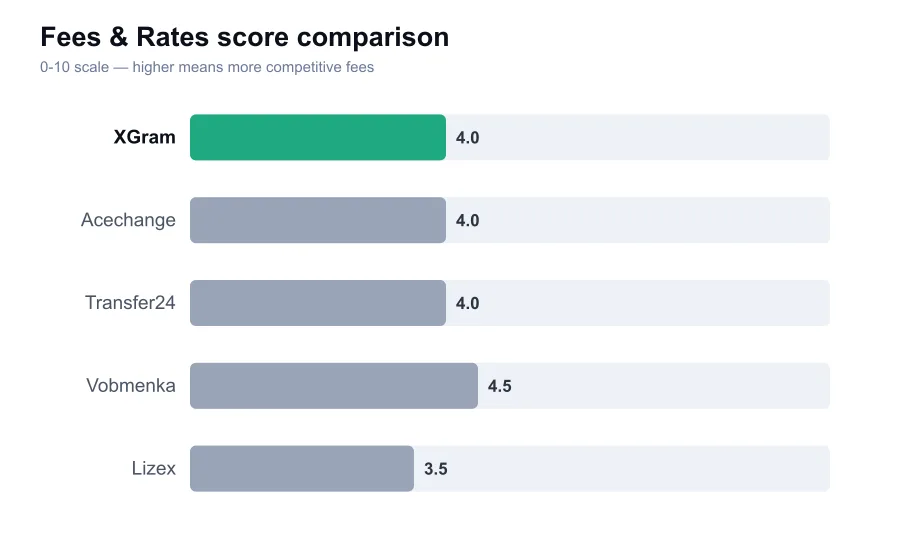
| Fees & Rates | 4.0 | Quote-based pricing, with limited public fee detail |
| Transaction Speed | 4.5 | Settlement depends on chain and liquidity routing |
| Security & KYC Policy | 3.0 | Public controls and hold policy are hard to verify |
| Reputation & Track Record | 2.5 | Limited independently documented operating history |
| Customer Support | 3.0 | Little public evidence of dispute handling |
| Fact | Value |
|---|---|
| Service model | Instant crypto conversion interface |
| Published fee schedule | Not clearly verifiable |
| Public KYC policy | Not clearly verifiable |
| Identifiable operator | Not independently verified |
| Review risk profile | Use small test transactions |
| Pros | Cons |
|---|---|
| Simple instant-swap model | — |
| May suit small comparison-tested swaps | — |
| Avoids a conventional trading interface | — |
| — | Fee structure is not clearly verifiable |
| — | KYC and hold procedures lack detail |
| — | Support quality is difficult to assess |
What is XGram?
How XGram Works
- Choose the asset pair and enter the amount
- Review the quoted estimated payout and destination address
- Send the deposit asset to the generated address
- Wait for network confirmations and exchange processing
- Confirm receipt in the destination wallet
KYC
| Requirement | optional |
|---|---|
| Notes | A reliable public policy was not available for verification. Do not assume a swap is immune from an AML-related identity request or temporary hold. |
How to Use XGram Safely
- Test the service with a small amount first
- Compare the final payout against established exchanges
- Check the exact network before sending
- Save the order ID, quote, and transaction hash
- Never send funds from a wallet you do not control
XGram presents itself as a crypto exchange service built around quick conversions rather than a full trading terminal. It belongs in the instant-exchange category, where the customer chooses a pair, receives a deposit address, and expects the purchased asset to arrive without opening a traditional trading account. That is an attractive pitch for someone who wants to swap coins without learning order books. The problem is that XGram gives a cautious buyer far less public evidence than established instant exchangers do.
The first issue is basic transparency. A credible exchange service should make it easy to identify the operator, legal terms, fee treatment, compliance process, support channels, and route for a formal complaint. XGram's public footprint has been thin enough that independently checking those details is difficult. That doesn't prove wrongdoing, and it would be irresponsible to make that leap. It does mean a user should treat the service as unproven rather than assuming it has the same maturity as ChangeNOW, LetsExchange, FixedFloat, or Changelly.
Fees are especially hard to judge in that setting. A site can advertise a swap quote without separately displaying its service spread, provider fee, and blockchain network fee. For a casual customer, the only number that matters is the amount actually received. If XGram's quote is competitive, it can still be a reasonable one-off option. But a quote is not the same thing as a transparent pricing model, and the lack of a clearly published standard fee makes comparison shopping more difficult than it should be.
That matters most on smaller trades. A hidden spread of a few percentage points can be easy to miss if somebody is converting a large amount of BTC, yet it can make a small altcoin swap distinctly poor value. Before sending funds, compare XGram's estimated payout against two established alternatives using exactly the same amount, asset, and network. Don't compare a BTC payout on one site with a USDT quote on another. Network choice, liquidity source, and rate type can change the result sharply.
The service model should also make users careful about rate volatility. In instant exchanges, a floating quote generally means the final payout can shift between the time the order is created and the time the deposit receives enough confirmations. Fixed-rate transactions reduce that uncertainty, but they often cost more and can have a short payment window. XGram should be judged by what its order page promises for the specific trade, not by a broad marketing claim about fast exchange.
Speed is another area where the interface can create unrealistic expectations. Generating an order is nearly instantaneous. Settlement is not. The deposited coin needs confirmations, the liquidity provider needs to process the swap, and the outgoing transaction must propagate on its destination chain. A Litecoin or Tron transfer may settle quickly, while Bitcoin, Ethereum during congestion, or an asset moving through a busy bridge can take much longer. Any exchange that calls every transaction instant is simplifying a process it doesn't fully control.
XGram does not have the long, independently documented operating record that would let a reviewer confidently assess its typical completion times or failure handling. This is a real disadvantage. Reliable speed is not just a matter of a clean website or a fast quote widget. It shows up when a transaction is underpaid, sent on the wrong network, delayed by a wallet maintenance event, or caught in a compliance review. Public evidence of how a provider handles those cases is more valuable than a homepage promise.
Security deserves a stricter standard than appearance. A non-custodial swap service can reduce the risk of leaving a balance on an exchange, since the user sends funds for a particular conversion rather than parking assets in an account. That does not remove risk. The service still controls the order flow after the deposit arrives, and customers depend on its liquidity partners, internal controls, address generation, and support team to complete the transaction accurately.
KYC is another point that needs plain language. Many instant exchangers advertise a registration-light process, then reserve the right to request identity documents under anti-money-laundering procedures. That arrangement is common across the sector. The important question is whether the provider explains when a hold can happen, what documents may be requested, and what happens if the customer cannot satisfy the request. XGram does not offer enough clearly verifiable public detail for me to score its policy generously.
A newcomer should never assume that sending a transaction means it can be cancelled. Once crypto reaches the generated deposit address, recovery depends on the exchange's willingness and ability to help. Mistyped destination tags, unsupported networks, and deposits below a required threshold are frequent causes of losses. A mature provider usually publishes practical recovery guidance and a detailed transaction-status process. With XGram, users should test those support and policy claims with a tiny amount before considering a meaningful transfer.
Reputation is where XGram falls furthest behind better-known competitors. A company does not need to be famous to be trustworthy, but it does need a record that can be inspected. That includes sustained user feedback across independent channels, identifiable business information, responsive public communication, and evidence that disputes are resolved rather than ignored. XGram has not built enough visible history for a reader to give it the benefit of the doubt on a large transaction.
Customer support is hard to score well without a demonstrated service record. A contact form or chat bubble is not proof that a customer will receive help after an exchange goes wrong. What matters is accessible support during a delayed order, clear ticket ownership, useful replies, and escalation when a blockchain transaction needs manual investigation. Until XGram supplies more verifiable evidence in that area, buyers should assume support may be limited and plan accordingly.
There is a narrow use case where XGram could make sense. If it quotes a materially better payout on a small, routine pair and the order details are clear, a user who understands instant-exchange risk may decide the test is worthwhile. That is very different from trusting it with a first large conversion, a time-sensitive payment, or funds that cannot be tied up for several days. Unknown operational quality is a cost, even when it doesn't appear as a line item in the quote.
My view is blunt. XGram may function as a convenient exchange front end, but it has not earned the confidence that comes with transparent fees, a well-documented compliance policy, and a long public track record. The service should be treated as experimental until it provides more independently checkable information. Use a small test transaction, document the quoted payout, and keep a stronger-established exchange available as the default.
Is XGram a traditional crypto exchange?
It appears to operate as an instant conversion service rather than a conventional exchange with order books and user trading balances.
Does XGram publish a fixed percentage exchange fee?
I could not verify a clear public standard percentage. Compare the final quoted payout with at least two alternatives before sending funds.
Can a completed XGram deposit be cancelled?
Crypto deposits are generally irreversible after confirmation. Contact support immediately if there is an error, but do not assume recovery is possible.
Should I use XGram for a large first transaction?
No. Its reputation score is 2.5 out of 10 because there is limited independently documented operating history. Test a small amount first.
Will XGram ask for identification?
Its public KYC and hold process is not sufficiently clear to treat it as guaranteed no-KYC. Instant exchangers can request verification for flagged transfers.
Editorial independence: our scores and rankings are produced using the fixed criteria above and are not influenced by advertisers. This is an independent ranking site and is not operated by, or affiliated with, any provider we list.
Affiliate disclosure: some links on this page may earn us a commission at no extra cost to you. This does not affect our rankings.