CCECash
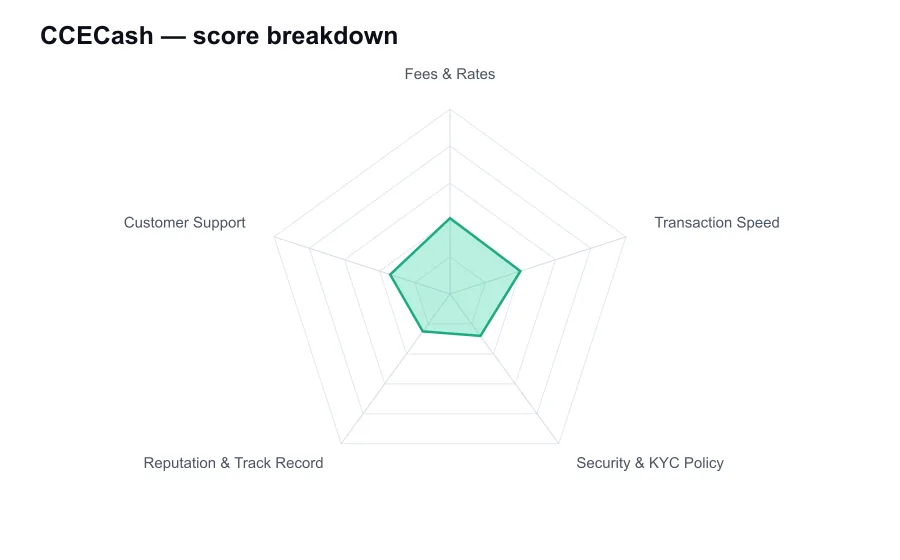
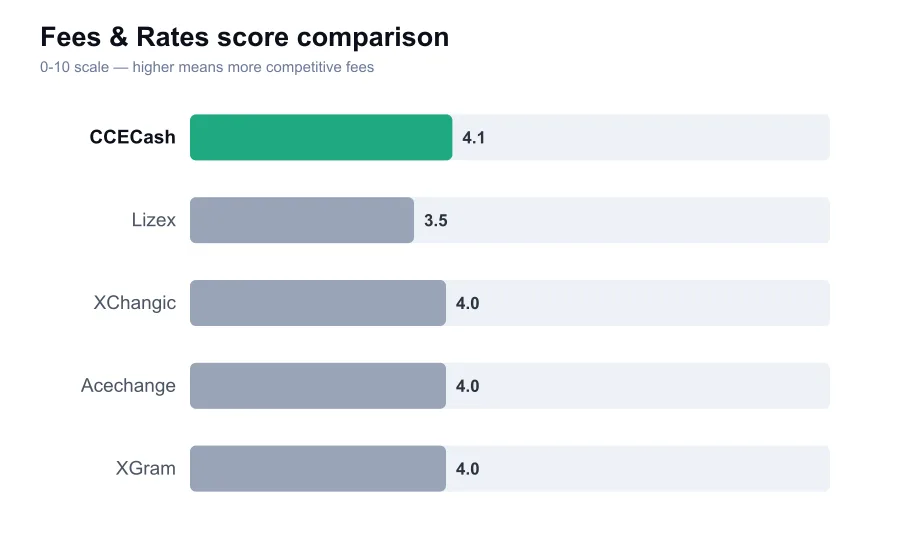
CCECash scores 3.4/10 overall in our independent review, measured against every other provider we've compared, strongest on Fees & Rates (4.1/10) and weakest on Reputation & Track Record (2.5/10).
Score: 3.4 How we score → Visit official siteEditorial independence: our scores and rankings are produced using the fixed criteria above and are not influenced by advertisers. This is an independent ranking site and is not operated by, or affiliated with, any provider we list.
Affiliate disclosure: some links on this page may earn us a commission at no extra cost to you. This does not affect our rankings.
| Criterion | Score | Note |
|---|---|---|
| Fees & Rates | 4.1 | Compare final quotes carefully, public fee clarity is limited |
| Transaction Speed | 4.0 | Routine automation may be quick, resilience is unproven |
| Security & KYC Policy | 2.8 | Insufficient public detail on operational security controls |
| Reputation & Track Record | 2.5 | Limited verifiable record beside established alternatives |
| Customer Support | 3.4 | Ask exception-handling questions before depositing |
| Pros | Cons |
|---|---|
| Direct crypto conversion concept | — |
| Potentially simple for a small test swap | — |
| Wallet-address payout model | — |
| — | No strong independently documented security record |
| — | Final pricing requires outside comparison |
| — | Unsuitable for important or high-value transfers |
CCECash appears to target the same audience as many small crypto conversion services: people who want to exchange coins quickly without navigating a full trading terminal. There is a real market for that. Not everyone needs advanced order types, fiat rails, tax reports, and a custodial account. The issue is that CCECash has not established the public credibility needed to make its convenience proposition compelling against larger, more transparent competitors.
The first thing I look for in an exchange provider is not a list of supported tokens. It is accountability. Who is the legal operator? Where is it registered? What licensing claims are made, if any? What is the formal complaints process? Which entity receives user funds during a swap? CCECash does not have a sufficiently well-developed, independently verifiable public profile on these points for me to treat it as a mature financial service.
That lack of visibility matters because the exchange process is inherently asymmetric. The customer sends funds first. The provider has more information about its wallets, liquidity, internal compliance rules, and transaction status than the customer does. If payment does not arrive, the user may have only a blockchain transaction ID and a support form. A reputable operator addresses that imbalance with transparent terms, responsive communication, and a history that users can inspect. CCECash has not yet built that confidence publicly.
The apparent appeal is straightforward: a direct crypto conversion without a lengthy signup process. For some people, that feels liberating after the identity checks and account restrictions of centralized exchanges. But convenience can conceal the true cost. A user should not ask only whether a platform charges a visible fee. They should ask whether the final amount received is competitive after spread, network charges, liquidity routing, and any minimum or maximum rules are applied.
I could not verify a widely reliable CCECash pricing schedule detailed enough to endorse its rate structure. That means every quote should be treated as a one-time offer requiring comparison. Open a price calculator at a major exchange, then request quotes from at least two established instant-swap alternatives. Compare the amount that will actually arrive, not the percentage displayed in promotional copy. For stablecoins, also check the exact chain because a cheap token swap can be undone by an expensive or unsupported withdrawal network.
Be particularly suspicious of an offer that looks unusually generous. Crypto exchange margins do not disappear through goodwill. A quote that beats every known competitor may reflect an outdated price feed, an eventual repricing policy, a restrictive confirmation window, or a hidden condition. It could be genuine, but the customer should know why it is possible before depositing. The more opaque the provider, the less willing I am to assume that an apparent bargain will survive contact with a real transaction.
Speed is hard to separate from reliability. CCECash may be able to process a straightforward, liquid swap quickly, as can many automated services. That tells us very little about what happens under load or in an exception. A Bitcoin deposit can remain unconfirmed because of a low fee. An Ethereum transfer can be held up by gas conditions. A token deposit can be rejected because it arrived on an unsupported network. The service earns trust by explaining those cases, not by showing a generic “fast exchange” message.
For a time-critical transfer, I would not rely on CCECash. An urgent payroll payment, a settlement, a liquidation-related transfer, or a purchase deadline requires a provider with proven operational depth and accessible human support. Small providers can work until they encounter a problem outside their automation path. If the downside of delay is serious, use a venue where you can see liquidity, withdraw from your own account, and contact a known support organization.
Security disclosures are another major concern. I could not confirm the kind of information that would support a high security rating, such as independently reviewed infrastructure, public incident reports, named security personnel, cold-storage policy, penetration-test summaries, or proof-of-reserves practices. Those measures are not universal even among respected exchanges, but their absence leaves a reviewer with little basis for confidence. A user is being asked to trust an operational black box.
It is tempting to call a service non-custodial because it sends assets directly to the wallet address a customer provides. That label needs qualification. During the swap, the provider receives the customer's deposit and controls the payout process. The user has counterparty exposure until the exchange is complete. If a site fails, pauses withdrawals, or disputes a transaction, the technical fact that you never opened a long-term account offers limited comfort.
The KYC position should be read from the current legal documents, not inferred from a quick order form. A platform can allow a customer to begin without registration while retaining the right to request identification, delay the payout, or return funds if a transaction is flagged by blockchain monitoring. CCECash has not established enough public policy clarity for me to recommend it to users for whom privacy certainty matters. No upfront document request is not the same as a predictable no-KYC policy.
Reputation is where CCECash falls furthest behind. I would expect a provider handling customer deposits to have a sizable body of credible, detailed external feedback and a demonstrable response to criticism. Generic praise, referral-driven articles, and unverified star ratings do not meet that standard. What matters are reviews that describe actual amounts, currencies, timestamps, order issues, and resolutions. The public evidence I could locate is not strong enough to call its track record established.
Support must carry much of the risk at a service like this, and that is a difficult burden. A support channel can look responsive when questions are simple. The important questions involve a transaction that has already gone wrong. Before using CCECash, ask what happens if you underpay, send an unsupported token contract, use the wrong memo, or need a refund. If the response is vague or directs you only to generic terms, do not send funds. There are too many better options.
Users who still choose to test CCECash should approach it like an unproven counterparty. Send a minimal amount from a wallet you control. Save every detail, including the generated address, quote, order number, transaction hash, and support correspondence. Do not use borrowed funds, funds needed for an imminent payment, or a token transfer that cannot be easily recovered. One completed test is only evidence that one order completed.
CCECash does not need to be assumed malicious for this review to reach a skeptical result. The problem is simpler: it has not earned the level of trust required by the business model. Crypto users have access to providers with clearer ownership, deeper public review histories, stronger support resources, and more visible security practices. Until CCECash closes that gap, it belongs in the category of services to approach cautiously, if at all.
Does CCECash have transparent fees?
A sufficiently detailed, independently verifiable public fee schedule is not clear. Compare the final receive amount against other providers before funding an order.
Is CCECash good for urgent exchanges?
No. Limited independent evidence of operational reliability makes it a poor choice for transactions tied to a deadline or a significant financial obligation.
Will CCECash ask for KYC documents?
Do not assume it will not. Check the current terms and AML policy before depositing, since risk-based review can occur even without an upfront account application.
Editorial independence: our scores and rankings are produced using the fixed criteria above and are not influenced by advertisers. This is an independent ranking site and is not operated by, or affiliated with, any provider we list.
Affiliate disclosure: some links on this page may earn us a commission at no extra cost to you. This does not affect our rankings.