Transfer24
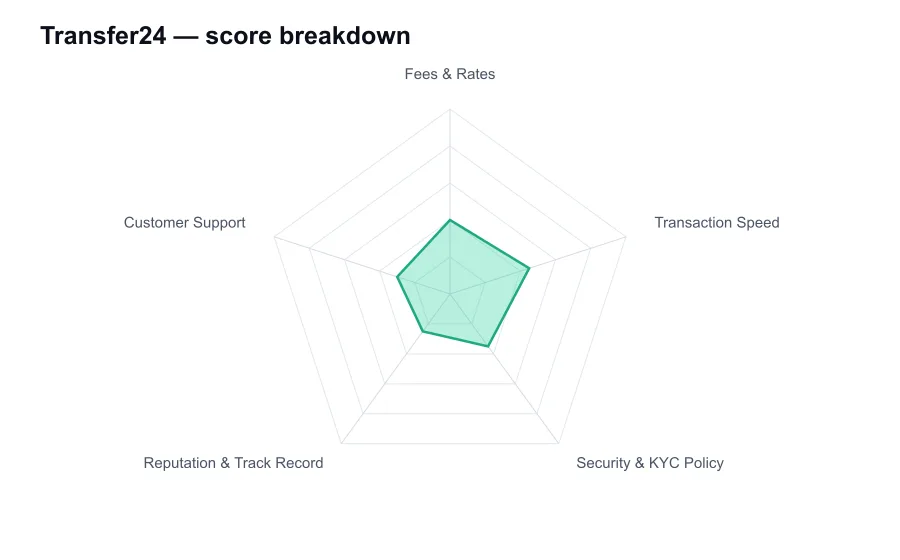
Transfer24 scores 3.6/10 overall in our independent review, measured against every other provider we've compared, strongest on Transaction Speed (4.5/10) and weakest on Reputation & Track Record (2.5/10).
Score: 3.6 How we score → Status: active (checked 2026-10-13T19:36:13.384Z) Visit official siteEditorial independence: our scores and rankings are produced using the fixed criteria above and are not influenced by advertisers. This is an independent ranking site and is not operated by, or affiliated with, any provider we list.
Affiliate disclosure: some links on this page may earn us a commission at no extra cost to you. This does not affect our rankings.
| Criterion | Score | Note |
|---|---|---|
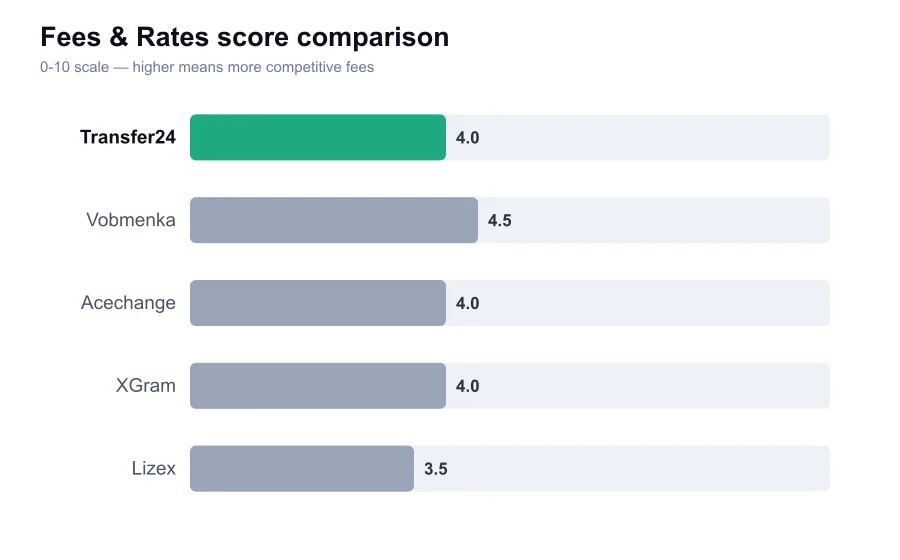
| Fees & Rates | 4.0 | Final price must be judged from each live quote |
| Transaction Speed | 4.5 | No strong public evidence on routine completion times |
| Security & KYC Policy | 3.5 | Limited public detail on controls and hold procedures |
| Reputation & Track Record | 2.5 | Insufficient independently verifiable operating record |
| Customer Support | 3.0 | Support responsiveness is difficult to verify publicly |
| Fact | Value |
|---|---|
| Service model | Crypto-to-crypto instant exchange |
| Pricing model | Rate quoted per transaction |
| Settlement model | Deposit confirmation before payout |
| Public fee schedule | Not clearly documented |
| Public track record | Limited independently verifiable record |
| Pros | Cons |
|---|---|
| Simple instant-exchange concept | — |
| Potentially useful for a small test swap | — |
| Avoids order-book complexity | — |
| — | No clear public fee schedule |
| — | Little evidence on exception handling |
| — | Unsuitable for large or urgent transfers |
What is Transfer24?
How Transfer24 Works
- Select the asset you want to send and receive
- Enter your destination wallet address
- Review the quoted output and network details
- Send the required amount to the generated deposit address
- Wait for blockchain confirmations and payout
- Use the order reference and transaction hash if support is needed
KYC
| Requirement | optional |
|---|---|
| Notes | An account-light swap process does not prevent compliance screening. Users should be prepared for possible verification requests or holds if a transaction triggers anti-money-laundering controls. |
How to Use Transfer24 Safely
- Start with a small major-asset transaction
- Compare the quote against established exchanges
- Verify the exact network and destination address
- Keep screenshots, order details, and transaction hashes
- Do not send follow-up deposits to an old address
- Avoid using it for deadline-sensitive payments
Transfer24 appears in the instant-exchange corner of crypto, where providers promise a quick conversion without requiring users to master a centralized exchange. The basic idea is appealing, particularly for someone holding one coin in a self-custody wallet who wants another. Yet Transfer24 is a name with a limited independently verifiable profile, and that fact shapes the review more than any claim on a landing page.
This category asks customers to trust an intermediary at exactly the point where a blockchain transfer becomes irreversible. The user chooses a pair, receives an address, and sends funds. From that point, the provider has to recognize the deposit, obtain liquidity, execute the trade, and send a payout. A smooth transaction can feel effortless. A delayed one quickly exposes whether the operator has real processes, accessible support, and enough liquidity to do the job.
Transfer24 does not have the public footprint needed to judge its prices from a published fee table. That is a weakness. Instant exchangers often build fees into the exchange rate, which is normal, but the user needs clear terms and a competitive final quote. Without a plainly documented fee methodology, customers should assume that the difference between market price and payout is the true cost of the service.
That cost can be larger than it first appears. Network fees are obvious on Bitcoin and Ethereum, but liquidity spread can matter even more on thin pairs. A provider may show a reasonable percentage difference on a major coin and a much weaker rate on a less common token. Transfer24 should be assessed pair by pair. If the quote cannot compete with a direct exchange trade plus withdrawal fee, its convenience is not worth paying for.
The platform's name implies speed, but no crypto service can promise genuinely instant settlement across every route. Bitcoin confirmations, Ethereum gas conditions, destination-chain congestion, token liquidity, and manual risk checks all introduce delay. A provider may process its part rapidly and still leave the customer waiting because the input transaction has not reached the required confirmation threshold. That is why realistic status information matters more than a fast-sounding brand name.
There is little independently verifiable performance data showing Transfer24's usual completion times, failed-order rate, or handling of unusually large transactions. That makes it hard to score the service generously on speed. For an ordinary swap of a liquid asset, it may work as intended. But a user cannot responsibly extrapolate from a simple interface to a proven ability to settle complicated transfers under volatile market conditions.
Security begins with the basic technical hygiene that every swap user should practice. Confirm that you are on the correct site, inspect the asset and network selection, and never accept a deposit address from an unsolicited message. More importantly, security includes the provider's own safeguards. Transfer24 provides limited public evidence of corporate identity, security controls, audit practices, or the procedures used if a transaction is flagged.
A no-registration flow, if offered, should not be read as a legally binding promise that no identity documents will ever be requested. Crypto swap providers can screen deposits against risk systems and may stop an order pending information. This possibility is especially relevant for funds originating from an exchange, mixing service, sanctioned-address exposure, or a wallet with an unclear transaction history. The user needs to know this before sending, not after an order is frozen.
The most frustrating cases in this sector are partial payments, incorrect networks, and mismatched deposit amounts. A reputable provider should explain how it handles them, whether a refund is possible, and who bears network costs. Transfer24's public documentation and public case history do not provide enough confidence that these edge cases are managed consistently. That uncertainty is manageable for a small test. It is unacceptable for money needed for rent, business settlement, or a major investment.
Its reputation score is low because a mature reputation must be earned in public. A useful record includes years of operation, active independent reviews, identifiable policies, responsive communication, and visible resolution of difficult cases. Transfer24 has not accumulated enough readily verifiable evidence on those fronts. Lack of visibility is not proof of fraud, and it would be irresponsible to claim that it is. It does mean the user is accepting an unusually large information gap.
Support should be judged before the transaction, not only after it. If a provider has a published support route, send a narrow question about the intended pair or network and see whether the response is clear and timely. Ask what happens if the sent amount differs from the quoted amount. Ask whether a tag or memo is needed for the destination. A provider unable to answer basic operational questions is not the place to send irreversible funds.
Transfer24 may appeal to someone who wants to try a small conversion without creating an account. That is its most defensible use. It is not a strong choice for a first-time crypto user, a person buying with fiat, a trader seeking repeatable execution, or anyone whose transaction has a strict deadline. Better-known services can still produce delays, but they give the customer more information and a larger record to assess.
If you decide to use it, reduce every avoidable risk. Start with a small amount, use a major asset and a common network, copy the receiving address directly from your own wallet, and retain every record. Do not send from a source that requires a payment reference unless you have confirmed the instruction. Do not send extra funds to the same deposit address later in the hope that it will be credited automatically.
My judgment is that Transfer24 is not yet established enough to recommend beyond a cautious test transaction. The interface model may be convenient, but convenience is cheap in crypto. Reliable execution, clear pricing, known compliance rules, and proven support are much harder to build, and Transfer24 has not publicly demonstrated enough of them. Most users have better options.
Does Transfer24 publish a standard trading fee?
A stable public percentage fee schedule is not clearly available. Compare the final receive amount in the live quote against other providers before sending funds.
Can Transfer24 ask for KYC after I send funds?
Potentially, yes. Instant exchangers can use anti-money-laundering screening and may request information or pause a transfer if it is flagged.
Is Transfer24 appropriate for a large stablecoin transfer?
No. Its limited independently verifiable reputation and unclear exception-handling record make it a poor choice for a large or time-sensitive stablecoin transfer.
What records should I keep for a Transfer24 transaction?
Keep the quote, order ID, deposit address, selected network, exact sent amount, and blockchain transaction hash. These are essential if support needs to investigate.
Why should I test Transfer24 with a major coin first?
Major assets on common networks generally have clearer confirmation behavior and deeper liquidity. A small test also exposes pricing or support problems before the stakes are high.
Editorial independence: our scores and rankings are produced using the fixed criteria above and are not influenced by advertisers. This is an independent ranking site and is not operated by, or affiliated with, any provider we list.
Affiliate disclosure: some links on this page may earn us a commission at no extra cost to you. This does not affect our rankings.