Mine
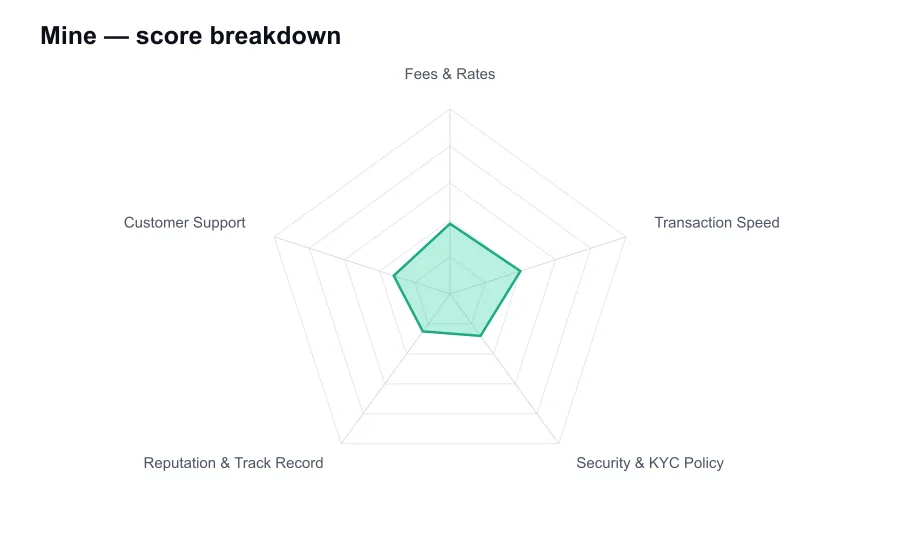
Mine scores 3.3/10 overall in our independent review, measured against every other provider we've compared, strongest on Transaction Speed (4.0/10) and weakest on Reputation & Track Record (2.5/10).
Score: 3.3 How we score → Visit official siteEditorial independence: our scores and rankings are produced using the fixed criteria above and are not influenced by advertisers. This is an independent ranking site and is not operated by, or affiliated with, any provider we list.
Affiliate disclosure: some links on this page may earn us a commission at no extra cost to you. This does not affect our rankings.
| Criterion | Score | Note |
|---|---|---|
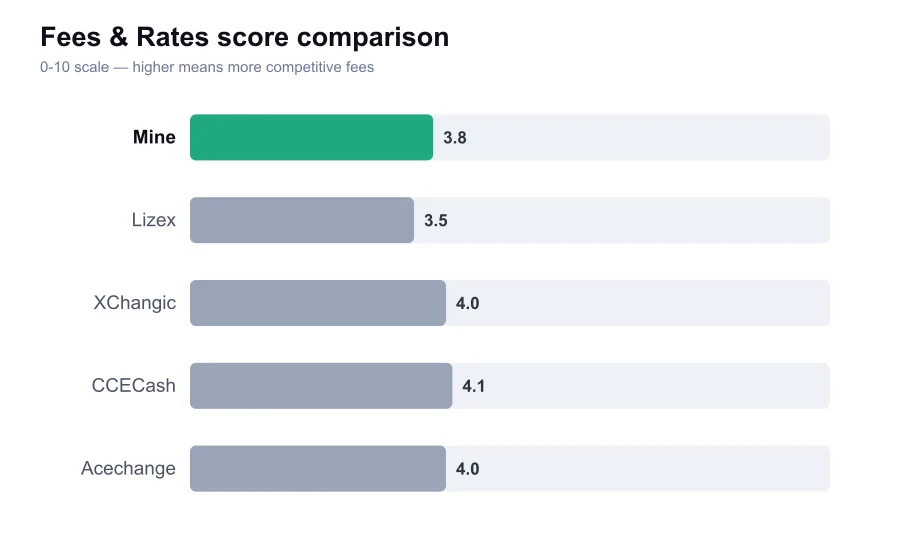
| Fees & Rates | 3.8 | All-in pricing is not sufficiently verifiable. |
| Transaction Speed | 4.0 | No strong public evidence of consistent processing performance. |
| Security & KYC Policy | 2.8 | Identity and security disclosures need far more clarity. |
| Reputation & Track Record | 2.5 | Generic branding and a thin verifiable public record. |
| Customer Support | 3.2 | Support quality should be tested before any deposit. |
| Pros | Cons |
|---|---|
| Potentially simple conversion concept | — |
| Could suit a very small test transaction | — |
| May offer less account friction than large exchanges | — |
| — | Weakly documented fee structure |
| — | Little public evidence on security operations |
| — | Not appropriate for urgent or high-value transfers |
Mine is an unusually difficult provider to assess because the name is generic, the market contains multiple unrelated crypto products using similar language, and a clear public identity is not easy to establish from the name alone. That is not a cosmetic problem. In financial services, knowing exactly who is taking your funds is the starting point of a review, not an optional detail buried in a footer. A provider called Mine needs to make its legal and operational identity unmistakable.
For that reason, I would not treat Mine as interchangeable with any similarly named exchange, mining company, wallet, token, or app. Crypto users are routinely targeted by cloned domains and lookalike brands. If a link to Mine arrived through Telegram, a direct message, a paid advert, or an unsolicited investment offer, stop there. Verify the domain independently, inspect the terms, and do not rely on a logo or a screenshot as proof that you have reached the genuine service.
Assuming Mine offers conversion or exchange functionality, the basic promise is familiar: a simpler route than opening an account at a major centralized exchange. That can be useful for a narrow job. But simplicity is only an advantage when the operator is identifiable and the process is documented. With a service whose public profile is hard to separate from other entities, the burden of verification is higher than normal.
Pricing is impossible to rate generously without a stable, published fee policy. A credible exchange should state whether it charges a trading commission, includes a spread in the rate, levies a withdrawal fee, passes through miner fees, or applies different terms to fixed and floating quotes. Mine does not have the kind of widely cited, independently reviewed pricing record that lets a customer predict the all-in cost with confidence. That uncertainty is especially dangerous during volatile markets, where a hidden spread can exceed the fee a user thought they were avoiding.
The right way to examine a quote is brutally practical. Calculate how much of the destination asset you will receive, then compare it to the result from a major exchange or a well-known swap service at the same moment. Do not compare only the displayed percentage or headline rate. A provider can advertise no fee while earning from a wider conversion spread. If Mine cannot make the final amount and any network deduction clear before you send funds, that is a reason to walk away.
Speed carries similar uncertainty. Crypto exchange transactions have several stages: your deposit must be broadcast and confirmed, the provider has to identify and process it, liquidity must be sourced, and the payout must be sent and confirmed. Any provider claiming universally instant settlement is overselling the reality. Mine might process routine major-asset swaps quickly, but there is not enough independently documented operational history to assume consistent performance under congestion or high demand.
The danger with an opaque service is not merely a slow transaction. It is the lack of a clear escalation path when a transaction is slow. A customer needs a trackable order reference, a visible deposit address, a payout transaction hash, and human support that can explain where the funds are. If those basics are absent, users have very little leverage once they have sent an irreversible payment. That is why I would never use Mine as the first step in a chain of time-sensitive transfers.
Security disclosure is where Mine falls furthest behind recognized exchanges. There is no broadly verifiable body of public information that establishes custody controls, corporate governance, licensing, security audits, incident reporting, reserve practices, or a mature bug-bounty program. Small firms may not publish all of these things, but a responsible operator should at least give customers enough information to understand who is accountable and how funds are handled.
KYC should also be approached without assumptions. The absence of an upfront account screen does not mean the absence of compliance checks. Many exchange services can pause a transaction and request identity documents, proof of address, source-of-funds evidence, or an explanation of wallet activity. If Mine has such a policy, customers need to see it clearly before they pay. A surprise verification request after funds have been sent is one of the most frustrating outcomes in this corner of the market.
Mine's reputation score is deliberately low, not because there is proof of misconduct in the information available to me, but because reputation requires positive evidence. Long-lived brands accumulate years of independent coverage, customer reports, incident records, legal disclosures, and public responses when something goes wrong. A sparse or ambiguous footprint provides none of that reassurance. In crypto, lack of evidence is not a neutral substitute for a track record.
Customer support could make a meaningful difference, but it is impossible to award credit based on promises alone. Before funding an order, try the support channel with a concrete question about fee calculation, supported networks, refunds, and compliance holds. Judge the reply by whether it is specific and accountable. A generic answer copied from a help page is not useful if your transaction later becomes stuck between chains.
This is also a service where the normal safety rules should be tightened. Use a fresh browser session, confirm the domain character by character, avoid links supplied by strangers, and never send a larger amount merely because a platform advertises a better rate for higher volume. Do not install remote-access software, share seed phrases, or pay a second transfer to release a supposedly frozen transaction. Those are classic danger signals regardless of the provider's name.
Mine might eventually prove to be a workable niche service, but its present review position is limited by identity and transparency rather than by a single bad feature. A good exchange earns trust through verifiable details, not through a minimal interface and broad claims. Until those details are easy to confirm, Mine belongs in the category of providers to investigate carefully rather than recommend casually.
My take is straightforward: this is not a service I would choose for a first crypto purchase, a substantial swap, or money tied to a deadline. There are too many established alternatives with clear legal entities, public fee documentation, recognizable support structures, and years of externally visible history. Mine may be suitable for a tiny test only after its exact official presence has been independently confirmed. For anything beyond that, the uncertainty is the product's biggest cost.
How can I verify that I found the real Mine service?
Do not trust a search advert or a social-media link alone. Confirm the legal entity, official domain, terms, and support contacts through independent sources before sending funds.
Should I use Mine for a first crypto purchase?
No. A first purchase is better made through an established provider with clear identity checks, transparent pricing, and accessible customer support.
Can a no-account exchange still request KYC?
Yes. Many services reserve the right to request identity or source-of-funds documents after a transaction has been flagged for review.
Editorial independence: our scores and rankings are produced using the fixed criteria above and are not influenced by advertisers. This is an independent ranking site and is not operated by, or affiliated with, any provider we list.
Affiliate disclosure: some links on this page may earn us a commission at no extra cost to you. This does not affect our rankings.