Moneta365
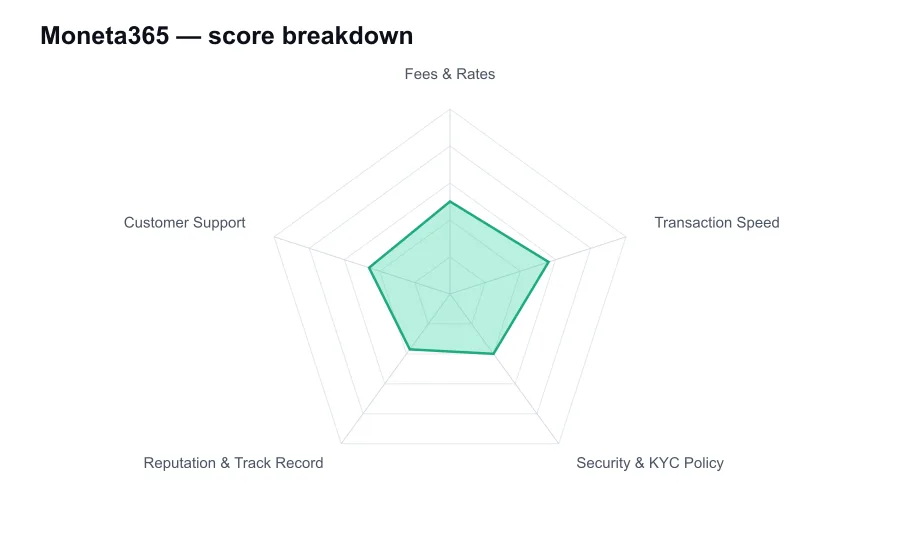
Moneta365 scores 4.6/10 overall in our independent review, measured against every other provider we've compared, strongest on Transaction Speed (5.6/10) and weakest on Reputation & Track Record (3.7/10).
Score: 4.6 How we score → Visit official siteEditorial independence: our scores and rankings are produced using the fixed criteria above and are not influenced by advertisers. This is an independent ranking site and is not operated by, or affiliated with, any provider we list.
Affiliate disclosure: some links on this page may earn us a commission at no extra cost to you. This does not affect our rankings.
| Criterion | Score | Note |
|---|---|---|
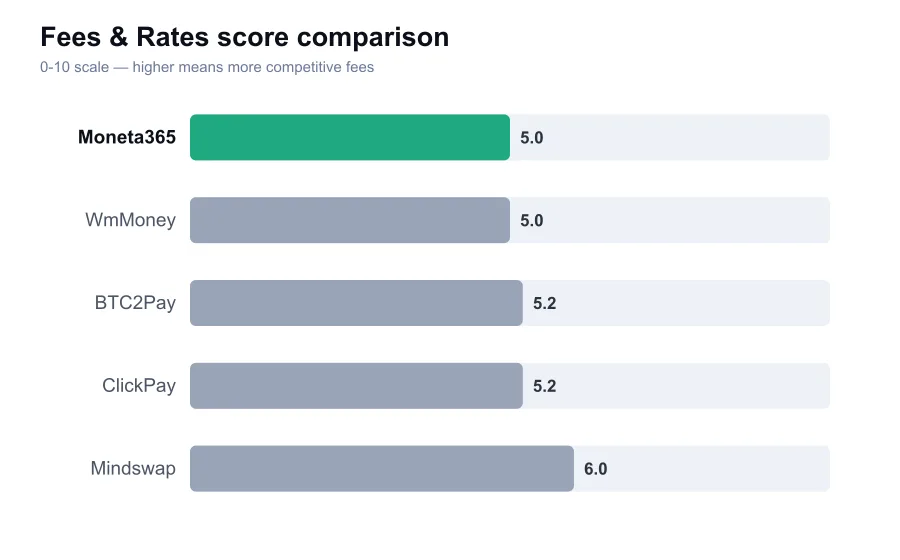
| Fees & Rates | 5.0 | Quote-led pricing can be practical but needs close comparison. |
| Transaction Speed | 5.6 | The swap model can be quick, subject to network conditions. |
| Security & KYC Policy | 4.0 | Public security and custody detail remains limited. |
| Reputation & Track Record | 3.7 | Insufficient independently visible long-term track record. |
| Customer Support | 4.6 | Round-the-clock claims should be tested with a real query. |
| Pros | Cons |
|---|---|
| Potentially convenient outside banking hours | — |
| Direct wallet-delivery model | — |
| Suitable for small common-asset swaps | — |
| Quote comparison is straightforward | — |
Moneta365 is positioned, at least by its name and apparent service model, as an always-available money and crypto conversion option. The promise behind a 365-style brand is obvious: access whenever markets are moving and banks are closed. That is a useful promise in crypto, where prices and blockchain networks do not stop for weekends. It is also a promise that needs evidence, because round-the-clock availability means little if customer help and transaction monitoring are not genuinely staffed around the clock.
Compared with mainstream exchanges, Moneta365 appears to sit closer to the instant-conversion side of the market than the full brokerage side. Users in that segment usually care about convenience, direct wallet delivery, and fewer account steps. They are not necessarily looking for maker-taker fees, order book depth, tax reporting tools, or institutional controls. That niche can work well, but it exposes users to a different set of risks, particularly opaque pricing and uncertainty when a transaction does not complete normally.
The first issue I would raise with Moneta365 is public verifiability. A provider handling crypto conversions should make its operating entity, terms, privacy policy, complaint route, and transaction rules easy to locate. I could not establish a substantial, independently documented record comparable with longer-running exchanges. That means Moneta365 should not be judged by how polished a checkout page looks. It should be judged cautiously, with a test transaction and a close reading of the terms.
Fees are likely to be quote-led rather than displayed as a simple trading commission. This is common in instant exchange services. The customer sees how much cryptocurrency they are sending and how much they are expected to receive, while the platform's revenue may be reflected in the conversion rate. There is nothing inherently wrong with that model. The problem begins if the provider does not clearly distinguish a fixed rate from a floating rate, or if network charges and minimums are difficult to identify before payment.
Moneta365 should be compared on the only number that finally matters: the amount that reaches your wallet. Take a live quote, check the source market price, compare it with a reputable centralized exchange and a recognized swap platform, then decide whether the convenience premium is fair. For a small transaction, paying a modest premium can be rational. For a larger transaction, even a few percentage points of spread can be expensive enough to outweigh the benefit of avoiding an account.
Its speed score is somewhat better than its reputation score because the underlying instant-swap model can be efficient for common assets if the route is functioning properly. A standard transaction still requires confirmations and a payout transaction, though. Bitcoin can take longer than users expect. Ethereum and token transfers can be affected by gas conditions. Lesser-known assets can introduce liquidity delays. Do not interpret a service that operates every day as a guarantee that every route settles in minutes.
A fixed-rate option, if offered on a particular pair, can be useful for people who need certainty about the expected payout. But a fixed rate is not automatically the cheaper rate. Providers normally build extra protection into fixed quotes because they bear the market risk during confirmation. A floating quote can produce a better result in calm markets, but it can produce a worse one when prices move sharply. Moneta365 should make this choice understandable before a user commits funds.
Security is where a smaller service must be especially disciplined. Users need to know whether funds are held only long enough to process an order, how suspicious transactions are handled, how the provider protects its systems, and where responsibility lies if a payout fails. I could not verify enough public security reporting or corporate detail to score Moneta365 strongly. That does not mean the service lacks controls. It means users are being asked to trust controls they cannot readily evaluate.
The KYC question deserves plain language. Many crypto conversion services allow a customer to initiate an order without a traditional account, but reserve the right to seek identification once a transaction triggers compliance screening. That can leave users caught off guard, particularly if their money is needed for an immediate onward payment. Before using Moneta365, read the current compliance terms and ask support what happens to funds during a verification review. If the answer is vague, do not send an amount you cannot leave idle.
Moneta365's reputation is limited less by a known public failure than by the absence of the extensive independent history that serious users should expect. A provider earns a strong reputation by surviving market stress, dealing publicly with support issues, maintaining stable terms, and making it possible to identify the responsible business. The available signal here is thin. That is enough to keep the score below average, even if individual transactions may proceed normally.
Support has particular importance for a service built around continuous access. A 24-hour operation should provide more than an email address that answers eventually. Customers need a transaction-status route, clear instructions for wrong memos and missing deposits, and an escalation path for compliance-related holds. I would test Moneta365's support before funding an order, ideally at an inconvenient hour, with a precise question that cannot be answered by a generic FAQ.
For a small personal conversion, Moneta365 may be more appealing than a large exchange to users who value direct wallet delivery and do not want an extended onboarding process. It is not a substitute for a regulated exchange account if you trade regularly, need transaction reporting, or want a company whose legal and support framework is easy to scrutinize. Nor would I use it to move business capital or settle a time-critical invoice.
The sensible first transaction is a common, low-value pair on a clearly supported network. Avoid token variants with similar names, avoid any destination requiring a memo unless you fully understand the process, and save the order details. If anything looks wrong, do not send a second payment to fix it without independent confirmation. A legitimate support agent will never need your wallet seed phrase, private key, or remote control of your device.
Moneta365 has a potentially useful premise, especially for someone who wants a simple direct conversion outside traditional banking hours. Still, the service has not shown enough independently verifiable depth to deserve blind trust. Price each transaction against alternatives, expect variable settlement times, and assume a compliance check is possible. My recommendation is cautious use for small, non-urgent transfers only, not a broad endorsement for serious trading or large balances.
Does Moneta365 guarantee 24-hour settlement?
A service can accept orders at all hours without guaranteeing immediate settlement. Blockchain confirmations, liquidity, and compliance checks can still delay a payout.
Are fixed rates always better on Moneta365?
Not necessarily. Fixed quotes can offer certainty but may include a larger premium. Compare the final amount with a floating quote and other providers.
Can Moneta365 ask for identification after I pay?
Many instant exchange services can request documents after transaction screening. Review the current policy before sending funds, especially if timing matters.
Editorial independence: our scores and rankings are produced using the fixed criteria above and are not influenced by advertisers. This is an independent ranking site and is not operated by, or affiliated with, any provider we list.
Affiliate disclosure: some links on this page may earn us a commission at no extra cost to you. This does not affect our rankings.