Mindswap
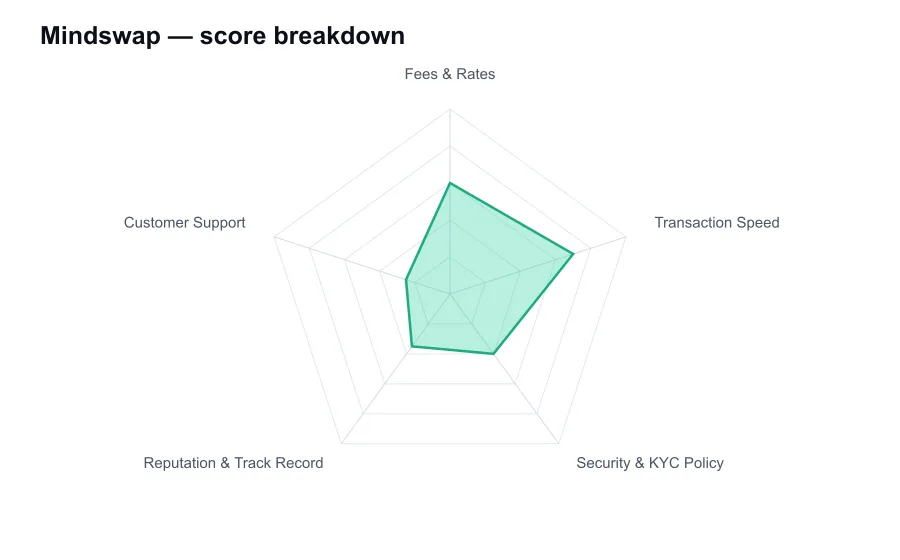
Mindswap scores 4.9/10 overall in our independent review, measured against every other provider we've compared, strongest on Transaction Speed (7.0/10) and weakest on Customer Support (2.5/10).
Score: 4.9 How we score → Status: active (checked 2026-10-13T19:18:35.516Z) Visit official siteEditorial independence: our scores and rankings are produced using the fixed criteria above and are not influenced by advertisers. This is an independent ranking site and is not operated by, or affiliated with, any provider we list.
Affiliate disclosure: some links on this page may earn us a commission at no extra cost to you. This does not affect our rankings.
| Criterion | Score | Note |
|---|---|---|
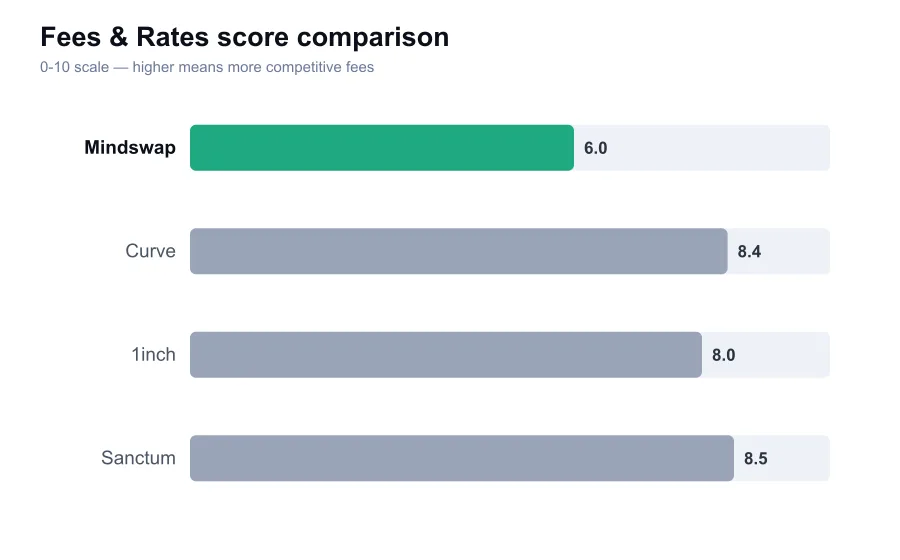
| Fees & Rates | 6.0 | Low Polygon network costs, but thin pools can create heavy slippage |
| Transaction Speed | 7.0 | Polygon swaps usually confirm quickly |
| Security & KYC Policy | 4.0 | Self-custody, but smart-contract and maintenance risk remain |
| Reputation & Track Record | 3.5 | Known from Polygon's 2021 DeFi cycle, with limited current presence |
| Customer Support | 2.5 | Community-style help, not a staffed exchange desk |
| Fact | Value |
|---|---|
| Primary network | Polygon |
| Custody model | Self-custody via wallet |
| Account requirement | No conventional account |
| Platform token | MIND |
| Core functions | Swaps, pools, and farming |
| Pros | Cons |
|---|---|
| Non-custodial wallet-based swaps | — |
| Low-cost Polygon transactions | — |
| No account registration for on-chain use | — |
| Liquidity pools and farming mechanics | — |
What is Mindswap?
How Mindswap Works
- Connect a Polygon-compatible self-custody wallet
- Choose the token pair and enter an amount
- Review price impact, minimum received, and token approvals
- Sign the approval if needed, then sign the swap
- Wait for Polygon confirmation and check the wallet balance
KYC
| Requirement | none |
|---|---|
| Notes | A typical DEX interaction is wallet-based and does not require identity documents. Third-party wallets, bridges, or fiat services may have their own rules. |
Supported Assets
| Notable Coins | MIND, USDC, WMATIC, WETH |
|---|---|
| Networks | Polygon |
How to Use Mindswap Safely
- Use a separate wallet with a limited balance
- Verify the domain and contract addresses independently
- Start with a small test swap
- Check price impact before signing
- Approve only the token amount you need
- Revoke unused token allowances
Mindswap was a Polygon-focused decentralized finance project built around token swaps, liquidity pools, farming, and its MIND token. It arrived during the 2021 Polygon DeFi rush, when cheap transactions made smaller automated market makers look genuinely competitive against Ethereum mainnet venues. Its pitch made sense at the time. Users could trade directly from a wallet, avoid account registration, and chase higher yields than traditional exchanges offered. The problem is that Mindswap never established the depth, development momentum, or durable user base needed to survive that period's shakeout.
The first thing prospective users should understand is that Mindswap is not a conventional exchange with a help desk, custody operation, bank rails, and a compliance department. It is a set of smart contracts and a web interface. A wallet connects to the application, tokens are approved, and swaps settle on Polygon. That removes a major point of failure associated with a centralized platform. It also means there is nobody who can reverse a bad transaction, recover funds sent to an incorrect address, or freeze an account after a phishing incident.
Fees were once one of Mindswap's better arguments. Polygon transaction costs are normally a fraction of a cent or a few cents, rather than the painful gas bills Ethereum users faced in 2021. A trader making modest swaps could therefore move funds and test pools without spending a large percentage of the position on network fees. That advantage belongs to Polygon, however, rather than Mindswap alone. QuickSwap, Uniswap on Polygon, and later aggregators gave users the same low-cost chain with much deeper liquidity.
The meaningful cost on a small automated market maker is rarely the visible swap fee. It is price impact. A quoted trade can look cheap, then execute materially worse because the pool is thin. Mindswap's smaller and less actively maintained pools make that risk much more serious than it is on the largest Polygon venues. A trader swapping a small amount of USDC for a major asset may get through fine. Someone trying to move a sizeable position, or trade a long-tail token, should assume that the effective cost could be high.
There is also the familiar liquidity-provider tradeoff. Pool providers earn a share of trading fees and, historically, could receive MIND-denominated incentives. But volatile paired assets can leave the provider with more of the falling token and less of the rising one. That is impermanent loss, and token rewards do not magically erase it. On a project with uncertain activity, the reward token itself can become the largest risk in the equation. I would not treat a headline annual percentage yield as income. It is a volatile incentive estimate, not a promise.
Speed is technically strong in the narrow sense. Polygon confirmations are generally quick, and a normal swap can settle in seconds to a few minutes depending on wallet settings, congestion, and the RPC connection. There is no deposit desk waiting for manual review and no centralized withdrawal queue. That is useful for users who already hold assets on Polygon. Yet a fast chain does not rescue a slow trade. If liquidity is weak, execution quality matters far more than the time shown by the transaction explorer.
Mindswap's no-KYC nature will appeal to users who value self-custody and do not want to hand identity documents to an exchange for a basic on-chain trade. The wallet is the account. That privacy comes with a blunt reality: compliance screening is not a customer-service workflow here, and user protections are limited to what the contracts and wallet security provide. Anyone needing fiat deposits, tax documents, account recovery, or formal transaction records should use a regulated centralized venue instead.
Security needs to be judged with more caution than a simple wallet-connect screen suggests. Smart contract risk, malicious token approvals, fake front ends, compromised social accounts, and phishing are all relevant. A well-known protocol with repeated audits, active developers, public governance, and a large community can at least give users more material to assess. Mindswap's much thinner public footprint makes that due diligence harder. I would use a separate wallet with a limited balance, verify the contract addresses independently, and revoke old approvals after testing.
The project's reputation is its weakest area. Mindswap had visibility during Polygon's DeFi expansion, but it did not become a top-tier destination in the way QuickSwap did. Its branding and token remain recognizable to some early Polygon users, yet recognition is not the same thing as current reliability. Sparse recent visibility is a practical warning sign for a DeFi application. Even if contracts remain accessible, users need confidence that the interface, documentation, routing, and community channels are being watched by people who can respond when something breaks.
That distinction matters in a market where abandoned applications can remain online for years. A live page is not proof of active operations. Before approving a token, I would check recent official communications, the state of liquidity pools, current contract ownership, and whether the domain shown by search results matches links from established project channels. If those checks produce uncertainty, the right response is not to take a larger risk. It is to walk away. There are too many mature alternatives to accept ambiguity for a routine swap.
Support is essentially community-level support rather than exchange support. There is no reason to expect a staffed 24-hour ticket team capable of handling transaction disputes. In DeFi, the transaction is final once signed, and support can at most explain what happened. That is normal for a decentralized protocol, but it is a poor fit for newcomers who expect someone to fix an accidental transfer. Mindswap's limited current profile makes this more concerning than it would be at a large, actively maintained protocol.
The MIND token adds another layer of risk. Platform tokens can create incentives for liquidity and governance participation, but they can also tie a user's returns to the fortunes of one small project. Treating MIND as a speculative asset is more honest than treating it as a stable yield enhancement. Its liquidity, exchange availability, and market interest can change sharply. A user who earns MIND through farming may discover that converting it back into a major asset is harder or more expensive than the dashboard implied.
For a researcher studying Polygon's early DeFi cycle, Mindswap is historically interesting. For somebody seeking a primary place to exchange assets in 2026, it is difficult to recommend. QuickSwap and Uniswap offer stronger liquidity and more visible maintenance, while large centralized exchanges are better for fiat access and customer support. Mindswap's structure still gives it the old DeFi virtues of self-custody and fast on-chain settlement, but those virtues are no longer rare.
My view is straightforward. Mindswap may be usable by technically capable users who independently verify every contract and are deliberately interacting with its specific pools or token. It is not a sensible default exchange, and it is especially unsuitable for a first crypto transaction or a meaningful portfolio allocation. Low Polygon fees do not compensate for uncertain activity, thin liquidity, and limited recourse. Treat it as a high-caution legacy DeFi protocol, not as a modern retail exchange.
Does Mindswap require KYC?
No identity check is normally built into a wallet-connected DEX flow. Your wallet authorizes the transaction, so there is no conventional exchange account to verify.
Which network does Mindswap use?
Mindswap is associated with Polygon. Users need Polygon-compatible assets and a wallet configured for the Polygon network to interact with its contracts.
Why can a Mindswap trade cost more than expected?
The main issue can be price impact rather than gas. Thin automated-market-maker pools move sharply when a trade represents a meaningful share of available liquidity.
Can Mindswap reverse a mistaken swap?
No. A signed on-chain swap is generally final after confirmation. There is no centralized support desk with the power to cancel or reverse it.
Is farming MIND the same as earning stable income?
No. Farming rewards can be paid in a volatile token, and liquidity providers can suffer impermanent loss. Yield figures are not guaranteed returns.
Should I approve unlimited token spending?
It is safer to approve only the amount needed, especially on lightly maintained DeFi applications. Revoke unused approvals through a reputable Polygon allowance tool.
Editorial independence: our scores and rankings are produced using the fixed criteria above and are not influenced by advertisers. This is an independent ranking site and is not operated by, or affiliated with, any provider we list.
Affiliate disclosure: some links on this page may earn us a commission at no extra cost to you. This does not affect our rankings.