Goexme
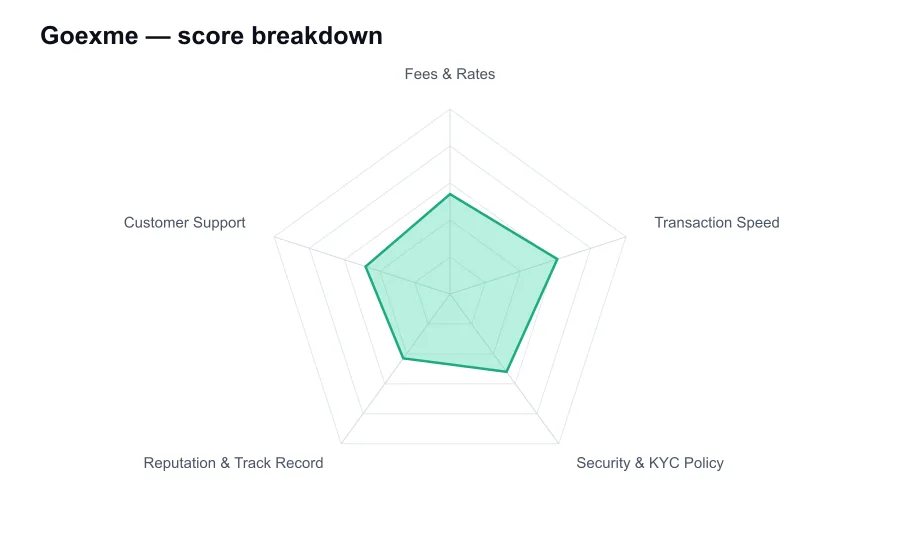
Goexme scores 5.2/10 overall in our independent review, measured against every other provider we've compared, strongest on Transaction Speed (6.1/10) and weakest on Reputation & Track Record (4.3/10).
Score: 5.2 How we score → Visit official siteEditorial independence: our scores and rankings are produced using the fixed criteria above and are not influenced by advertisers. This is an independent ranking site and is not operated by, or affiliated with, any provider we list.
Affiliate disclosure: some links on this page may earn us a commission at no extra cost to you. This does not affect our rankings.
| Criterion | Score | Note |
|---|---|---|
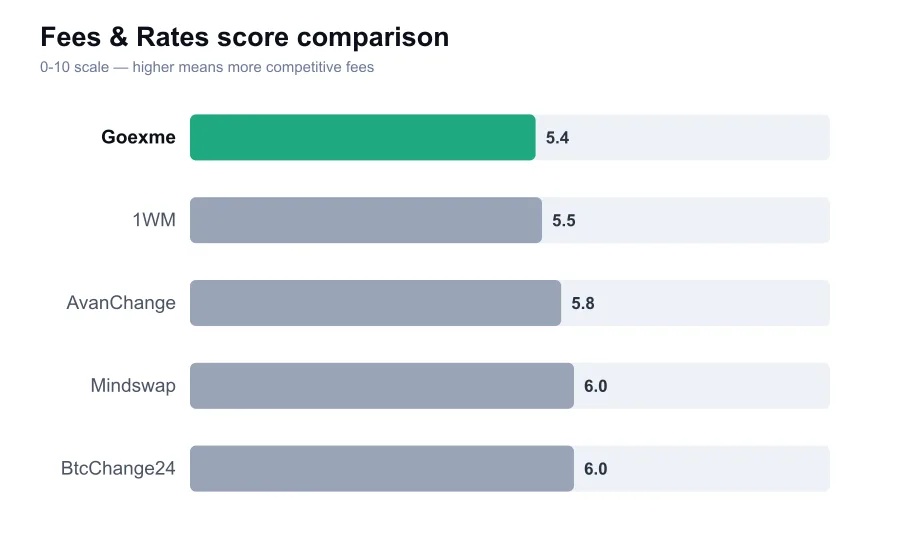
| Fees & Rates | 5.4 | Quoted pricing needs close comparison due to limited transparency. |
| Transaction Speed | 6.1 | Network timing dominates, with less evidence on edge cases. |
| Security & KYC Policy | 5.2 | Non-custodial concept, but limited public security detail. |
| Reputation & Track Record | 4.3 | Much smaller independently visible track record. |
| Customer Support | 4.8 | Support capacity is harder to assess than larger rivals. |
| Pros | Cons |
|---|---|
| Simple wallet-to-wallet exchange concept | — |
| Potentially useful for small one-off swaps | — |
| Avoids maintaining a conventional trading balance | — |
| — | Pricing transparency is difficult to verify |
| — | Support and recovery capability are less proven |
| — | Not appropriate for large or urgent transfers |
Goexme is a much less familiar name in the instant cryptocurrency exchange market than StealthEX, ChangeNOW, or Quickex. It presents the basic proposition users expect from this category: exchange one cryptocurrency for another without operating a full trading account or handing over custody for an extended period. That can be useful in theory. In practice, a smaller provider deserves a more demanding standard of research because the public evidence around its operations, pricing, and dispute handling is thinner.
The interface is aimed at simplicity. Users choose a sending asset, select a receiving asset, enter a destination address, and fund an order. That model is easy to understand, and it is often preferable to navigating a full exchange for a one-time conversion. A clean workflow, however, should not be mistaken for a complete due-diligence package. The hard questions begin after the deposit is sent: who supplies liquidity, what happens in a compliance hold, and how reliably can a customer obtain help?
Goexme's biggest challenge is not necessarily that the service is unusable. It is that its public footprint is comparatively limited. There are fewer detailed independent transaction reports, fewer widely recognized industry references, and less of the long-running public conversation that helps a reviewer distinguish a temporary glitch from a recurring operational problem. A new or small provider can be perfectly legitimate, but users should not assign it the same default trust they would give an exchange with a decade of documented history.
Pricing should be treated as a quote-comparison exercise, not as a claim to accept on faith. Instant exchanges usually make their margin visible through the amount received rather than through a conventional trading fee schedule. The displayed result may include an exchange spread, network fees, liquidity-routing costs, and a volatility allowance. If Goexme offers an attractive figure on a liquid pair, that is useful. It does not prove that the same service will be competitive on a low-volume token or during a volatile market.
For a small conversion, the difference between providers might be tolerable. For a larger order, a two-minute comparison can save meaningful money. Check Goexme against StealthEX, Quickex, ChangeNOW, and a centralized exchange if you already have access to one. Do not compare a floating quote against a fixed quote without understanding the distinction. A fixed payout provides certainty but may cost more, while a floating order may settle above or below the estimate after the deposit arrives.
The site category promises quick swaps, but speed always starts with the deposit network. A transfer on a fast, low-cost chain may be recognized rapidly. Bitcoin confirmations, Ethereum congestion, wallet fee settings, and liquidity availability can add substantial time. With a smaller provider, I would be particularly cautious about assuming that a delayed order has the same escalation capacity as it would at a better-known competitor. The normal case may be fast. The exception case is what determines whether a provider deserves confidence.
Users should also be alert to minimum and maximum order conditions. An instant exchange can have different limits for each route, and those limits may change with liquidity. Sending less than the required amount can create a support issue, while sending more than a displayed maximum may put an order into manual handling. These restrictions are not unusual, but smaller services tend to explain them less comprehensively. Read the order screen closely and make a small test transfer before a meaningful transaction.
A non-custodial label offers some protection, but it has boundaries. If Goexme does not maintain user balances in the way a conventional exchange does, users retain their own wallet control before and after the exchange. That is a favorable design choice. During the actual swap, though, funds pass through an operational process controlled by the provider and its counterparties. There is no sensible reason to describe that as risk-free, especially where public company information is limited.
KYC policy is another point where users should avoid assumptions. A service can allow a basic order without registration and still use transaction monitoring, sanctions screening, and anti-money-laundering checks. If a transaction is flagged, the provider may request identity documents or source-of-funds details. That can be inconvenient, but it is now normal across much of the instant-exchange sector. The risk is greater for a user who sends first and discovers later that they cannot or will not satisfy a review request.
The absence of a large, independently verifiable public reputation does not mean every Goexme order will fail. It does mean the burden shifts to the customer to reduce exposure. Search recent discussions, inspect the terms and refund policy, verify the exact destination domain yourself, and avoid relying on an ad or a lookalike link. Crypto users are routinely targeted by cloned swap pages. A small provider with limited brand recognition gives phishing attempts an easier environment to succeed.
Support is the area where Goexme has the most to prove. A smaller operation may answer a routine request quickly, but users have less reason to assume it has a deep support team, formal escalation process, or resources for complicated recoveries. If you use the service, record the order ID, deposit address, exact quote, timestamps, and blockchain transaction hash. Those details are essential if funds are delayed. Vague messages such as “my money is missing” make an already difficult support case harder.
I would not use Goexme for a large first transaction, a business payment, loan collateral, or a swap where the recipient needs funds at a particular time. Those use cases require proven operational resilience and clear accountability. The potential savings from a slightly better quote do not compensate for the trouble of a long delay or disputed order. Established exchanges can be cumbersome, but their extra controls and public support records are valuable when money is on the line.
That does not make Goexme pointless. It may appeal to users who want a simple conversion, are comfortable evaluating a quote, and are deliberately keeping the transaction small. A careful test order can reveal basic execution quality without exposing a serious amount of capital. If that goes well, it is still sensible to treat later transactions independently. Past completion does not guarantee that every asset route or market condition will behave the same way.
My view is more cautious than hostile. Goexme may work for limited, low-risk conversions, but it has not earned the confidence I would attach to a better-known provider with a larger body of public evidence. The interface and non-custodial concept are not enough on their own. Until its reputation, support visibility, and operational transparency are easier to assess, I would compare it aggressively and reserve it for small test swaps rather than meaningful holdings.
Should I use Goexme for a large crypto swap?
I would not use a large first transaction. Its limited public track record makes a small test order and a comparison with established providers the safer approach.
Can a Goexme swap require KYC?
Users should assume that compliance checks are possible. No routine registration does not guarantee that a transaction will never be reviewed or require documentation.
How can I reduce risk when using Goexme?
Verify the domain carefully, compare the final payout, confirm the network and address, send a small test amount, and save the order ID and transaction hash.
Editorial independence: our scores and rankings are produced using the fixed criteria above and are not influenced by advertisers. This is an independent ranking site and is not operated by, or affiliated with, any provider we list.
Affiliate disclosure: some links on this page may earn us a commission at no extra cost to you. This does not affect our rankings.