ClickPay
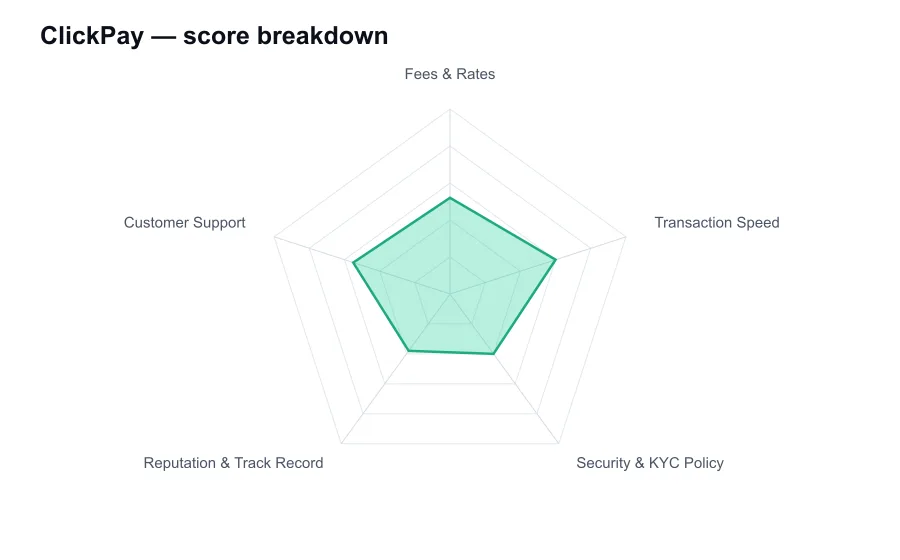
ClickPay scores 4.8/10 overall in our independent review, measured against every other provider we've compared, strongest on Transaction Speed (6.0/10) and weakest on Reputation & Track Record (3.8/10).
Score: 4.8 How we score → Status: active (checked 2026-10-13T19:47:00.442Z) Visit official siteEditorial independence: our scores and rankings are produced using the fixed criteria above and are not influenced by advertisers. This is an independent ranking site and is not operated by, or affiliated with, any provider we list.
Affiliate disclosure: some links on this page may earn us a commission at no extra cost to you. This does not affect our rankings.
| Criterion | Score | Note |
|---|---|---|
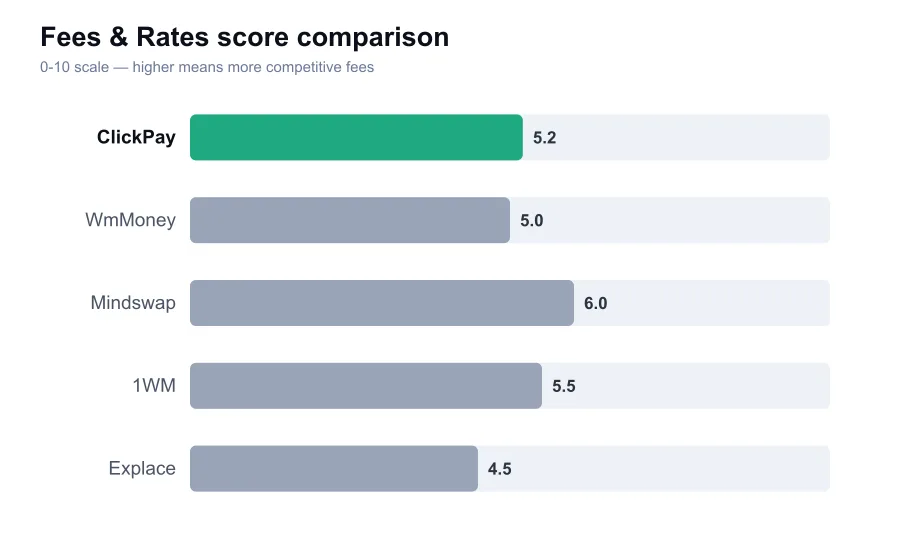
| Fees & Rates | 5.2 | Cost is embedded in quoted exchange rates |
| Transaction Speed | 6.0 | Straightforward orders can be processed quickly |
| Security & KYC Policy | 4.0 | Limited publicly verifiable security detail |
| Reputation & Track Record | 3.8 | Small public footprint versus major exchanges |
| Customer Support | 5.5 | Order-level support matters for manual exchanges |
| Fact | Value |
|---|---|
| Service model | Quoted-rate online exchanger |
| Pricing model | Rate spread included in order quote |
| Intended use | Transaction processing, not custody |
| Order type | Conversion order |
| Risk profile | Higher counterparty risk than major CEXs |
| Pros | Cons |
|---|---|
| Simple quote-and-order exchange flow | — |
| Useful for certain e-money conversion routes | — |
| Can suit small one-off exchanges | — |
| No complex trading terminal | — |
What is ClickPay?
How ClickPay Works
- Choose the source and destination payment methods
- Enter the amount and review the quoted payout
- Provide the destination wallet or payment details
- Create the order and follow the payment instructions
- Save the order number and payment proof
- Receive the payout after processing
KYC
| Requirement | tiered |
|---|---|
| Notes | A lightweight order flow does not guarantee anonymous processing. Payment checks, fraud flags, or source-of-funds concerns can trigger a request for identity or transaction information. |
How to Use ClickPay Safely
- Run a small test order before a large transfer
- Compare the final payout with multiple exchangers
- Verify the blockchain network before sending crypto
- Save the order number and transaction receipt
- Do not use an exchanger as long-term custody
ClickPay is a small online exchanger positioned around fast conversions between cryptocurrencies, electronic money systems, and local payment methods. It sits at the less formal end of the exchange market, closer to a manually operated currency-exchange desk than a full cryptocurrency exchange such as Kraken, Binance, or Coinbase. That distinction matters. You are not opening a trading account and placing market orders. You are asking an operator to complete a quoted conversion.
The attraction is simplicity. A visitor can generally select the sending and receiving directions, enter an amount, provide payout details, and create an order without learning a large trading interface. That can be useful for people moving money between an e-wallet, a bank card, and a crypto wallet. It is also exactly the sort of service where the quality of the operator matters more than polished branding.
ClickPay's pricing is difficult to assess with the confidence available for a major exchange. There is no widely published fee table comparable with the maker and taker schedules offered by centralized exchanges. The practical cost is built into the quoted rate. That is normal for this business model, but it means users should compare the final amount received, not just the source amount or a headline percentage.
For a small exchange order, the quoted spread can be acceptable if ClickPay has liquidity in the route you need. For larger transfers, the lack of transparent public pricing becomes a serious weakness. A 1 percent difference in a quote can matter far more than a small network fee. Anyone exchanging a meaningful amount should open quotes from ClickPay and at least two established alternatives before sending funds.
The service may look cheaper than a card-funded exchange because it does not necessarily show a separate service charge. That does not make it cheaper. A spread hidden inside the rate is still a cost. Experienced users know to calculate the effective rate by dividing the amount they will receive by the amount they send, then comparing that result with a market reference and the stated blockchain or payment-rail costs.
Speed depends heavily on the chosen direction. Crypto transfers can be processed quickly once the inbound transaction has the required network confirmations, while bank transfers, card payments, and electronic-money transfers may need a human review. A straightforward order can move quickly, but there is little reason to assume that every route is instant. The manual-exchanger model is fast only when payment details are clean and reserve is available.
ClickPay does not have the public infrastructure or independently documented operational record that gives a major exchange its credibility. That should affect the amount you are willing to leave exposed. A service can complete small orders competently and still be a poor place for a large first transaction. The sensible approach is to test the exact route with a modest amount, confirm the receiving method, then decide whether the service has earned a larger order.
Security information is another area where the public record appears thin. A customer should not confuse a website using HTTPS with proof of strong custody controls, reserve management, incident response procedures, or a formal compliance program. Those things are different. For an exchange service that receives funds first and pays out later, the key question is whether the operator can be trusted to complete the order under stress.
KYC can also become relevant even where an order flow appears lightweight. Payment providers, anti-fraud checks, and source-of-funds reviews can lead to a request for identification or transaction evidence. Users who need predictable compliance treatment should choose a regulated exchange with written verification tiers. ClickPay may suit a simple conversion, but it is not the service I would pick for a business payment that needs a clear audit trail.
Reputation is the decisive weakness. ClickPay is not a household name in crypto, and its public footprint is much harder to evaluate than providers with years of independent coverage, disclosed corporate ownership, regulatory registrations, and detailed incident reporting. That does not prove bad conduct. It does mean the burden of caution stays with the customer.
Customer support appears to be part of the core service rather than an optional extra. If an order is manually reviewed, support can often resolve a typo, clarify a reserve issue, or explain a pending payout. The problem is that private chat support is not the same thing as accountable dispute handling. A fast answer is useful, but it does not replace clear terms for delayed, rejected, or disputed orders.
I would pay close attention to the order instructions. Many exchanger disputes begin with a sender using the wrong network, sending an amount different from the invoice, adding an incorrect payment reference, or sending from a third-party account. Those errors can turn an otherwise simple conversion into a manual investigation. Screenshot the quote and order number before you transfer anything.
ClickPay may be reasonable for a small, time-sensitive exchange where its quote is clearly better than the alternatives and the payment route is familiar to you. It is not a convincing destination for long-term custody, repeat institutional use, or a first large transfer. The service asks users to trust an operator with limited publicly verifiable safeguards, and that should be reflected in the amount sent.
My view is blunt. ClickPay can fill a niche, but it has not earned the confidence premium that comes with a strong public reputation and transparent pricing. Use it as a transactional tool, not as a financial home. If the quote is not materially better than a larger exchange or a well-documented competitor, there is little reason to accept the extra uncertainty.
Does ClickPay publish a flat trading fee?
ClickPay appears to use quoted exchange rates rather than a widely published maker and taker fee schedule. Compare the final payout against at least two competing quotes before paying.
Is ClickPay a place to store cryptocurrency?
No. Treat it as a conversion service. Send funds for a specific order and move any crypto payout to a wallet you control once the exchange is complete.
Why can a ClickPay order take longer than expected?
Processing can depend on blockchain confirmations, payment-provider checks, reserve availability, and manual review of payout details.
Should I test ClickPay before sending a large amount?
Yes. A small test order verifies the exact payout route, support response, network selection, and actual effective rate before you expose a larger sum.
What details should I save before paying?
Keep the order number, quoted payout, receiving address or account details, payment receipt, and transaction hash. These are the records support will need if an order is delayed.
Can the quoted rate differ from the market price?
Yes. The quote can include the operator's spread, liquidity cost, payment-rail risk, and network expenses. The market price alone is not the final cost.
Editorial independence: our scores and rankings are produced using the fixed criteria above and are not influenced by advertisers. This is an independent ranking site and is not operated by, or affiliated with, any provider we list.
Affiliate disclosure: some links on this page may earn us a commission at no extra cost to you. This does not affect our rankings.