AvanChange
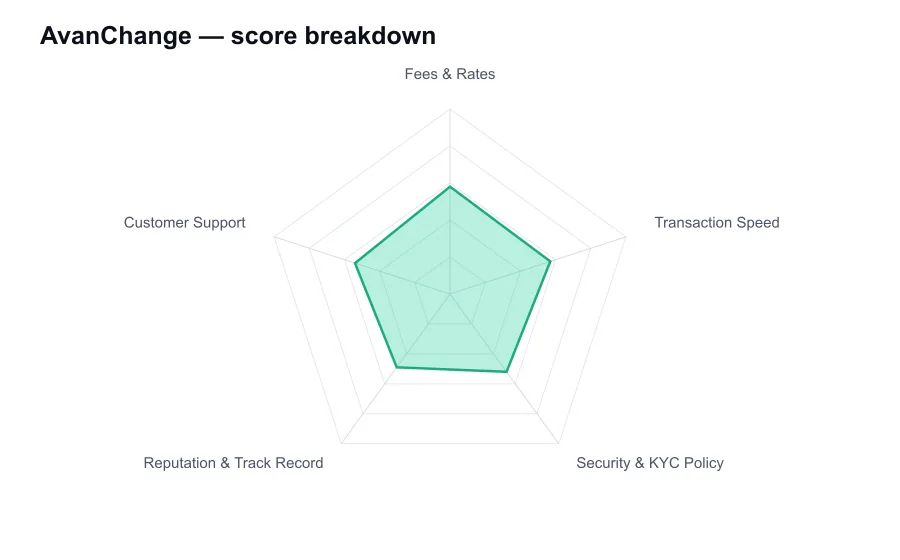
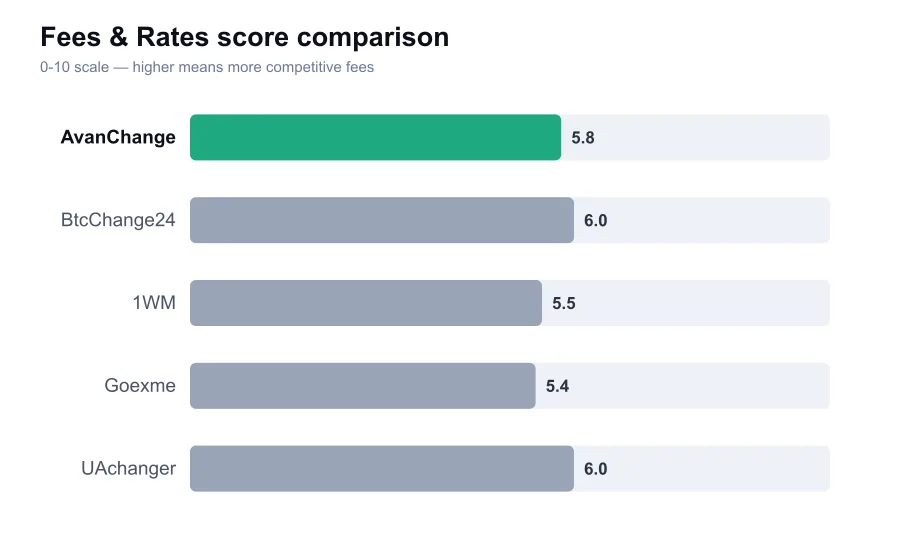
AvanChange scores 5.4/10 overall in our independent review, measured against every other provider we've compared, strongest on Fees & Rates (5.8/10) and weakest on Reputation & Track Record (4.9/10).
Score: 5.4 How we score → Visit official siteEditorial independence: our scores and rankings are produced using the fixed criteria above and are not influenced by advertisers. This is an independent ranking site and is not operated by, or affiliated with, any provider we list.
Affiliate disclosure: some links on this page may earn us a commission at no extra cost to you. This does not affect our rankings.
| Criterion | Score | Note |
|---|---|---|
| Fees & Rates | 5.8 | Judge it by final payout, as route-level costs can vary. |
| Transaction Speed | 5.7 | Settlement depends on confirmations, reserve, and manual review. |
| Security & KYC Policy | 5.2 | Counterparty and verification policies need close scrutiny. |
| Reputation & Track Record | 4.9 | Smaller public footprint than established exchange brands. |
| Customer Support | 5.4 | Support quality is crucial, but public evidence is limited. |
| Pros | Cons |
|---|---|
| Route-specific crypto and payment conversions | — |
| Potentially useful for small one-off exchanges | — |
| Simple transaction-oriented model | — |
| Can be compared through final payout quotes | — |
AvanChange appears to operate in the same broad category as online currency and crypto exchangers rather than competing directly with Coinbase, Kraken, or Binance as a full-scale trading exchange. That is an important starting point for any review. The product is a transaction service: choose a route, send one asset or payment method, and receive another. It can be useful, but it should not be judged as if it offers the liquidity, disclosures, or protections of a large regulated marketplace.
The first thing I would examine before using AvanChange is the exact route. A service may be excellent at a particular cryptocurrency-to-bank transfer direction and mediocre on another. Reserve size, payment limits, manual workload, and network availability can differ dramatically across the same website. A user who sees one favorable USDT quote should not extrapolate that experience to Bitcoin, cash, card, or electronic-money directions without checking the individual order terms.
AvanChange's pricing should be assessed through net payout, not a claimed percentage. Many exchangers combine the operator's margin, an external payment charge, and a network withdrawal cost into the quote. That is not automatically deceptive, but it does make side-by-side comparison essential. A rate that appears best on a monitoring table can become less attractive after a small reserve, payment-method commission, or unfavorable minimum is applied. The amount shown as receivable before payment is the only useful benchmark.
There is also a difference between a fixed quote and an indication. If AvanChange creates an order with a limited payment window, customers need to understand what happens if the transfer arrives late or with the wrong amount. Crypto markets can move quickly, and a normal policy may allow a rate recalculation. A fair provider spells that out and provides an intelligible choice between completion at the current rate and refund where possible. A vague rule gives the operator too much discretion.
Speed will depend on whether the transaction is automated. For a straightforward on-chain conversion with sufficient reserve, the operator may process an order quickly after receiving confirmations. For a bank payment or cash-related route, speed is more likely to depend on working hours and a human checker. Users should not view a status such as "received" as proof that the payout has been sent. Wait for the outgoing transaction hash or payment confirmation, then independently verify it.
A sensible expectation for crypto transfers includes the time required for the deposit chain to confirm. Bitcoin may take substantially longer than a stablecoin on a fast, inexpensive network. Even then, the network itself is only one part of the process. The exchanger has to approve the order and release funds. If AvanChange does not state typical processing windows clearly on an order, that is a weakness. Financial services should set expectations before money moves, not after a customer asks.
On security, AvanChange should be approached as a counterparty handling an in-flight transfer. Even where there is no user account, no long-term custody is not the same as no custody. The operator temporarily controls the incoming funds and controls the outgoing payment. Users should confirm the domain through an independent listing, use a unique contact route, and never follow payment details pasted into unsolicited messages. Support impersonation is common in this niche.
The KYC position deserves particular care. Some exchanger users assume local or no-registration services are anonymous by design. That is a dangerous assumption. Fraud controls, payment-provider rules, and anti-money-laundering policies may lead to document requests or transaction reviews. If AvanChange can request identification, it should identify the grounds, the data requested, retention terms, and refund procedure. If those terms are incomplete or difficult to find, customers should reduce the amount they are willing to risk.
I would not send privacy-sensitive personal documents to an exchanger casually. First establish that the site is genuine, read the privacy policy, and ask support through official channels if a transaction is likely to require verification. A reputable service should not ask for unrelated credentials, seed phrases, exchange login information, remote-access software, or a payment to unlock a withdrawal. Those requests are red flags regardless of the brand involved.
AvanChange's reputation is difficult to place beside established exchanges because the scale and public record are different. For a smaller exchanger, the relevant evidence is recent and specific: independent monitor listings, complaint patterns, service responses, consistency of payout reports, and how the operator handles delays. A handful of positive testimonials on the provider's own pages means very little. A recent stream of credible complaints about withheld orders or changing terms means a great deal.
Customer support can determine whether an otherwise ordinary exchange becomes acceptable or intolerable. In a routine order, nobody needs support. In a delayed order, an unclear answer is often worse than a slow one. I look for staff who can identify the order state, explain whether confirmation, reserve, compliance, or payment processing is causing the delay, and provide a realistic next action. AvanChange should be measured by that standard, not by a generic promise of fast replies.
This service makes most sense for users who already understand the route they are buying. If you need to convert a limited amount and AvanChange's final quote is genuinely better than alternatives, a small test exchange can be reasonable. If you need recurring purchases, advanced orders, audited reserves, a broad regulatory framework, or institutional-grade support, this is the wrong category of provider. Do not force a utility exchanger into a role it was never designed to fill.
I also recommend avoiding urgency. Do not use a niche exchanger to meet a liquidation deadline, settle an invoice at the last minute, or move funds required for an immediate purchase. The same applies to unusually large transactions. An exchange service may work flawlessly for routine amounts and still struggle with a larger payment that triggers reserve, compliance, or banking constraints. Splitting a legitimate transfer into tests is wiser than discovering a problem with the entire balance exposed.
AvanChange earns a middling score because the model can be useful, but the level of public transparency expected from a trusted financial provider is not readily established. It may be a workable route-specific option, particularly for users accustomed to exchanger monitors and manual processing. The burden of verification sits heavily with the customer. Compare the live payout, confirm the official site independently, read the rules before payment, and choose a more documented provider whenever the amount is significant.
How can I tell whether AvanChange has the best rate?
Compare the net amount you will receive after every stated charge and minimum. Check at least two alternative providers using the same asset, network, payment method, and transaction size.
Can an AvanChange order be delayed?
Yes. Delays can arise from blockchain confirmations, reserve availability, manual checks, bank processing, or compliance screening. Keep the order ID and payment proof.
Should I use AvanChange for a large amount?
Not without first testing the exact route on a small amount. For a high-value transfer, a more documented provider with clear compliance and escalation procedures is safer.
Editorial independence: our scores and rankings are produced using the fixed criteria above and are not influenced by advertisers. This is an independent ranking site and is not operated by, or affiliated with, any provider we list.
Affiliate disclosure: some links on this page may earn us a commission at no extra cost to you. This does not affect our rankings.