SecureShift
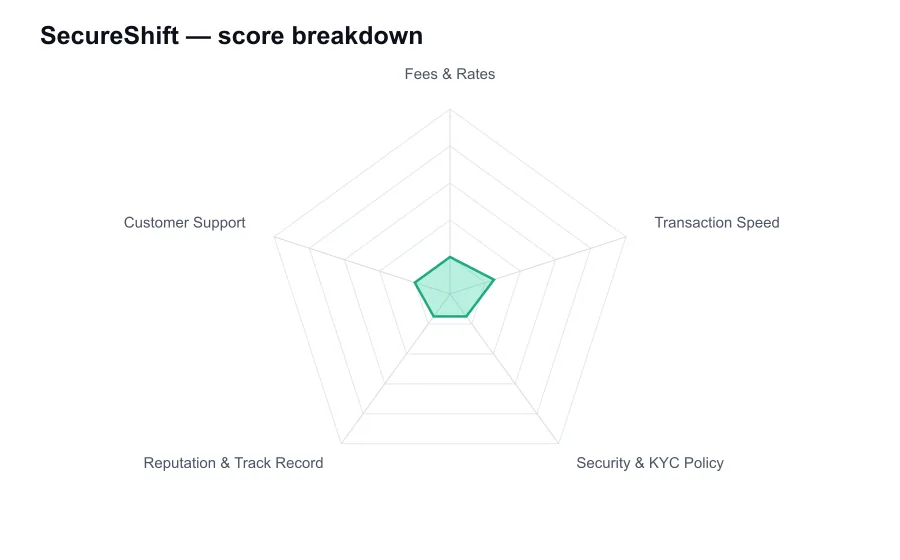
SecureShift scores 1.9/10 overall in our independent review, measured against every other provider we've compared, strongest on Transaction Speed (2.5/10) and weakest on Reputation & Track Record (1.5/10).
Score: 1.9 How we score → Status: active (checked 2026-10-13T19:38:04.319Z) Visit official siteEditorial independence: our scores and rankings are produced using the fixed criteria above and are not influenced by advertisers. This is an independent ranking site and is not operated by, or affiliated with, any provider we list.
Affiliate disclosure: some links on this page may earn us a commission at no extra cost to you. This does not affect our rankings.
| Criterion | Score | Note |
|---|---|---|
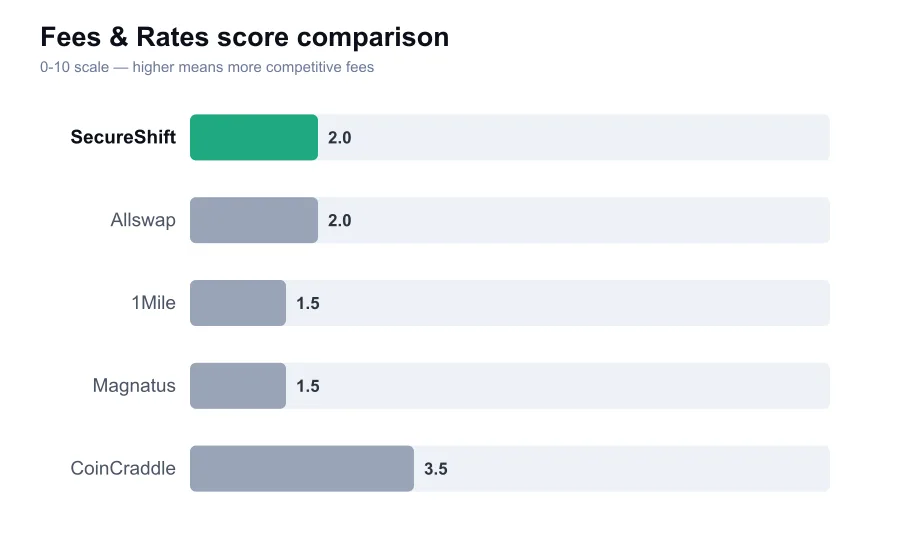
| Fees & Rates | 2.0 | No independently verifiable public fee schedule. |
| Transaction Speed | 2.5 | No reliable public completion-time evidence. |
| Security & KYC Policy | 1.5 | Security, operator, and KYC details are unclear. |
| Reputation & Track Record | 1.5 | Very limited independently attributable track record. |
| Customer Support | 2.0 | Escalation quality cannot be independently assessed. |
| Fact | Value |
|---|---|
| Public fee schedule | Not independently verified |
| Named legal operator | Not independently verified |
| Public security audit | Not independently verified |
| Proof of reserves | Not independently verified |
| Published service levels | Not independently verified |
| Pros | Cons |
|---|---|
| May offer a simple swap-style user flow | — |
| Could suit a small test transaction | — |
| Does not appear to require account-based trading | — |
| — | No confirmed operator or security record |
| — | Little independent reputation evidence |
| — | Not suitable for large or urgent transfers |
What is SecureShift?
How SecureShift Works
- Verify that you are on the authentic current SecureShift site
- Review the quote, rate type, terms, and destination network
- Start with a small test amount
- Send funds only to the generated address after checking it carefully
- Keep the transaction hash and all correspondence until payout arrives
KYC
| Requirement | tiered |
|---|---|
| Notes | A definitive SecureShift KYC policy could not be independently verified. Assume an instant exchanger may request identity information or pause a transaction if automated screening flags it. |
How to Use SecureShift Safely
- Test with a small amount before relying on the service
- Compare the quoted payout with established swap providers
- Check the token contract and network, not just the ticker
- Save screenshots of the quote and transaction hash
- Never send a time-critical or irreplaceable payment
SecureShift presents itself by name as a crypto swapping service, a category where trust is earned through transparent execution, identifiable operators, and a long record of completed customer transactions. I could not establish enough reliable public information to treat SecureShift as a proven, mainstream exchange provider. That matters more here than it would for a new app with a well-known parent company.
The instant-exchange market is crowded with established names such as ChangeNOW, SimpleSwap, Swapzone, and FixedFloat. Those firms are not beyond criticism, but a customer can at least find substantial documentation, third-party coverage, and years of discussion about their performance. SecureShift does not currently have that same visible footprint.
A new exchange can still be legitimate. Plenty of small services begin with little recognition. The problem is that crypto transactions are final, and a customer has few remedies after sending coins to a deposit address controlled by an unfamiliar service. A thin public record therefore isn't a minor cosmetic problem. It's the central risk.
I was unable to verify a dependable public fee schedule for SecureShift. That makes it impossible to assess whether its quoted rate contains a service spread, network-fee markup, liquidity-provider markup, or all three. For a swap provider, the quote is the fee disclosure. If the service does not clearly distinguish fixed and floating quotes, users cannot know what they are agreeing to.
This is particularly important during sharp price moves. A floating-rate swap may produce less than the estimate if the market changes between deposit confirmation and execution. A legitimate fixed-rate option can reduce that uncertainty, although it usually carries a wider spread. SecureShift should make that distinction, any refund conditions, and the applicable network fee easy to see before a deposit is sent.
Speed is another area where evidence is missing. No independently verifiable data set establishes typical completion times, confirmation requirements, liquidity sources, or how SecureShift handles delayed deposits. Claims of fast execution mean very little unless they state whether the clock starts at broadcast, first confirmation, or final payout.
A Bitcoin transaction and a USDT transfer on Tron do not have comparable confirmation patterns. Nor does a cross-chain swap involving a congested Ethereum transaction resemble a simple same-network conversion. A service that gives one universal speed promise is usually marketing around a complicated operational process.
Security documentation is equally difficult to assess from a distance. I could not confirm a named legal entity, audited custody design, proof-of-reserves publication, bug-bounty programme, or independently reviewed security controls associated with SecureShift. An instant exchanger may not hold balances like a conventional centralised exchange, but it still takes custody during the transaction.
The absence of a clear compliance policy also creates uncertainty. Some non-custodial-style swap sites advertise no registration, then request identity documents after a transaction is flagged by their screening provider. That procedure can be legitimate in limited cases, yet it must be explained before the customer sends funds. A vague right to freeze funds is unacceptable.
Reputation is where SecureShift falls furthest behind recognised competitors. I could not locate the volume of long-running, attributable independent feedback needed to judge its dispute handling fairly. That does not prove wrongdoing. It does mean the service has not supplied enough public evidence for a reviewer to assume that a delayed or challenged swap will be resolved well.
Support deserves the same caution. An email address, chat widget, or social account is not meaningful support unless the operator publishes response expectations and can be held accountable for outcomes. The difficult cases are wrong-network deposits, underpaid miner fees, compliance holds, and destination-wallet problems. Those are precisely the cases a new service must document well.
If you decide to test SecureShift, use an amount you can afford to lose and begin with a small, liquid asset on a familiar network. Save the quoted exchange rate, transaction ID, destination address, and every support message. Do not use it for a time-sensitive payment, a large treasury conversion, or the first leg of a complex arbitrage trade.
The service may improve its standing by publishing a legal identity, transparent terms, a current fee methodology, supported-network rules, and verifiable customer-service records. Those are basic expectations, not luxury features. Until then, the burden of proof remains with SecureShift rather than with the user.
My view is straightforward. SecureShift is too opaque to recommend for meaningful transfers. Its potential convenience cannot compensate for the inability to independently confirm fees, execution standards, compliance procedures, or a durable operating record. More established instant exchangers, or a reputable exchange with transparent withdrawal controls, are the safer choice.
Can SecureShift's legal operator be independently verified?
I could not independently confirm a clearly identified legal operator from reliable public material available for this review. Do not send funds until you can verify the entity named in the current terms.
Does SecureShift publish a fixed swap fee?
No dependable public fixed fee or spread schedule could be verified. Treat the live quote as the only possible price reference and compare the received amount against established services before sending.
Is SecureShift suitable for a large Bitcoin transfer?
No. Its public execution history, refund process, and dispute handling could not be independently established. Use a well-known provider for any transfer where loss or delay would be material.
Could a swap be held for compliance checks?
That risk exists with many instant exchangers, but I could not verify SecureShift's precise screening and release procedure. Avoid sending funds if its current policy does not state what happens during a review.
How should I test SecureShift safely?
Use a small amount, confirm the destination network character by character, record the quote and transaction hash, and wait for completion before attempting a larger transfer.
Editorial independence: our scores and rankings are produced using the fixed criteria above and are not influenced by advertisers. This is an independent ranking site and is not operated by, or affiliated with, any provider we list.
Affiliate disclosure: some links on this page may earn us a commission at no extra cost to you. This does not affect our rankings.