CoinDrop
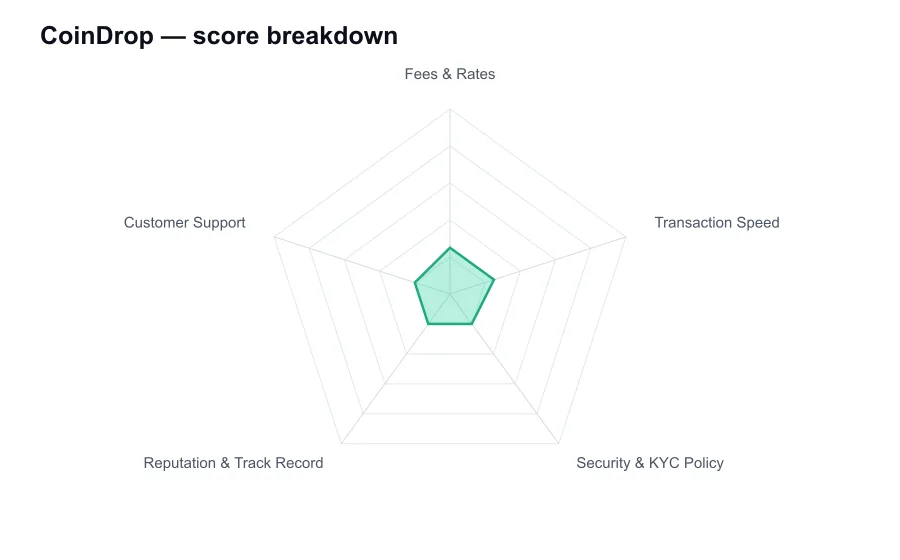
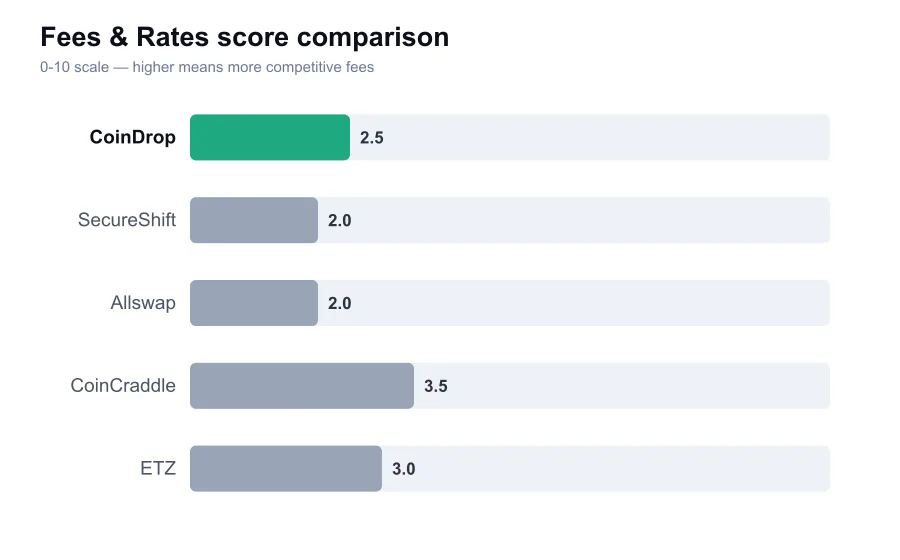
CoinDrop scores 2.2/10 overall in our independent review, measured against every other provider we've compared, strongest on Fees & Rates (2.5/10) and weakest on Customer Support (2.0/10).
Score: 2.2 How we score → Visit official siteEditorial independence: our scores and rankings are produced using the fixed criteria above and are not influenced by advertisers. This is an independent ranking site and is not operated by, or affiliated with, any provider we list.
Affiliate disclosure: some links on this page may earn us a commission at no extra cost to you. This does not affect our rankings.
| Criterion | Score | Note |
|---|---|---|
| Fees & Rates | 2.5 | No consistently verifiable public fee schedule |
| Transaction Speed | 2.5 | Payout speed lacks a reliable public record |
| Security & KYC Policy | 2.0 | Limited public custody and security disclosures |
| Reputation & Track Record | 2.0 | Brand identity and operating history remain unclear |
| Customer Support | 2.0 | No established evidence of dispute handling |
| Pros | Cons |
|---|---|
| May appear simple for basic crypto conversions | — |
| Potentially lower setup friction than large exchanges | — |
| Could suit only a negligible technical test | — |
| — | No proven competitive fee or spread history |
| — | Limited security and custody information |
| — | No strong independent support reputation |
CoinDrop is a name used in crypto contexts that is not sufficiently distinct or consistently documented to support a confident exchange-provider endorsement. That ambiguity is a problem by itself. In this industry, users need to know exactly which legal entity, domain, application, and wallet service they are dealing with before they transfer funds. A familiar-sounding name does not establish that a particular CoinDrop operation is the same business described in a search result or social-media post.
The exchange market is full of similar names, temporary domains, and services that borrow the vocabulary of established brands. That makes source verification essential. I could not establish a single, broadly recognized CoinDrop exchange operation with the public transparency, regulatory presence, trading history, and independently reviewed security practices expected from a mainstream provider. Readers should not assume that an app listing or a search-engine result has solved that identity question.
Fees are therefore impossible to praise with much conviction. A legitimate provider should make its schedule easy to find and specific enough to calculate the final cost before a transfer. For trading, that means maker and taker fees, spread methodology, and withdrawal charges. For swaps, it means the quoted rate, service fee, network fee, and whether the rate is fixed or floating. CoinDrop does not have a widely validated fee record that allows a reviewer to compare it confidently against major alternatives.
A hidden spread can be more expensive than an obvious fee. Suppose bitcoin is trading at a liquid market price, but an instant-buy service quotes a rate several percentage points worse and calls the transaction fee-free. The user still pays that difference. The only honest way to assess a smaller provider is to compare the final amount received with a live quote from several recognized venues. CoinDrop has not established enough public data to suggest that its execution is consistently competitive.
Speed is another claim that can sound better than it works in practice. Crypto transactions involve deposit confirmations, liquidity sourcing, risk screening, conversion, and payout broadcast. On a simple route, that can be quick. Under stress, it can be delayed dramatically. I found too little reliable, detailed evidence about CoinDrop's normal payout performance to offer a meaningful typical settlement range.
Users should be wary of providers that describe every transaction as instant while providing no status page, no transaction tracking, and no explanation of confirmation requirements. A payout hash is the minimum proof that the provider has actually released the funds. Without it, a customer is left trusting an internal interface. CoinDrop has not developed a public operational record that makes such trust easy.
The security question is more serious than the user-interface question. I could not confirm a widely recognized set of CoinDrop security materials covering custody, wallet segregation, two-factor authentication, breach procedures, independent audits, or proof of reserves. A service need not publish every operational detail, but it should provide enough information for customers to understand where the risk sits. Here, that picture remains unclear.
KYC and privacy terms deserve the same scrutiny. Some users seek smaller providers because they expect less paperwork than on Coinbase or Kraken. That expectation can be costly if verification is triggered after the funds have been sent. A responsible platform states whether it may request documents, which documents are accepted, how long reviews usually take, what happens to rejected transactions, and how personal data is stored. CoinDrop does not have a sufficiently established public policy record for users to rely on assumptions.
Reputation is not just an aggregate rating. It is whether a company has endured routine stress without vanishing, changing its terms, or leaving customers without answers. Major exchanges have survived market crashes, network congestion, regulatory challenges, and public criticism. CoinDrop has not accumulated a similarly visible record. That does not make every interaction unsafe, but it does make it unsuitable for confidence-based use.
Support is likely to be fragile at an obscure provider. The meaningful standard is not whether someone responds to a pre-deposit question. It is whether support can locate a transaction, explain the reason for a delay, provide a real case number, and resolve an issue without demanding risky actions from the customer. I could not identify enough reliable evidence that CoinDrop consistently meets that standard.
For users who simply want to buy a small amount of crypto, a regulated local exchange or a long-established broker is usually the better choice. The verification can be more intrusive, but the pricing, withdrawal process, and customer obligations are more visible. For wallet-to-wallet swaps, a known noncustodial provider with a documented history is a better starting point than a name with uncertain provenance.
If you encounter CoinDrop through a referral, treat the referral as advertising rather than proof. Do not allow another person to configure your wallet, do not share a seed phrase, and do not send crypto to a deposit address without verifying the domain independently. Be suspicious of promises of returns, bonus credits, or a requirement to make one more payment before a withdrawal can be processed.
There is a difference between caution and paranoia. A new provider can earn trust through transparent ownership, clear terms, verifiable on-chain operations, independent audits, and honest responses to criticism. CoinDrop has not supplied enough publicly checkable evidence to make that case. Until it does, the risk is not justified by any distinctive advantage.
A small test transaction can reveal basic technical problems, but it cannot establish solvency, legal accountability, or fair treatment during an account dispute. Users should not mistake a successful first deposit for proof that a service is safe. The larger risk often appears only at withdrawal or during a compliance hold.
My verdict on CoinDrop is cautious but firm. The available public record is too thin to support a positive recommendation. There are too many alternatives with clearer fees, better security disclosures, and a history that can be checked. I would choose one of them rather than gamble on uncertainty.
Is CoinDrop a well-known crypto exchange?
CoinDrop does not have the broadly established market profile of major exchanges. Verify the exact domain and operator before interacting with any service using this name.
What are CoinDrop's fees?
A dependable, independently checked public fee record is not readily available. Compare the final receive amount, not only an advertised percentage.
Can CoinDrop request KYC after I deposit?
It may be possible if the service uses transaction screening. Do not assume an account-light process guarantees that identity verification will not be requested.
Editorial independence: our scores and rankings are produced using the fixed criteria above and are not influenced by advertisers. This is an independent ranking site and is not operated by, or affiliated with, any provider we list.
Affiliate disclosure: some links on this page may earn us a commission at no extra cost to you. This does not affect our rankings.