ETZ
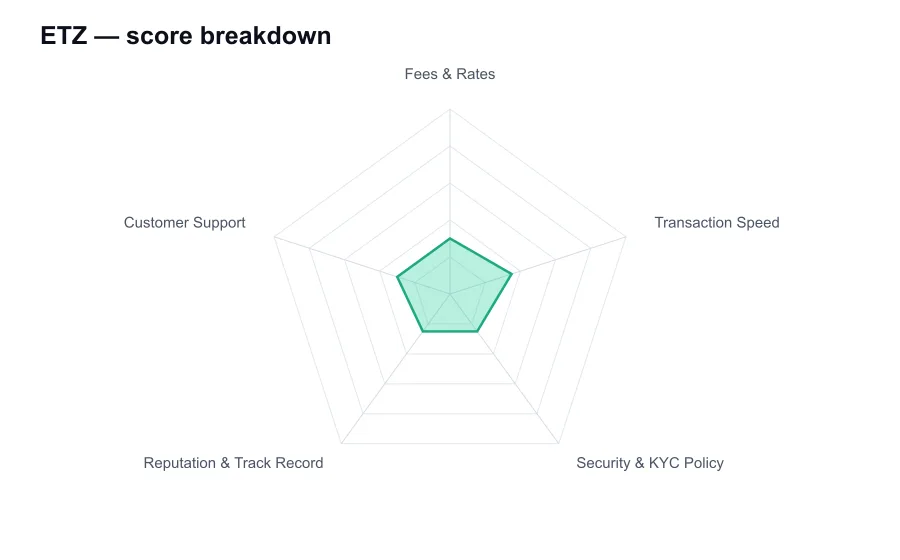
ETZ scores 2.9/10 overall in our independent review, measured against every other provider we've compared, strongest on Transaction Speed (3.5/10) and weakest on Reputation & Track Record (2.5/10).
Score: 2.9 How we score → Status: active (checked 2026-10-13T19:25:43.823Z) Visit official siteEditorial independence: our scores and rankings are produced using the fixed criteria above and are not influenced by advertisers. This is an independent ranking site and is not operated by, or affiliated with, any provider we list.
Affiliate disclosure: some links on this page may earn us a commission at no extra cost to you. This does not affect our rankings.
| Criterion | Score | Note |
|---|---|---|
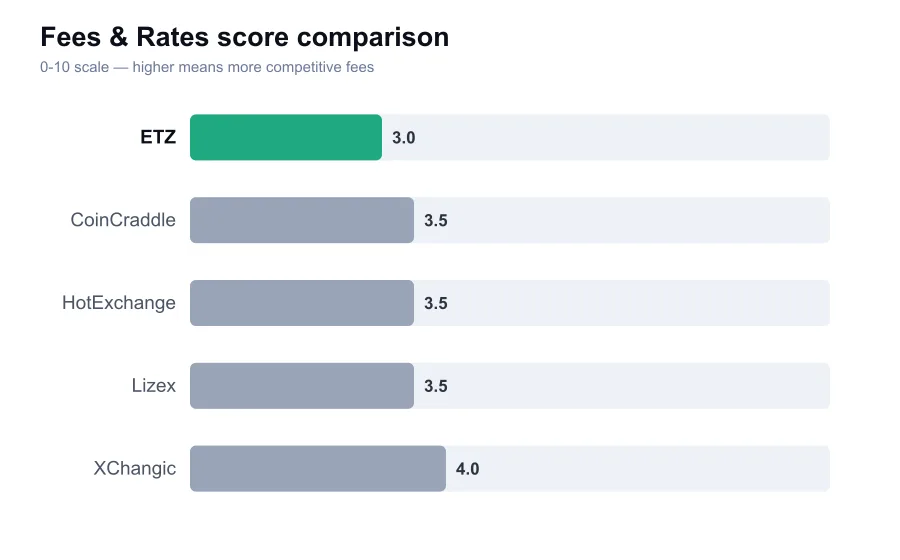
| Fees & Rates | 3.0 | No reliably verifiable public fee schedule located |
| Transaction Speed | 3.5 | Processing and withdrawal timing are not well documented |
| Security & KYC Policy | 2.5 | Insufficient public evidence of custody and control practices |
| Reputation & Track Record | 2.5 | Limited independently verifiable operating record |
| Customer Support | 3.0 | Too little public evidence of dependable support handling |
| Fact | Value |
|---|---|
| Public fee schedule | Not reliably verified |
| Security documentation | Limited public detail verified |
| Custody disclosure | Not reliably verified |
| Independent support record | Limited public evidence |
| Recommended use | Small test only, if used |
| Pros | Cons |
|---|---|
| May offer access where larger venues are unavailable | — |
| Small test transactions can reveal operational behavior | — |
| No confirmed shutdown was identified | — |
| — | Limited public security documentation |
| — | Thin independent reputation record |
| — | Not appropriate for significant deposits |
What is ETZ?
How ETZ Works
- Verify the official domain and read the legal and fee pages
- Create an account only after reviewing security options
- Complete any verification the platform requests
- Test the service with a very small deposit
- Attempt a small withdrawal before committing further funds
KYC
| Requirement | tiered |
|---|---|
| Notes | A complete, current public verification framework could not be reliably confirmed. Users should expect that identity checks may be required before access to all functions or withdrawals. |
How to Use ETZ Safely
- Do not deposit funds you cannot afford to lose
- Test a withdrawal before making a larger deposit
- Use a unique password and enable 2FA if offered
- Keep long-term assets in self-custody
- Save screenshots of quotes, transaction IDs, and support messages
ETZ is a difficult provider to assess with the confidence readers should demand before trusting an exchange with money. Publicly available material does not establish the kind of clear corporate history, independently verifiable operating record, transparent fee table, or detailed security documentation associated with major cryptocurrency exchanges. That does not prove misconduct. It does mean the service starts from a position of weak verifiability.
For an exchange, that is not a minor paperwork issue. Crypto customers are routinely asked to send irreversible assets to an address controlled by the provider. A polished site, a token listing, or a social media profile cannot substitute for identifiable ownership, dependable terms, published withdrawal rules, and a long trail of credible customer experience. ETZ has not earned the presumption of trust that older, better-documented firms receive.
The first question a prospective user should ask is what ETZ actually provides. If it offers custodial trading, then customers need to know who holds the private keys, whether client assets are segregated, how withdrawals are authorized, and whether reserves are independently attested. If it is acting as a broker or instant exchanger, the important questions shift to quote construction, counterparties, transaction settlement, and the handling of failed orders. Those basics should be plain.
I could not verify a stable, public fee schedule comparable to the transparent maker and taker pricing published by Kraken, Coinbase, Bitstamp, or Binance. That makes a fair fee score impossible. An exchange may charge a competitive headline percentage and still deliver a poor execution price through a wide spread, a withdrawal charge, or a conversion rate that is only disclosed at confirmation. With ETZ, users should assume nothing until the full amount received is visible.
Lack of published pricing is especially concerning for smaller platforms because there is no deep market reputation to counterbalance it. On an exchange with robust public order books, a customer can inspect the spread and compare execution directly. On a lightly documented provider, there may be no meaningful way to distinguish a fair quote from an expensive one. That is a bad starting point for anyone exchanging more than a test amount.
Speed is another area where ETZ does not provide enough dependable evidence to justify a positive claim. Blockchain transfers themselves have known confirmation mechanics, but provider-side processing is separate. Deposits can be credited quickly or remain pending. Withdrawals can be automated or manually reviewed. A service that does not clearly state expected processing times, cut-off conditions, and escalation routes leaves customers exposed to uncertainty precisely when they need information.
The security picture is weaker still because strong claims require strong proof. I would expect a credible custodial exchange to explain two-factor authentication, withdrawal address controls, encryption, suspicious-login alerts, cold-storage policy, incident response, and its approach to client-asset custody. Public evidence connecting ETZ to such practices is too thin to reward it with a high score. Silence is not a security feature.
KYC treatment should be approached carefully. I could not substantiate a detailed, current ETZ verification framework that tells customers which tiers exist, what transaction levels trigger identity checks, or how long a review may take. That matters because unclear compliance rules can result in a deposit being accepted before a customer learns that withdrawal or conversion requires additional documents. Legitimate providers publish this information in advance.
ETZ also lacks the broad, independently visible track record that helps users judge how a company behaves under pressure. Reputation is built during mundane withdrawal requests, volatile market sessions, security incidents, and disputed transactions. It is not built by a claim on a homepage. I found insufficient reliable material to put ETZ in the same trust category as established global venues or even better-known instant exchange brands.
That doesn't mean every lesser-known exchange is automatically unsafe. New providers need a chance to establish themselves. But the burden is on the company to show why users should accept additional counterparty risk. ETZ has not supplied enough readily verifiable information to meet that burden. A reviewer should not fill those gaps with optimism, and a customer should not fill them with a large deposit.
Customer support is difficult to grade for the same reason. A listed contact channel is only the beginning. What users need is a published support process, clear response expectations, identifiable legal terms, and evidence that complex disputes are resolved fairly. I could not verify enough independent support history to treat ETZ as reliable for urgent account, deposit, or withdrawal problems.
The sensible approach, if you are considering ETZ despite these reservations, is to conduct a narrow technical test. Read the legal pages before registering. Verify that the official domain is authentic. Test account security features. Deposit only an amount you can afford to lose, make a small withdrawal, and record each step. Do not treat a successful deposit as proof that the service is safe. The withdrawal test is much more informative.
Do not use an obscure exchange as a wallet. There is little reason to leave assets on a provider whose custody controls and operating history cannot be independently evaluated. Hold long-term assets in a wallet where you control the keys, and use an established venue for significant conversions. This is conservative advice, but crypto's history is full of customers learning that distinction too late.
My assessment of ETZ is blunt. It is not a provider I would recommend for meaningful funds until it supplies better evidence around ownership, fees, security, compliance procedures, and customer service. A low score here reflects an information deficit and elevated trust risk, rather than a claim about a confirmed single event. There are too many established alternatives to justify making ETZ your first experiment with crypto trading.
Is ETZ a suitable place to keep long-term crypto holdings?
No. Publicly verifiable details about ETZ's custody controls and reserve practices are too limited to justify treating it as a long-term wallet.
Can I verify ETZ's trading fees before depositing?
A reliable public fee schedule comparable to major exchanges was not verified. Confirm the full quote, spread, deposit rules, and withdrawal charge before sending any funds.
Should I test withdrawals before using ETZ seriously?
Yes. If you choose to use ETZ, make a small deposit and a small withdrawal first. A successful withdrawal is more informative than a successful deposit.
Does ETZ publish a detailed custody model?
I could not verify detailed public documentation covering client-asset segregation, cold storage, reserve attestations, or a comparable custody framework.
Can users rely on ETZ for urgent support cases?
That cannot be assumed. There is too little independently visible evidence about response times or dispute resolution to treat ETZ as dependable during an urgent withdrawal issue.
Editorial independence: our scores and rankings are produced using the fixed criteria above and are not influenced by advertisers. This is an independent ranking site and is not operated by, or affiliated with, any provider we list.
Affiliate disclosure: some links on this page may earn us a commission at no extra cost to you. This does not affect our rankings.