CoinCraddle
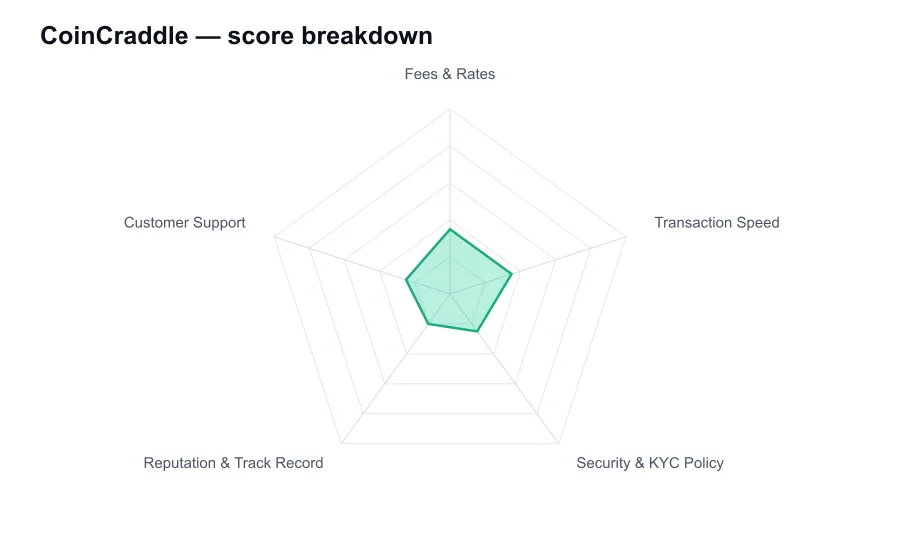
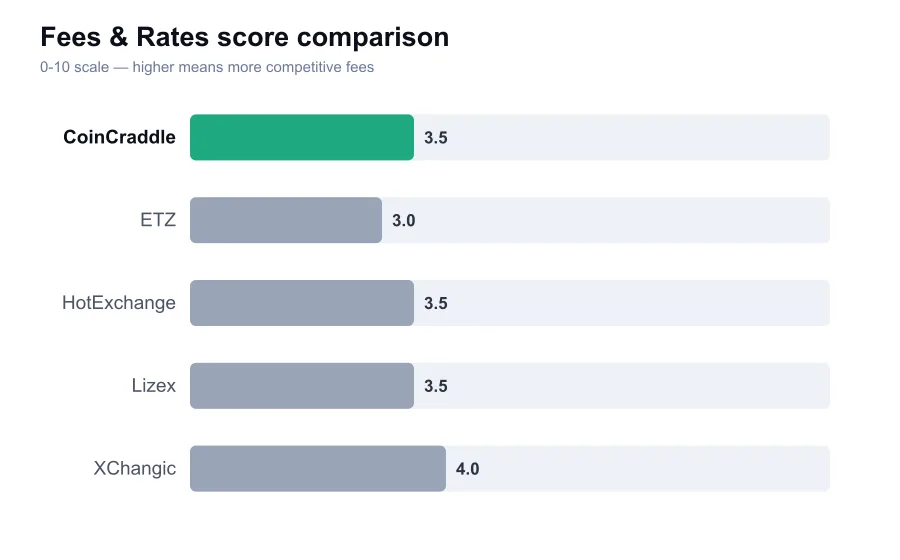
CoinCraddle scores 2.9/10 overall in our independent review, measured against every other provider we've compared, strongest on Fees & Rates (3.5/10) and weakest on Reputation & Track Record (2.0/10).
Score: 2.9 How we score → Status: active (checked 2026-10-13T19:34:19.166Z) Visit official siteEditorial independence: our scores and rankings are produced using the fixed criteria above and are not influenced by advertisers. This is an independent ranking site and is not operated by, or affiliated with, any provider we list.
Affiliate disclosure: some links on this page may earn us a commission at no extra cost to you. This does not affect our rankings.
| Criterion | Score | Note |
|---|---|---|
| Fees & Rates | 3.5 | No clearly verifiable public pricing schedule |
| Transaction Speed | 3.5 | Little independent evidence on completed orders |
| Security & KYC Policy | 2.5 | Controls and compliance process are insufficiently documented |
| Reputation & Track Record | 2.0 | Very limited public track record |
| Customer Support | 2.5 | No strong public evidence of case resolution |
| Fact | Value |
|---|---|
| Service model | Instant crypto conversion interface |
| Published fee schedule | Not clearly verifiable |
| Public support record | Limited independent evidence |
| Compliance policy | Insufficiently documented |
| Recommended first trade | Very small test transaction |
| Pros | Cons |
|---|---|
| Straightforward swap-oriented concept | — |
| No advanced trading interface required | — |
| Can be tested with a very small transfer | — |
| — | Unclear fee and spread disclosure |
| — | Weakly documented compliance process |
| — | Support reliability is unproven |
What is CoinCraddle?
How CoinCraddle Works
- Select the cryptocurrency pair and amount
- Enter a receiving wallet address
- Review the payout quote and deposit instructions
- Send the exact deposit on the correct network
- Track the transaction until the receiving wallet is credited
KYC
| Requirement | optional |
|---|---|
| Notes | Do not assume no-KYC status. The service's publicly verifiable policy on AML reviews, requested documents, and refunds after a hold is limited. |
How to Use CoinCraddle Safely
- Use a small test transfer before any larger order
- Check the network, token contract, and destination address
- Compare the final payout with two established providers
- Store all order records and transaction hashes
- Avoid time-critical or high-value transfers
CoinCraddle is the sort of crypto exchange name that requires more scrutiny than a polished homepage can provide. It appears to sit in the instant-exchange segment, promising a simpler route between digital assets than a conventional centralized exchange. That category can be useful. A customer does not need to manage an order book, park a balance with a custodian, or learn advanced trading controls. Yet convenience only works when the operator behind it is easy to evaluate, and CoinCraddle has not made that evaluation easy.
A publication should not label a provider fraudulent merely because it is small or unfamiliar. Plenty of legitimate crypto businesses began with little recognition. Still, a company asking customers to send irreversible assets needs to provide more than a brand name and a conversion widget. Users should be able to establish who operates it, which terms govern a trade, how fees are calculated, how compliance holds work, and how to reach a responsible person if a transaction stalls.
CoinCraddle's visible public record is too light for comfort. That is the central fact behind this review, and it affects every score. Without durable independent feedback, formal business details, detailed policies, or a well-established record of resolved customer cases, a reviewer cannot confidently separate a smooth-looking interface from a dependable financial service. This isn't a stylistic complaint. It is a practical risk assessment for a business handling irreversible transfers.
Pricing is a good example. Instant exchanges rarely need to charge a single headline percentage. They can earn through an embedded spread, a partner rate, a network charge, or a mixture of all three. There is nothing inherently improper about that model. The issue is disclosure. CoinCraddle does not provide enough readily verifiable information to establish whether its quoted payout is consistently competitive or whether customers are paying a substantial spread without realizing it.
The right test is simple but often ignored. Enter an identical swap on CoinCraddle and on two established instant exchanges, using the same network and destination assumptions. Record the amount sent and the amount promised. If CoinCraddle is worse by more than a trivial amount, its convenience has no special value. If it is better, use that information only as a reason for a small test, not as proof that it can safely handle a larger transfer.
Speed claims should also be read carefully. An instant conversion service can create an order within seconds, but that says almost nothing about final settlement. The deposit chain may require confirmations. The provider may route liquidity externally. The payout wallet may face congestion or maintenance. Bitcoin and Ethereum transactions can be slow at busy periods, while token transfers on cheaper chains may arrive quickly. CoinCraddle has not accumulated enough public transaction history for a reliable independent view of its normal completion times.
This lack of history becomes more serious in exceptions. Every experienced crypto user eventually sees an exchange delayed by a low-fee deposit, an incorrect memo, a contract migration, or a wallet maintenance event. The service that matters is not the one that completes an easy swap. It is the one that can identify an incoming transaction, explain the delay accurately, and either complete or return the funds under a documented process. CoinCraddle has not supplied enough evidence to score well on that standard.
Security is not limited to whether a site asks users to create an account. A non-custodial-style swap reduces exposure to a standing custodial balance, which is helpful. But customers still surrender control of the deposited funds during processing. They need confidence that the generated address is correct, the exchange's routing is secure, and the staff can prevent or correct operational failures. There is little public material to independently assess CoinCraddle's controls, custody arrangements, or security governance.
The KYC question is equally unresolved. Services in this category often market low-friction swaps while retaining the right to seek verification where automated screening identifies a risk signal. That policy can be lawful and sensible, but it must be explained before funds are committed. A customer needs to know whether a hold can occur, what information might be requested, whether a rejected case can receive a refund, and how long that review may last. CoinCraddle's public explanation is not strong enough to offer confidence.
I would be particularly wary of sending privacy-focused assets, high-risk token contracts, or funds coming from a complicated transaction history into a lightly documented service. Those are exactly the cases most likely to trigger an internal review. If the exchange cannot quickly explain its policy or escalation route before a deposit, don't discover the answer after the money has arrived. Use a provider with a published compliance framework and a verifiable support record instead.
Reputation is not measured by advertising language or anonymous testimonial blocks. It comes from time, independent reviews, technical consistency, and a public pattern of dealing fairly with problems. CoinCraddle does not have enough of that visible record to rank alongside established instant exchanges. A low reputation score is not a prediction that every order will fail. It reflects the fact that a user cannot reasonably verify how the provider behaves when a transaction does not follow the happy path.
Support is the weakest practical area for an unproven exchange. A generic email address or embedded chat is easy to create. Meaningful support requires a response system, trained staff, access to transaction data, clear ownership of a case, and an escalation route. There is little independent evidence that CoinCraddle offers this level of service. Anyone using it should preserve screenshots, transaction hashes, order details, and the exact quoted amount from the beginning.
There are safer ways to get the same convenience. Established instant exchangers may request KYC in exceptional cases too, and their rates are not always the best. What they usually provide is a much more inspectable history, clearer terms, and a larger base of users who have tested their processes. That additional visibility is valuable insurance, especially because a crypto swap has no card chargeback mechanism.
CoinCraddle is not a provider I would recommend for meaningful sums. It may be tempting if a quote looks unusually favorable, but unusually favorable rates are precisely where a buyer should slow down and verify every detail. Until it develops a stronger, independently visible record and clearer public policies, it belongs in the tiny-test-transaction category. Most readers will be better served elsewhere.
Why is CoinCraddle's reputation score only 2 out of 10?
There is very limited independently documented operating history, public dispute handling, and verifiable company information compared with established competitors.
Does CoinCraddle show a fixed exchange fee?
I could not verify a reliable standard percentage. Check the actual payout against other services, since a spread may be embedded in the quote.
What should I save if a CoinCraddle order is delayed?
Keep the order ID, deposit address, destination address, quote screenshot, transaction hash, amount, network, and timestamps.
Is a low-friction swap the same as guaranteed no-KYC?
No. Instant exchange services may request documents after a transaction is screened. CoinCraddle's public hold and verification process is not clear enough to assume otherwise.
Can I safely use CoinCraddle for an urgent payment?
No. Its speed score is 3.5 out of 10 because normal settlement and exception handling are not independently well documented.
Editorial independence: our scores and rankings are produced using the fixed criteria above and are not influenced by advertisers. This is an independent ranking site and is not operated by, or affiliated with, any provider we list.
Affiliate disclosure: some links on this page may earn us a commission at no extra cost to you. This does not affect our rankings.