HotExchange
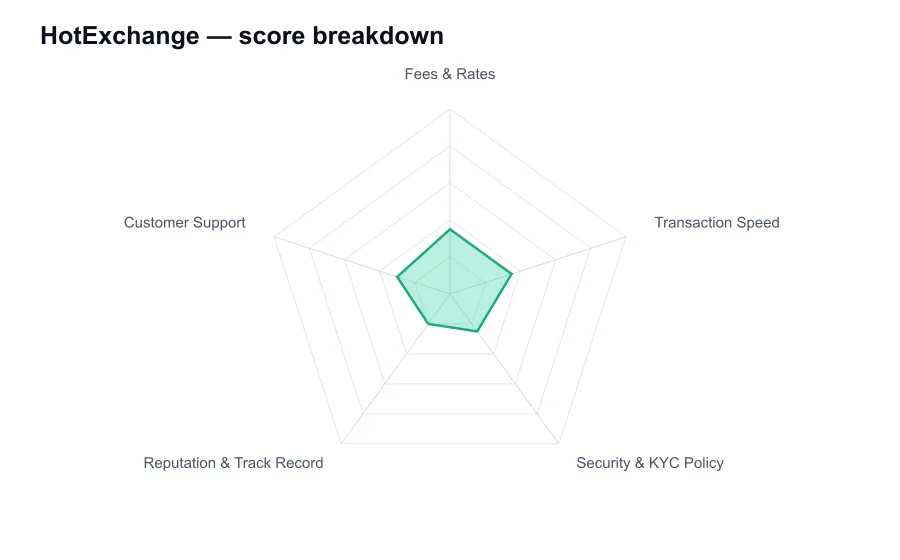
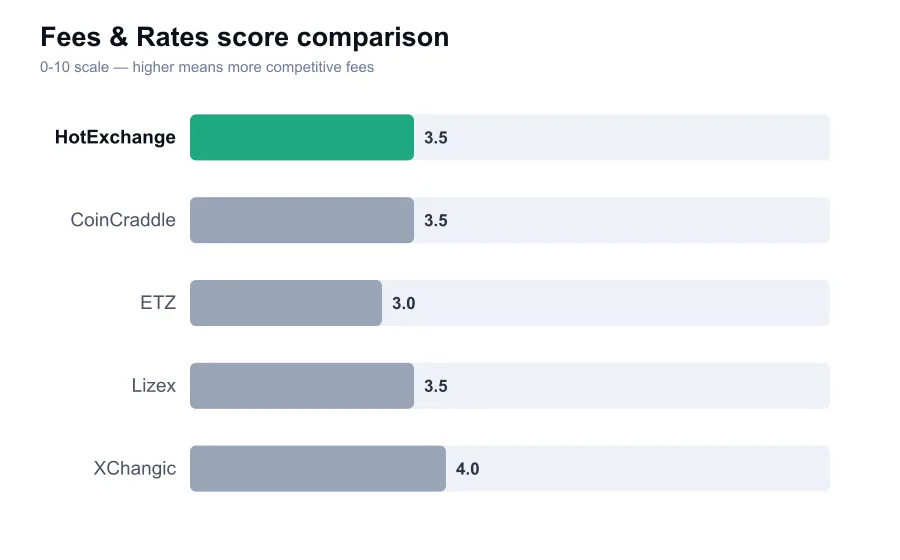
HotExchange scores 2.9/10 overall in our independent review, measured against every other provider we've compared, strongest on Fees & Rates (3.5/10) and weakest on Reputation & Track Record (2.0/10).
Score: 2.9 How we score → Status: active (checked 2026-10-13T19:49:14.286Z) Visit official siteEditorial independence: our scores and rankings are produced using the fixed criteria above and are not influenced by advertisers. This is an independent ranking site and is not operated by, or affiliated with, any provider we list.
Affiliate disclosure: some links on this page may earn us a commission at no extra cost to you. This does not affect our rankings.
| Criterion | Score | Note |
|---|---|---|
| Fees & Rates | 3.5 | No independently verified transparent fee schedule |
| Transaction Speed | 3.5 | No verified settlement targets or status standards |
| Security & KYC Policy | 2.5 | Custody and account-security controls are unclear |
| Reputation & Track Record | 2.0 | Insufficient independently verifiable track record |
| Customer Support | 3.0 | Support quality should be tested before any deposit |
| Fact | Value |
|---|---|
| Service model | Crypto exchange brand |
| Verified fee schedule | Not independently verified |
| Proof of reserves | Not independently verified |
| Public security audit | Not independently verified |
| Recommended use | Small test only, if used |
| Pros | Cons |
|---|---|
| Potentially simple exchange interface | — |
| May be usable for a tiny test conversion | — |
| Could avoid complex trading screens | — |
| — | No verified published fee structure |
| — | Limited public reputation evidence |
| — | Not appropriate for stored balances or large deposits |
What is HotExchange?
KYC
| Requirement | optional |
|---|---|
| Notes | The current KYC policy should be confirmed directly in the active terms before a deposit. Registration without documents does not rule out later verification or a transaction hold. |
How to Use HotExchange Safely
- Do not leave a balance on an unverified platform
- Confirm the official website through independent sources
- Test support before depositing
- Use a small first transaction
- Record every transaction hash and order ID
- Never share wallet recovery words or remote access
HotExchange is presented as a crypto exchange brand, but it does not have the visible public footprint I would expect from a provider asking users to trust it with digital assets. In a market packed with regulated exchanges, transparent trading platforms, and established non-custodial protocols, a little-known service needs to provide unusually clear evidence of who operates it, how funds are safeguarded, and how customers can obtain help if a transaction goes wrong.
I could not independently verify enough durable public information about HotExchange to treat it as a peer of recognised centralised exchanges. That is not a claim that the service is fraudulent. It is a practical assessment of due diligence. A customer should be able to find reliable ownership information, applicable legal terms, a documented fee model, meaningful security explanations, and a history that extends beyond promotional material.
The first issue is classification. A name alone does not tell a customer whether a business is a custodial exchange, a broker, an instant converter, or a front end for third party liquidity. Each model carries different risks. If HotExchange receives a deposit into a wallet it controls before crediting or converting it, users are accepting counterparty risk. That risk should be compensated by transparency. I could not confirm enough information to make that trade-off attractive.
Fees are a particular blind spot. Reputable trading venues publish maker and taker schedules, withdrawal charges, minimum order sizes, and explanations of how spread-based conversions are priced. Smaller exchange brands sometimes show a conversion rate without exposing the margin inside it. The customer then sees a clean interface but cannot readily tell whether the deal is competitive. Without a verified schedule, I score HotExchange poorly here.
Before using any service like this, compare the exact amount to be received with at least two alternatives. Do not compare only the headline exchange rate. Include blockchain withdrawal fees, trading fees, and the possibility that a quoted rate changes before settlement. If the provider asks for a deposit before showing a final binding quote, that is a reason to slow down rather than a reason to hurry.
There is also no dependable public basis for assigning HotExchange a strong speed score. Crypto platforms often advertise instant exchanges, but settlement depends on deposit confirmations, internal processing, liquidity, compliance checks, and the outgoing blockchain transaction. An instant label is useful only if the provider states what it means. I could not verify published settlement targets or confirmation requirements for HotExchange.
A delayed order becomes much more serious when there is no robust support trail. Customers should receive an order reference, an address for the asset sent, and a transaction record that lets them demonstrate what occurred. If the service has a status page, it should show something more informative than a vague pending message. The practical question is whether a user can prove the service received their money and can get a meaningful response if it does not proceed.
Security is the category where missing details should hurt most. I could not verify audited custody controls, proof-of-reserves reporting, a named security programme, a documented cold-storage arrangement, or a clear incident disclosure record for HotExchange. Some small operators do have reasonable internal controls without publishing every detail. That still leaves customers unable to assess the protection of their funds.
Account security matters too. If HotExchange offers user accounts, a prospective customer should confirm whether two-factor authentication, withdrawal address controls, anti-phishing codes, session management, and withdrawal notifications are actually available. These are ordinary safeguards at competent custodial exchanges. A provider that cannot clearly explain them should not be holding a meaningful balance.
The KYC position should not be guessed from marketing language. A platform may permit registration without documents but reserve the right to freeze withdrawals or request identification later. That possibility is common across crypto services and can be legitimate, but the process must be explained fairly. Users need to know what can trigger review, whether deposits can be returned, and what documents are accepted.
Reputation is weaker than the rest of the evaluation because it depends on time and independent scrutiny. I could not establish a long, broad record of public customer feedback, regulatory disclosure, or well documented operational history for HotExchange. A few comments, affiliate pages, or social accounts are not enough. Those sources can be manipulated, selectively presented, or too recent to reveal how a business handles stressful periods.
Customer support cannot compensate for weak disclosure, but it can reduce damage when an ordinary mistake happens. Test the official contact route before depositing. Ask a specific question about a network, a withdrawal process, or a transaction review policy. A support channel that gives canned replies or pushes users into private messages is not good enough for a platform expected to safeguard money.
I would not use HotExchange as a primary trading venue, savings platform, or place to leave assets between trades. The risk is not just technical. It is informational. If a deposit is delayed, a withdrawal is held, or the business changes its terms, the user may have limited evidence and limited leverage. That is a poor position to enter voluntarily.
There may be narrow cases where an experienced user makes a very small test conversion after confirming every live detail. That is the most generous recommendation I can make from the available evidence. Anyone requiring reliable execution, visible security practices, regulated fiat access, or established dispute handling should choose a better documented exchange.
HotExchange does not clear the threshold I use for a positive recommendation. The brand may offer a functional service, but public verifiability is too limited to justify trust with substantial funds. A low fee or attractive rate would not change that assessment unless it is backed by clear terms and a demonstrable track record. In crypto, the ability to verify the operator matters as much as the trade screen.
Is HotExchange a suitable place to keep crypto?
I would not use it for stored balances. Its security score is 2.5 out of 10 because custody controls, reserve reporting, and account safeguards could not be independently verified.
Are HotExchange trading fees publicly verified?
No reliable public fee schedule was independently verified for this review. Compare the final amount received, including withdrawal and network charges, before funding an order.
Could HotExchange request KYC after a deposit?
Treat that as possible unless current terms clearly exclude it. Many crypto services can trigger identity review after a deposit under AML, sanctions, or fraud procedures.
What should I test before using HotExchange?
Confirm the official domain, test the stated support channel, read the withdrawal rules, and make only a small transaction that you can afford to have delayed.
What proof should I keep for a delayed exchange?
Keep the order reference, deposit address, screenshots of the quote, timestamp, and blockchain transaction hash. The hash proves whether and when a deposit was confirmed.
Why is a public company identity important for an exchange?
A clear operating entity gives users a way to assess terms, jurisdiction, complaint routes, and accountability. That information is especially important where a service takes custody of funds.
Editorial independence: our scores and rankings are produced using the fixed criteria above and are not influenced by advertisers. This is an independent ranking site and is not operated by, or affiliated with, any provider we list.
Affiliate disclosure: some links on this page may earn us a commission at no extra cost to you. This does not affect our rankings.