CryptoVortex
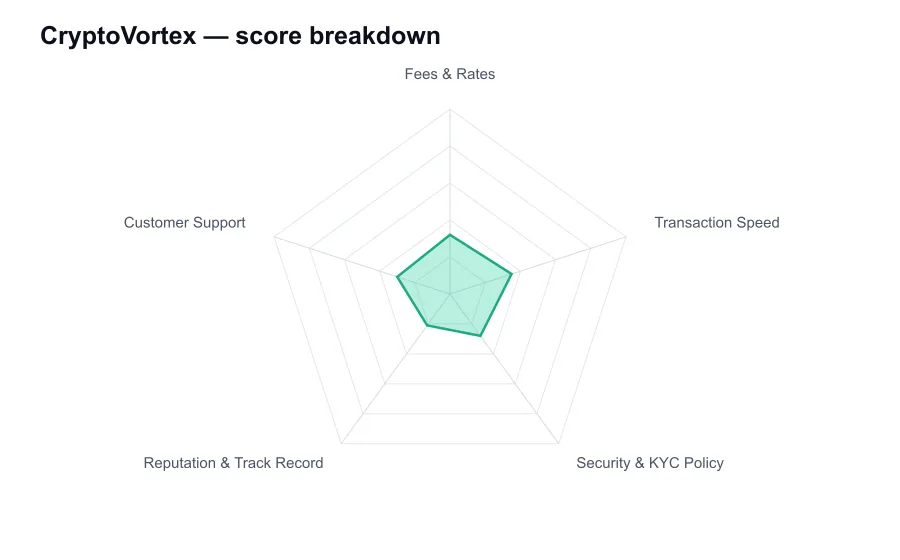
CryptoVortex scores 2.9/10 overall in our independent review, measured against every other provider we've compared, strongest on Transaction Speed (3.5/10) and weakest on Reputation & Track Record (2.1/10).
Score: 2.9 How we score → Visit official siteEditorial independence: our scores and rankings are produced using the fixed criteria above and are not influenced by advertisers. This is an independent ranking site and is not operated by, or affiliated with, any provider we list.
Affiliate disclosure: some links on this page may earn us a commission at no extra cost to you. This does not affect our rankings.
| Criterion | Score | Note |
|---|---|---|
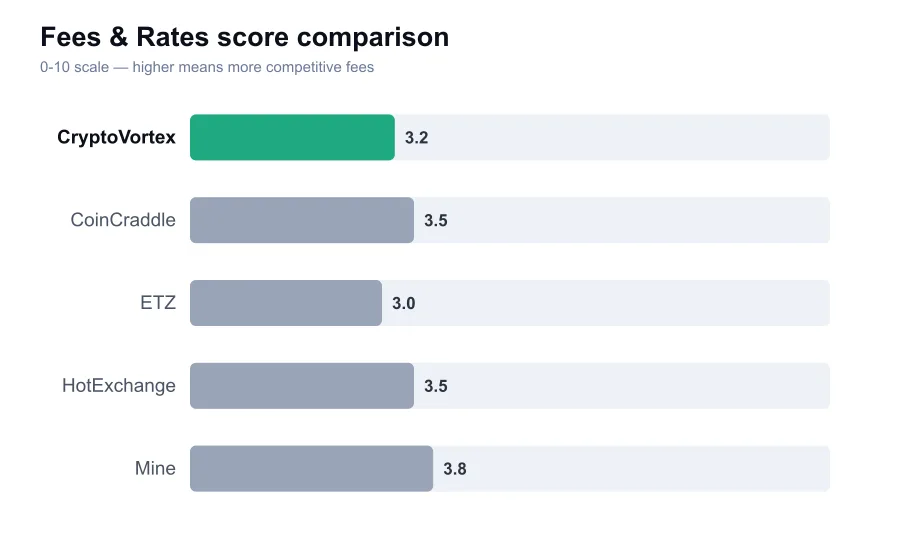
| Fees & Rates | 3.2 | Effective costs are not sufficiently transparent to rate highly. |
| Transaction Speed | 3.5 | No strong independently verifiable settlement record. |
| Security & KYC Policy | 2.8 | Public security and KYC information is too limited. |
| Reputation & Track Record | 2.1 | Insufficient established independent track record. |
| Customer Support | 3.0 | No persuasive public evidence of accountable support operations. |
| Pros | Cons |
|---|---|
| May offer a simple exchange-style interface | — |
| Could be tested with a minimal amount only | — |
| Potentially avoids a traditional trading interface | — |
| — | Unclear effective fees and policy disclosures |
| — | Unknown KYC, refund, and hold procedures |
| — | Not appropriate for significant funds |
CryptoVortex is the most difficult provider in this group to recommend because its public identity is not sufficiently established. The name sounds like a generic crypto brand, and that is not a trivial issue. Generic naming makes it harder for customers to distinguish a real service from a clone, a scam campaign, or an unrelated project using similar branding. In financial services, discoverability and verifiable identity are basic trust requirements, not cosmetic extras.
I could not establish a clear, widely recognized operating record for CryptoVortex comparable to known exchanges or even better documented niche exchangers. That should immediately change the way a prospective user approaches it. Lack of public history is not proof that a service is dishonest. It is proof that the customer has less evidence to rely on if an order fails, a withdrawal is delayed, or an identity document is requested. That distinction matters because crypto transfers are generally irreversible.
Any claimed fee advantage should be treated with unusual skepticism until it can be verified in a live, complete quote. Some weak crypto sites advertise zero fees while collecting a large hidden spread. Others display an attractive conversion amount before a customer deposits and then cite network conditions, liquidity, or verification for a lower payout. A legitimate provider does not need to hide the effective cost. It should show the send amount, receive amount, rate type, network fee, and material conditions before the user commits funds.
CryptoVortex does not have the transparent, publicly documented fee architecture I would expect before recommending it above established alternatives. A centralized exchange normally publishes maker and taker schedules, withdrawal charges, and supported networks. A credible instant exchanger at least makes fixed versus floating-rate terms clear. If a customer has to infer costs from an opaque widget or wait until after a transfer settles, the service has already failed an important consumer-protection test.
Speed claims deserve the same scrutiny. A crypto conversion cannot be honestly described as instant if it requires multiple deposit confirmations, a manual review, and an external liquidity provider. That does not mean the service is poor. It means its marketing should state realistic timing. The actual settlement time will vary by asset, blockchain congestion, amount, wallet maintenance, and risk checks. Any provider that refuses to supply an order status, a transaction hash, or a meaningful explanation of delay should be avoided.
With CryptoVortex, I would not send anything beyond a minimal test transaction. A test should use the exact asset and network planned for the larger transfer, because a successful low-value stablecoin swap tells you little about a large Bitcoin payout or a different chain. Check that the address is correct, that the quoted amount matches the order, and that the outgoing payment can be verified on-chain. If the service cannot pass that modest test cleanly, stop there.
Security is not just about whether a website uses HTTPS or displays a padlock. A user needs to know who controls the service, how its operational wallets are managed, whether it has an incident-response process, and what happens to funds during a compliance review. CryptoVortex does not appear to provide enough readily verifiable public information to support confidence on these questions. A privacy-focused flow can be appealing, but opacity from the operator is not the same thing as privacy for the customer.
The KYC risk is particularly serious with poorly documented services. A customer may be attracted by an apparent no-registration process, send funds, then be asked for identification, wallet history, or source-of-funds evidence. Compliance requests can be legitimate, but the policy must be clear before the transaction. Without a published and comprehensible procedure, the customer has no way to judge whether a hold is normal, how long it may last, or whether a refund is possible.
Never provide a seed phrase, private key, exchange password, remote-access session, or extra crypto payment to resolve a CryptoVortex issue. No legitimate exchange needs a wallet recovery phrase to release a conversion. Be equally wary of support agents approaching through Telegram, WhatsApp, direct messages, or search-engine advertisements. Start from a domain confirmed through independent, trustworthy sources, and keep a record of every page and message if you decide to test the service.
Reputation is where CryptoVortex scores very poorly. I do not see the public evidence necessary for a customer to rely on it with meaningful funds. A trustworthy track record is built over time through independently visible trading activity, credible reviews, clear company information, security disclosures, and how an operator handles things when they go wrong. A polished landing page or a few anonymous comments cannot replace any of that. This is a high-risk information environment.
Support cannot rescue an unknown provider unless it is demonstrably accountable. A chat response that says an order is being processed is not meaningful support. Useful support identifies the order, explains the cause of a delay, supplies a transaction reference, and gives a specific path to resolution. Before sending money, try asking a concrete pre-sale question through an official channel. If the reply is evasive, generic, or pushes urgency, there is no sensible reason to proceed.
Compared with named, longer-running services, CryptoVortex offers no clear advantage strong enough to offset these concerns. The crypto market has plenty of options for basic purchases, swaps, and withdrawals. Even users who prefer noncustodial exchanges can choose providers with years of independent coverage and clearer policies. Taking additional counterparty risk only makes sense when there is a compelling benefit, such as an unavailable route or materially better execution. I do not see enough evidence of either here.
There is a tendency in crypto to treat caution as fear and to assume early use of obscure services is somehow sophisticated. It is not. Sophistication means recognizing information asymmetry. The operator knows its wallets, liquidity arrangements, and compliance practices. The customer does not. If the operator does not make those matters sufficiently legible, the rational response is not to trust harder. It is to choose another provider.
My view is unequivocal: CryptoVortex should be avoided for substantial transactions until it can demonstrate a verifiable official identity, transparent pricing, clear compliance rules, and a meaningful independent record. The score is not a statement that every order will fail. It reflects the fact that a user currently bears too much unquantifiable risk for too little apparent benefit. If curiosity gets the better of you, make only a tiny test. For anything important, use a better documented alternative.
Is CryptoVortex safe to use?
I would not consider it sufficiently verified for meaningful funds. Its public track record and policy transparency appear limited, so choose a more established provider for important transactions.
Should I test CryptoVortex with a small amount?
If you proceed despite the risks, use only a minimal amount you can afford to lose or have delayed. Verify the exact domain, network, order details, and outgoing transaction.
Can CryptoVortex request KYC after deposit?
Any crypto service may apply compliance screening. Do not assume a no-registration interface prevents later verification requests, and do not deposit before reading the current terms.
Editorial independence: our scores and rankings are produced using the fixed criteria above and are not influenced by advertisers. This is an independent ranking site and is not operated by, or affiliated with, any provider we list.
Affiliate disclosure: some links on this page may earn us a commission at no extra cost to you. This does not affect our rankings.