Coinalyze
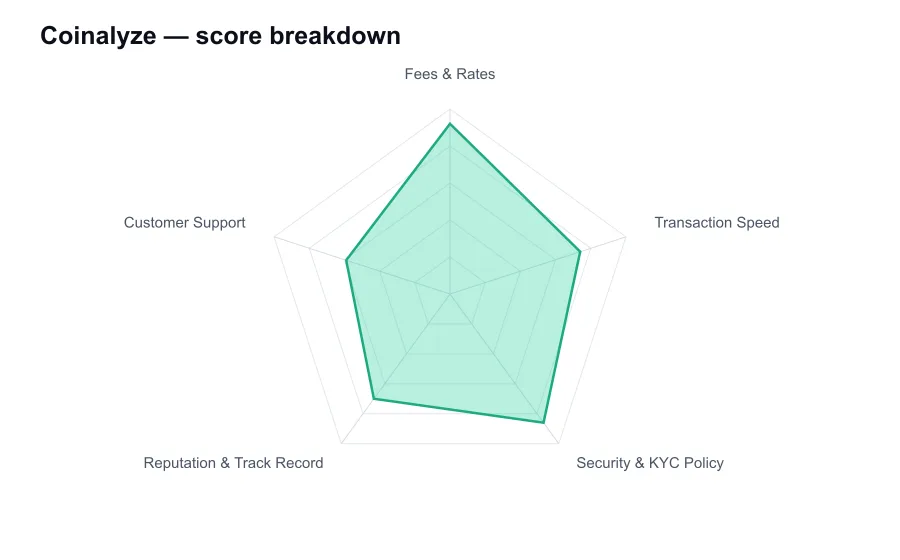
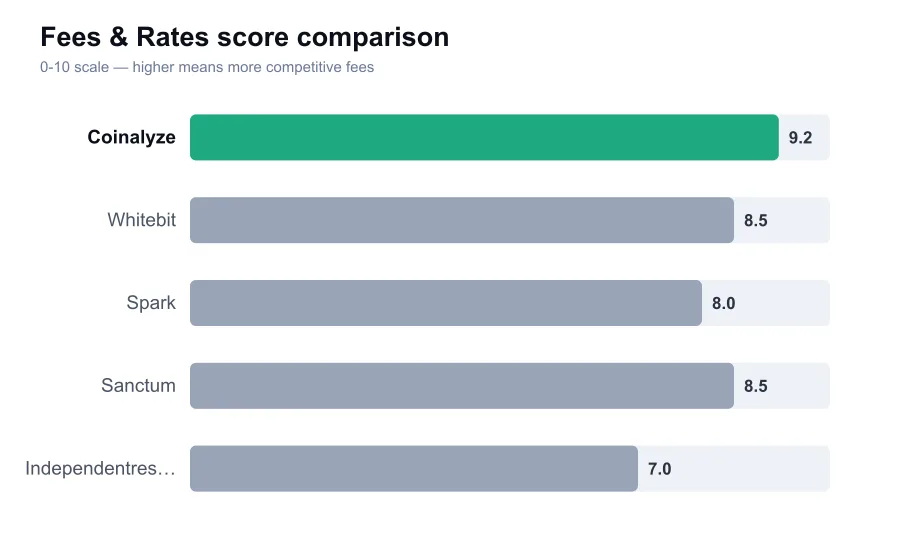
Coinalyze scores 7.9/10 overall in our independent review, measured against every other provider we've compared, strongest on Fees & Rates (9.2/10) and weakest on Customer Support (5.9/10).
Score: 7.9 How we score → Status: active (checked 2026-10-13T19:42:54.322Z) Visit official siteEditorial independence: our scores and rankings are produced using the fixed criteria above and are not influenced by advertisers. This is an independent ranking site and is not operated by, or affiliated with, any provider we list.
Affiliate disclosure: some links on this page may earn us a commission at no extra cost to you. This does not affect our rankings.
| Criterion | Score | Note |
|---|---|---|
| Fees & Rates | 9.2 | Core derivatives analytics are available without trading commissions. |
| Transaction Speed | 7.4 | Useful market monitoring, but it does not execute transactions. |
| Security & KYC Policy | 8.6 | No custody, deposits, wallet connection, or standard KYC flow. |
| Reputation & Track Record | 7.0 | Recognized specialist source for crypto derivatives data. |
| Customer Support | 5.9 | Lightweight support appropriate for a self-service analytics site. |
| Fact | Value |
|---|---|
| Service type | Crypto derivatives analytics |
| Custody | No customer custody |
| Trade execution | Not offered |
| Core metrics | Funding, OI, liquidations |
| KYC for chart access | Not required |
| Pros | Cons |
|---|---|
| Free access to futures and perpetual-market analytics | — |
| No custody, deposits, or wallet connection required | — |
| Open interest, funding, liquidations, and positioning data | — |
| Useful complement to an exchange charting screen | — |
What is Coinalyze?
How to Use Coinalyze Safely
- Treat funding and open interest as context, not a trading signal
- Verify the exchange and contract behind every chart
- Avoid sharing exchange API keys with unrelated browser tools
- Use position sizing and stop-loss rules before trading leverage
- Check live exchange data before placing a time-sensitive trade
Coinalyze is a crypto derivatives analytics platform, not an exchange, broker, wallet, or custody provider. It gives traders market data such as futures open interest, funding rates, liquidation activity, long and short positioning, and price charts across multiple exchanges. That difference should frame any review. You cannot deposit money into Coinalyze, execute a trade through its own order book, or ask it to release a withdrawal.
The service sits in a competitive niche alongside Coinglass, TradingView, Velo Data, Laevitas, and exchange-native analytics pages. Coinalyze is aimed at traders who think derivatives positioning can reveal more than price alone. A spot chart shows what happened to price. Open interest, liquidations, and funding can help explain whether a move is supported by new leverage, short covering, or a crowded perpetual-futures trade.
Its core attraction is accessible derivatives data. Traders can inspect perpetual and futures markets, compare open interest across venues, view funding rates, and follow liquidations. The platform's charts are useful for quickly spotting leverage building into a breakout or a flush of forced liquidations after a sharp move. Those are real analytical inputs. They are not trading signals that work reliably by themselves.
That point needs emphasis because crypto analytics sites can make noisy data look decisive. A rising open-interest figure can mean bullish conviction, but it can also mean leveraged longs are building just before a liquidation cascade. Negative funding can create a short-squeeze setup, but it can also persist during a genuine downtrend. Coinalyze provides the raw context. The user still needs a risk plan, market knowledge, and skepticism.
Fees are easy to assess because the core website has been available as a free data service. There is no commission for viewing charts because Coinalyze does not process trades. That earns a high fee score, though it would be misleading to treat free access as a complete economic advantage. Traders who use the information to make poor leveraged decisions can lose far more than they would ever save on a subscription.
Transaction speed is mostly irrelevant here. Coinalyze is not responsible for order matching, blockchain settlement, deposits, or withdrawals. The relevant performance question is data freshness and chart responsiveness. For market monitoring, the platform is typically quick enough to be useful, but serious short-term traders should understand that data aggregation and exchange reporting can introduce delays or differences. A liquidation dashboard is a monitoring tool, not a guaranteed real-time feed for automated execution.
The charting experience is practical. It does not have the visual polish or enormous indicator ecosystem of TradingView, but it provides the derivative-specific data that TradingView users often need to source elsewhere. Traders can switch between instruments and venues, inspect historical metrics, and compare data around major price events. The site is more useful on a desktop browser than on a small phone screen, where dense derivatives charts quickly become hard to read.
Coinalyze's lack of custody is its main security advantage. It does not ask users to deposit cryptocurrency, hand over a recovery phrase, or connect a wallet merely to view public market information. There is no account balance to lose in a platform insolvency. That strips out an entire category of crypto risk. It does not remove ordinary web risks such as phishing pages, malicious browser extensions, fake social-media links, or compromised API credentials if users interact with separate services.
KYC is not part of the standard analytics experience. A visitor can access public charts without completing identity verification because no financial transaction is occurring. That makes Coinalyze more private than an exchange account, but readers should not confuse privacy with anonymity in every context. Website operators can still collect technical data such as browser, IP, and usage information according to their policies.
Its reputation is respectable within the derivatives-data community, though it is more of a specialist tool than a household consumer brand. Coinalyze does not have the broad name recognition of CoinMarketCap or TradingView, and it has no reason to. Its audience is narrower: traders who care about futures positioning. The service has been around long enough to establish a user base, and its data is regularly referenced by market participants.
The limitation is dependence on exchange-the public record and the complexity of comparing it. Open interest denominated in contracts, coins, or dollars can be interpreted differently. An exchange may have different contract specifications, index calculations, and reporting practices. Coinalyze can aggregate a useful picture, but aggregation never makes unlike products perfectly identical. Traders should inspect the exchange and instrument behind a chart before drawing a conclusion.
Support is necessarily lighter than support at a financial platform. There are no deposits to trace or identity checks to resolve. Users are more likely to need help understanding an indicator, reporting a chart problem, or asking about available data than dealing with a frozen account. Documentation and contact channels are adequate for that purpose, but anyone expecting dedicated market-analysis coaching will be disappointed.
Coinalyze is valuable if used with discipline. It is especially good for a trader who already has a preferred exchange and wants an extra layer of futures context before entering a position. It is less useful for a passive investor who buys Bitcoin monthly and does not intend to trade around volatility. It can also encourage overtrading if a user begins treating every funding-rate change as a call to action.
My verdict is favorable, with a firm warning attached. Coinalyze offers a lot of market intelligence for a free analytics service and avoids the custodial hazards of exchange platforms because it never holds funds. Its data can sharpen a trader's read on leverage and positioning, but it cannot turn a weak trading process into a strong one. Use it as a dashboard and a source of questions, not as an oracle.
Can I buy or sell cryptocurrency on Coinalyze?
No. Coinalyze is an analytics platform. It provides derivatives-market charts and metrics, but it does not operate an exchange, accept deposits, or execute trades.
Does Coinalyze require KYC?
No standard KYC process is required to view its public analytics. Coinalyze does not provide customer trading accounts or custody services.
What does open interest on Coinalyze mean?
Open interest measures the value or number of outstanding derivatives positions for a market. Rising open interest can indicate increasing leverage, but it does not by itself predict price direction.
What are liquidation charts used for?
Liquidation charts show forced closures of leveraged positions reported by supported exchanges. Traders use them to assess where leverage was wiped out during sharp market moves.
Why can Coinalyze funding data differ between exchanges?
Each perpetual-futures exchange has its own contract design, index methodology, funding schedule, and participant base. Funding rates should be read by venue, not as a universal market number.
Can Coinalyze data be used for automated trading?
It can inform a strategy, but the site is not a trading venue and analytics data may have aggregation or reporting delays. Do not treat dashboard figures as a guaranteed execution feed.
Editorial independence: our scores and rankings are produced using the fixed criteria above and are not influenced by advertisers. This is an independent ranking site and is not operated by, or affiliated with, any provider we list.
Affiliate disclosure: some links on this page may earn us a commission at no extra cost to you. This does not affect our rankings.