Sanctum
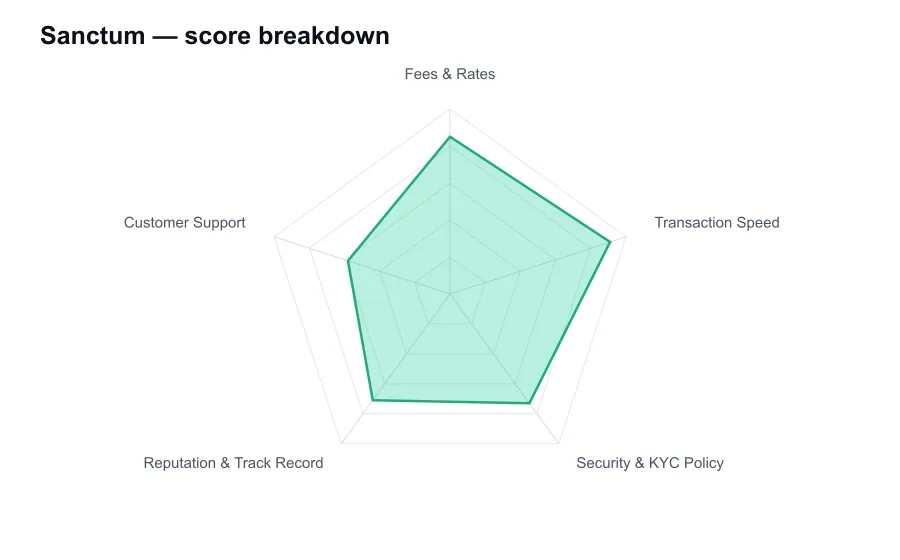
Sanctum scores 7.8/10 overall in our independent review, measured against every other provider we've compared, strongest on Transaction Speed (9.1/10) and weakest on Customer Support (5.8/10).
Score: 7.8 How we score → Status: active (checked 2026-10-13T19:23:23.372Z) Visit official siteEditorial independence: our scores and rankings are produced using the fixed criteria above and are not influenced by advertisers. This is an independent ranking site and is not operated by, or affiliated with, any provider we list.
Affiliate disclosure: some links on this page may earn us a commission at no extra cost to you. This does not affect our rankings.
| Criterion | Score | Note |
|---|---|---|
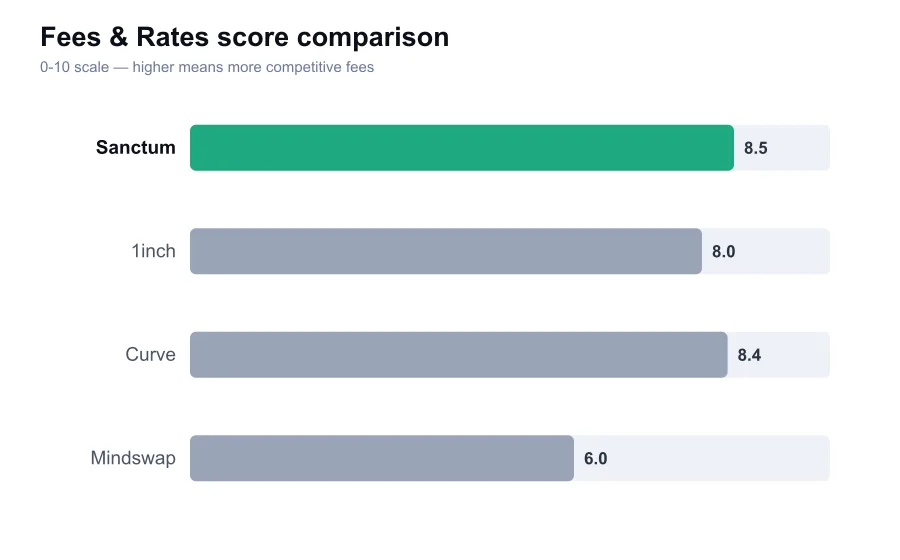
| Fees & Rates | 8.5 | Very low protocol costs, though slippage still affects output. |
| Transaction Speed | 9.1 | Solana transactions usually settle in seconds. |
| Security & KYC Policy | 7.3 | Non-custodial design and audits, with material smart-contract risk. |
| Reputation & Track Record | 7.1 | Prominent Solana LST protocol, but still comparatively young. |
| Customer Support | 5.8 | Documentation and community help, no recovery desk for bad signatures. |
| Fact | Value |
|---|---|
| Blockchain | Solana |
| Service type | Liquid staking liquidity protocol |
| Custody | Non-custodial wallet interaction |
| Core product | Infinity LST liquidity pool |
| CLOUD launch | 2024 |
| Typical chain speed | Seconds on Solana |
| Pros | Cons |
|---|---|
| Specialised liquidity for Solana liquid staking tokens | — |
| Fast, low-cost Solana transaction flow | — |
| Non-custodial wallet-based access | — |
| Useful routes between supported LSTs | — |
What is Sanctum?
How Sanctum Works
- Install and fund a compatible Solana wallet
- Open the verified Sanctum application
- Connect the wallet and choose a SOL or LST route
- Review token amount, price impact, and transaction details
- Sign the transaction in the wallet
- Confirm the received token balance on Solana
KYC
| Requirement | none |
|---|---|
| Notes | Sanctum is a wallet-connected DeFi protocol and does not use standard exchange account onboarding. Wallet providers and user jurisdictions can still have separate requirements. |
Supported Assets
| Notable Coins | SOL, JitoSOL, mSOL, bSOL, INF |
|---|---|
| Networks | Solana |
Limits
| Notes | There is no standard account limit. Practical swap size depends on available route liquidity, price impact, wallet balance, and Solana network conditions. |
|---|
Availability
| Global? | Yes |
|---|---|
| Notes | The protocol is accessible through self-custody wallets, subject to user responsibility and any applicable local legal restrictions. |
How to Use Sanctum Safely
- Verify the sanctum.so domain before connecting a wallet
- Use a small test transaction before moving significant SOL
- Inspect token mint and output amount before signing
- Compare price impact with another Solana route
- Never share a wallet seed phrase or private key
- Keep only necessary funds in a hot wallet
Sanctum is a Solana-native liquidity protocol built around a problem that is easy to miss until you try staking seriously. Solana liquid staking tokens are useful because they let a user keep a tradable token while their SOL remains staked. The problem is fragmentation. Different validators and staking products create different LSTs, and each one can have thin markets or awkward redemption paths. Sanctum tries to make those assets easier to enter, exit, and trade through shared liquidity and its Infinity pool model.
This is not a centralised exchange, a crypto bank, or a simple wallet. It is a decentralised protocol accessed through a Solana wallet. Users connect a wallet, swap SOL into supported liquid staking tokens, trade one LST for another, or use Sanctum's liquidity routes to exit an LST without waiting through a standard stake deactivation period. Its core value proposition is liquidity. If it works as intended, a user can choose an LST for validator alignment or yield preferences without being trapped in a tiny isolated market.
The distinction between staking yield and trading return matters. Holding an LST can provide exposure to staking rewards, but token prices, validator commissions, protocol mechanics, and liquidity conditions all shape the result. Sanctum does not make staking risk disappear. It changes the user experience around it. A person can potentially obtain an LST or redeem it through a deep shared liquidity mechanism instead of waiting for delayed unstaking, but that convenience may carry a quoted fee, a price impact, or a deviation from the token's theoretical SOL value.
Fees are one of Sanctum's more attractive qualities, provided users look at the actual route. Standard swaps through the Infinity pool have been promoted with very low, and in some cases zero, swap fees, while other charges can arise from liquidity conditions, partner routes, LST-specific economics, and Solana network fees. It is much cheaper structurally than a retail broker spread, especially for native Solana users. Still, calling a route free because its explicit protocol fee is zero can be misleading if slippage is present. The output amount is what counts.
Solana's speed is a major practical advantage here. Transactions often confirm in seconds, and the network's fees are generally tiny compared with Ethereum mainnet. That makes Sanctum pleasant for iterative staking operations, rebalancing, or testing with a small amount. It also means users can make a mistake quickly. A wallet confirmation is not an email confirmation. Once signed and finalised, a bad transaction is generally irreversible. Fast execution amplifies both convenience and the need to inspect every instruction.
Sanctum's Infinity pool is the protocol's central idea. Rather than requiring every LST to establish a separate deep SOL pool, it supports a shared liquidity design intended to make swaps among participating LSTs more efficient. This could matter for smaller validator-focused LSTs that would otherwise have poor exit liquidity. It is a genuinely useful design direction for Solana staking. The caveat is that shared liquidity does not magically remove stress risk. During sharp market moves, unusual redemptions, or liquidity imbalances, prices and available routes still deserve scrutiny.
The protocol's LST focus also makes it more specialised than Jupiter, the broader Solana swap aggregator. Jupiter may be the better choice if a user wants to shop across a wide range of token pools. Sanctum is more compelling when the task specifically concerns liquid staking assets, such as exchanging SOL for an LST, moving between LSTs, or getting liquidity out of a supported LST. A smart user often checks both, because aggregators and direct protocol routes can produce different outcomes at a given moment.
Security must be judged differently from a custodial exchange. Sanctum does not hold an account balance in the manner of Ripio or SatoshiTango. The user's wallet controls the assets until a signed transaction interacts with a smart contract. That removes account-freeze and exchange-custody risks, but it introduces smart contract, oracle, liquidity, frontend, and wallet-security risk. A contract exploit or a malicious approval can be more final than a delayed support ticket. Self-custody means the user has more control and more responsibility.
The protocol has undergone security review work, including audits by firms such as OtterSec for parts of its Solana programs. Audits are useful evidence of engineering discipline, not insurance. They cover a particular codebase and point in time, and they do not guarantee that every integration, frontend route, governance decision, or future upgrade is safe. DeFi users should be wary of anyone presenting an audit badge as proof that funds cannot be lost. That is not how smart-contract risk works.
Sanctum gained meaningful attention through its 2024 ecosystem activity, including its Wonderland points campaign and the CLOUD token launch. That visibility helped bring users and liquidity, though it also created the usual incentive-program behaviour: people moving capital to farm rewards rather than because they understand the underlying product. The protocol should be evaluated after the rewards excitement, not only during it. A liquidity system needs durable participants and sensible economics, not just temporary capital attracted by token distribution.
Its reputation is promising but young. Sanctum is associated with a known Solana DeFi team and has become a relevant name in the LST category, yet it does not have the decade-long operational history of mature infrastructure. Solana itself has faced past network reliability issues, and the liquid-staking sector contains layers of interconnected risk. A user holding an LST through Sanctum is exposed to Solana, the relevant stake pool or validator system, the LST's market liquidity, and the protocol route used. That stack is manageable, but it is not simple.
Customer support is another place where expectations should be realistic. Sanctum has community channels and documentation, which are useful for understanding routes and troubleshooting basic wallet issues. It does not offer the kind of personal account support someone expects from a bank. If a user signs a transaction to the wrong address, uses a counterfeit site, or interacts with a scam token, there is usually no recovery desk. The most valuable support tool in DeFi is careful preparation before signing.
For a Solana-native user, Sanctum can be genuinely excellent. It makes the LST category more usable and reduces friction around liquidity that once pushed many users toward a single dominant staking token. It is especially interesting for users who want to support a particular validator or diversify LST exposure without accepting a painful exit process. But it is not beginner-friendly in the way a custodial app is beginner-friendly. Someone unfamiliar with wallet signing, token accounts, and Solana explorers should learn those basics first.
Risk management should be boring and deliberate. Start with a small amount of SOL. Verify the domain, connect through a trusted wallet, inspect the token received, and compare the expected output with an independent route such as Jupiter. Do not borrow to chase LST yield or incentive points. Do not assume an LST always trades exactly at its theoretical redemption value. And never treat a high displayed annualised return as a guarantee.
My verdict is positive, with limits. Sanctum is one of the more thoughtful Solana DeFi products because it addresses real LST fragmentation rather than inventing another token for its own sake. Its low-cost, near-instant interactions are a material advantage, and the shared-liquidity concept is useful. Yet the protocol is young, DeFi risk is real, and support cannot rescue a careless transaction. It is a strong tool for informed Solana users, not a safe first stop for someone who has never managed a self-custody wallet.
Is Sanctum a centralised exchange?
No. Sanctum is a Solana DeFi protocol accessed through a self-custody wallet. Users sign on-chain transactions rather than deposit into a conventional exchange account.
What does Sanctum's Infinity pool do?
Infinity is Sanctum's shared-liquidity design for supported Solana liquid staking tokens. It aims to make LST swaps and exits more efficient than isolated pools.
Are Sanctum swaps free?
Some routes can have zero or very low explicit protocol fees, but users still need to inspect slippage, route pricing, and Solana network fees before signing.
Can I recover funds after signing the wrong transaction?
Usually not. Solana transactions are generally irreversible after confirmation, and Sanctum cannot provide bank-style recovery for a mistaken wallet signature.
Does an LST always equal exactly one SOL?
No. An LST's value reflects accrued staking rewards and market conditions. It can trade at a premium or discount to a theoretical SOL redemption value.
Why compare Sanctum with Jupiter?
Sanctum specialises in liquid staking token liquidity, while Jupiter aggregates wider Solana markets. Checking both can reveal a better route or lower price impact.
Was Sanctum involved in the CLOUD token launch?
Yes. Sanctum's 2024 ecosystem activity included the Wonderland campaign and CLOUD token launch, which increased attention on the protocol.
Editorial independence: our scores and rankings are produced using the fixed criteria above and are not influenced by advertisers. This is an independent ranking site and is not operated by, or affiliated with, any provider we list.
Affiliate disclosure: some links on this page may earn us a commission at no extra cost to you. This does not affect our rankings.