Spark
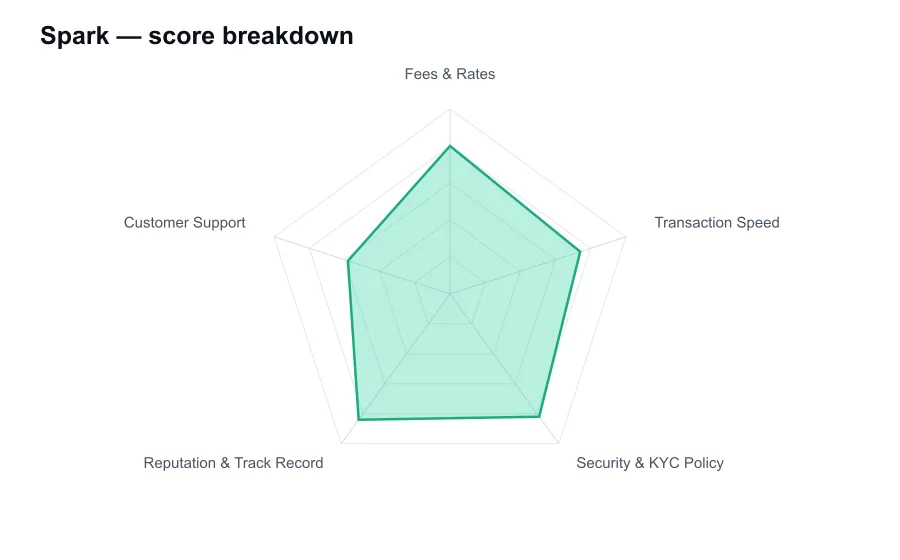
Spark scores 7.8/10 overall in our independent review, measured against every other provider we've compared, strongest on Reputation & Track Record (8.4/10) and weakest on Customer Support (5.8/10).
Score: 7.8 How we score → Status: active (checked 2026-10-13T19:32:12.596Z) Visit official siteEditorial independence: our scores and rankings are produced using the fixed criteria above and are not influenced by advertisers. This is an independent ranking site and is not operated by, or affiliated with, any provider we list.
Affiliate disclosure: some links on this page may earn us a commission at no extra cost to you. This does not affect our rankings.
| Criterion | Score | Note |
|---|---|---|
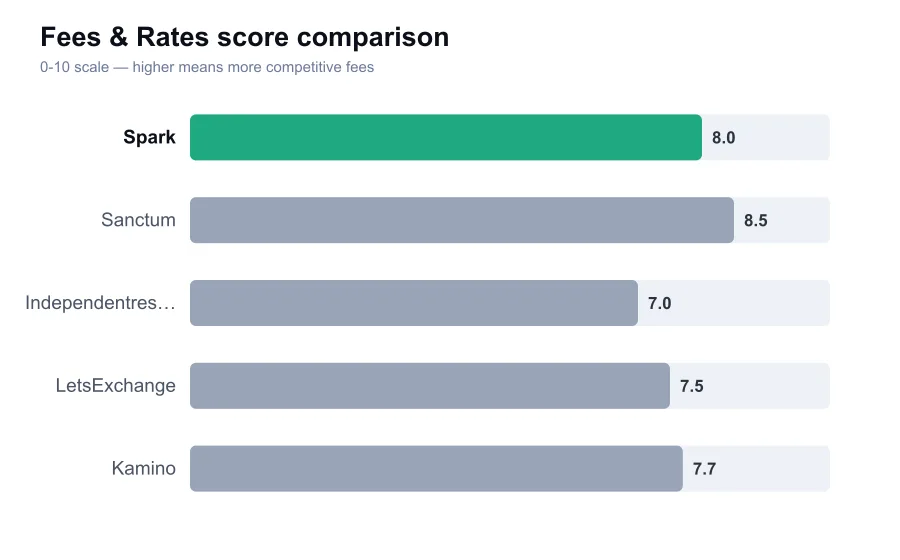
| Fees & Rates | 8.0 | Variable protocol rates, with Ethereum gas as the main cost |
| Transaction Speed | 7.4 | Execution depends on Ethereum confirmation and gas conditions |
| Security & KYC Policy | 8.2 | Public DeFi contracts, but liquidation and smart contract risk remain |
| Reputation & Track Record | 8.4 | Built within the established Sky and MakerDAO ecosystem |
| Customer Support | 5.8 | Documentation and community help, not account-level recovery |
| Fact | Value |
|---|---|
| Core product | SparkLend money market |
| Savings token | sUSDS |
| Primary chain | Ethereum |
| Protocol KYC | Not required |
| Interest model | Variable by utilization |
| Custody model | Self-custody smart contracts |
| Pros | Cons |
|---|---|
| Integrated with the established Sky stablecoin ecosystem | — |
| No protocol-level KYC for self-custody users | — |
| USDS savings and lending tools in one interface | — |
| Transparent on-chain position management | — |
What is Spark?
How Spark Works
- Connect an Ethereum-compatible self-custody wallet
- Choose a lending, borrowing or USDS savings product
- Approve the selected token in your wallet
- Submit the supply, borrow or deposit transaction
- Monitor borrowing health and repay or add collateral if needed
KYC
| Requirement | none |
|---|---|
| Notes | Spark's protocol does not normally require identity verification for wallet interactions. Users remain responsible for local legal and tax obligations. |
Supported Assets
| Notable Coins | USDS, DAI, Ethereum, Wrapped Bitcoin, USD Coin |
|---|---|
| Networks | Ethereum |
How to Use Spark Safely
- Use the verified spark.fi domain and inspect wallet prompts
- Keep borrowed positions well below liquidation thresholds
- Monitor interest rates and collateral health regularly
- Revoke unused token approvals
- Do not treat stablecoin yield as insured cash interest
Spark is a decentralized finance product built around the Sky ecosystem, formerly known as MakerDAO. It is not an instant exchange in the Exolix sense and it should not be judged as if it were one. Spark's core purpose is lending, borrowing and earning yield on stablecoin deposits through smart contracts, primarily on Ethereum.
The main product is SparkLend, a money market where users can supply approved collateral and borrow supported assets. The familiar use case is depositing ETH, wrapped Bitcoin or a stablecoin, then borrowing USDS or another supported asset against that collateral. It resembles Aave in interface and mechanics, though Spark is closely tied to Sky's stablecoin system and governance structure.
Spark also offers savings products connected to USDS. Users who hold USDS can deposit into the Spark Savings mechanism and receive sUSDS, a token representing a yield-bearing position. The rate is set through Sky governance and can change. That makes the product simple to use, but it does not make the yield permanent or risk-free.
The service earns its place in a crypto exchange comparison only because users may move between assets, collateral and stablecoins within the same DeFi workflow. Calling it an exchange is misleading. There is no conventional centralized matching engine, no customer-service desk that can reverse a trade and no promise of immediate conversion at a quoted retail price.
Fees are more transparent here than at most instant exchangers, although they are more complicated. Suppliers and borrowers face interest rates that change with pool utilization and governance parameters. On Ethereum, gas is an unavoidable additional cost. A small deposit or withdrawal can be uneconomic during periods of high network fees, even if Spark's own protocol charge is low.
Borrowers should focus on the annualized borrow rate rather than looking for a single headline fee. The rate varies by asset and can rise as borrowing demand increases. A user who borrows USDS against ETH may pay a very different rate from someone borrowing another asset against stablecoin collateral. Leaving a position unattended is poor practice because rates, collateral values and liquidation risk move independently.
For stablecoin savers, the relevant figure is the Savings Rate available through sUSDS. That rate is governed, not contractually fixed forever. Spark has often been attractive because the Sky ecosystem can direct substantial stablecoin liquidity toward savings products. The catch is obvious. A high yield is only useful if you understand USDS exposure, smart contract risk and the possibility of a governance decision changing the rate.
Speed is governed by Ethereum. Opening a supply position, borrowing and withdrawing are generally completed as soon as the transaction is included and finalized to the user's satisfaction. In ordinary conditions that feels quick. Under heavy gas conditions, the experience can be expensive and less pleasant. There is no support agent who can speed up a pending transaction, and users must set a sensible gas fee themselves.
Spark's security model is stronger than a thinly documented swap website because it relies on public smart contracts, formal governance processes and a mature ecosystem around Sky. That should not be confused with a guarantee. DeFi security is technical security, and smart contracts can have bugs, oracle systems can fail and governance can make decisions token holders dislike.
KYC is not required at the protocol layer for a normal self-custody wallet interaction. That is a genuine difference from centralized lenders and from instant exchange providers that may request documents after a risk flag. The absence of KYC does not make the activity anonymous in a complete sense. Ethereum transactions are public, and regulated entry and exit points may still identify users.
Liquidation is the central risk that inexperienced users underestimate. If borrowed funds are secured by volatile collateral and that collateral falls enough, liquidators can repay debt and seize collateral according to the protocol rules. Spark provides health metrics, but a dashboard indicator is not a substitute for maintaining a conservative loan-to-value ratio. Borrowing against ETH during a steep sell-off can become painful very quickly.
The product's reputation is tied closely to MakerDAO and Sky, one of DeFi's longest-running stablecoin organizations. That gives Spark more institutional depth than a new yield app with anonymous developers. It also means users are exposed to a fairly elaborate governance system, real-world asset strategies and stablecoin policy choices. The project is serious, but it isn't simple.
Support is limited by the nature of the product. Spark provides documentation and community channels, but it does not offer the sort of account-level rescue that users expect from a bank or centralized exchange. If you sign a malicious approval, send assets to the wrong contract or allow a collateral position to be liquidated, there may be no practical remedy.
Spark is best viewed as a focused DeFi money market for users who already understand wallets, approvals, Ethereum gas and collateral management. It can be a very efficient place to earn on USDS or access stablecoin liquidity without selling core collateral. It is a bad first crypto product. The strongest feature is its connection to Sky's established stablecoin machinery, and the biggest danger is assuming that established means simple or safe enough to ignore risk.
Is Spark a cryptocurrency exchange?
Not in the usual sense. Spark is primarily a DeFi lending and savings protocol where users supply assets, borrow against collateral and earn through USDS-related products.
Does Spark require KYC?
No KYC is generally required to interact with Spark through a self-custody wallet. Ethereum transactions remain public and external fiat providers may have their own checks.
What is sUSDS?
sUSDS is the token users receive after depositing USDS into Spark Savings. It represents a yield-bearing USDS position and its rate can change through Sky governance.
Can a Spark borrowing position be liquidated?
Yes. If your collateral value falls or debt grows enough to breach the applicable risk threshold, protocol liquidators can repay debt and seize collateral.
Why does a small Spark transaction cost so much?
Spark transactions on Ethereum require gas. During congestion, Ethereum network fees can exceed the value of a small deposit, withdrawal or position adjustment.
Can Spark support reverse a transaction?
No. Spark uses self-custody smart contracts. Confirmed blockchain transactions, approvals and liquidations generally cannot be reversed by a support team.
Editorial independence: our scores and rankings are produced using the fixed criteria above and are not influenced by advertisers. This is an independent ranking site and is not operated by, or affiliated with, any provider we list.
Affiliate disclosure: some links on this page may earn us a commission at no extra cost to you. This does not affect our rankings.