Kamino
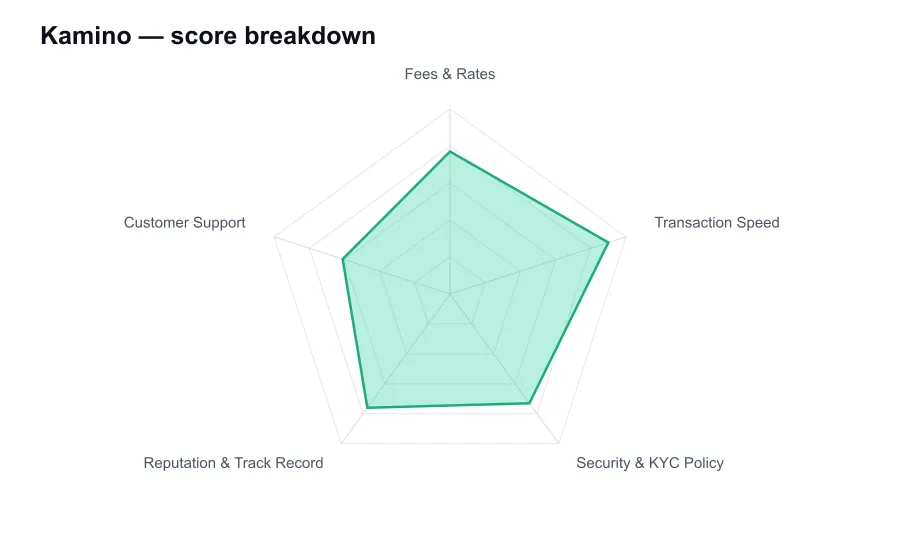
Kamino scores 7.7/10 overall in our independent review, measured against every other provider we've compared, strongest on Transaction Speed (9.0/10) and weakest on Customer Support (6.1/10).
Score: 7.7 How we score → Status: active (checked 2026-10-13T19:40:44.158Z) Visit official siteEditorial independence: our scores and rankings are produced using the fixed criteria above and are not influenced by advertisers. This is an independent ranking site and is not operated by, or affiliated with, any provider we list.
Affiliate disclosure: some links on this page may earn us a commission at no extra cost to you. This does not affect our rankings.
| Criterion | Score | Note |
|---|---|---|
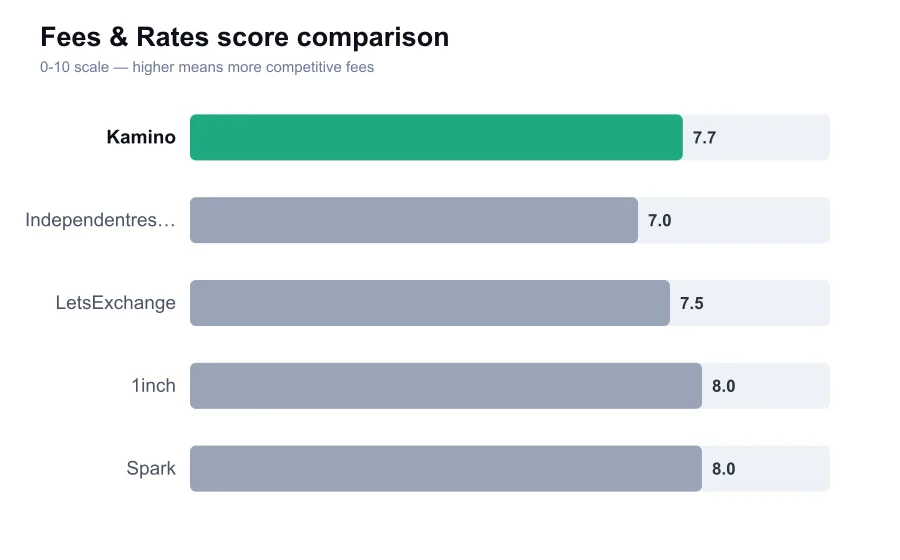
| Fees & Rates | 7.7 | Low Solana transaction costs, but lending rates vary by utilization. |
| Transaction Speed | 9.0 | Solana confirmations make deposits and position changes very fast. |
| Security & KYC Policy | 7.3 | Audited non-custodial contracts, with material liquidation and DeFi risk. |
| Reputation & Track Record | 7.6 | A prominent Solana DeFi protocol, though still relatively young. |
| Customer Support | 6.1 | Documentation and community help, no recovery from on-chain errors. |
| Fact | Value |
|---|---|
| Primary blockchain | Solana |
| Lending product | Kamino Lend |
| Governance token | KMNO |
| KMNO launch year | 2024 |
| KYC model | No routine KYC |
| Rate model | Variable by reserve utilization |
| Pros | Cons |
|---|---|
| Fast, low-cost Solana lending and borrowing | — |
| Non-custodial access without routine KYC | — |
| Automated liquidity vaults and lending in one interface | — |
| Supports conservative collateral management well | — |
What is Kamino?
How Kamino Works
- Connect a compatible Solana wallet
- Choose a lending reserve or liquidity strategy
- Review displayed annualized rates, collateral rules and risks
- Deposit an asset or post collateral before borrowing
- Monitor health factor and utilization after opening a position
- Repay debt or withdraw funds through a signed Solana transaction
KYC
| Requirement | none |
|---|---|
| Notes | Kamino's on-chain application normally requires only a compatible Solana wallet. Users remain responsible for wallet security, local legal obligations and transaction authorization. |
Supported Assets
| Notable Coins | SOL, USDC, USDt, JitoSOL, mSOL, bSOL, PYTH |
|---|---|
| Networks | Solana |
How to Use Kamino Safely
- Use a hardware wallet for meaningful deposits or collateral
- Keep loan health well above liquidation levels
- Check variable borrow rates before opening leverage
- Verify the official Kamino URL before connecting a wallet
- Do not treat vault yield as guaranteed income
- Never share a seed phrase with alleged support staff
Kamino is one of Solana's leading DeFi protocols, combining lending, borrowing, leveraged liquidity strategies and automated liquidity vaults in one product suite. It is not an exchange in the ordinary centralized sense. There is no company-held account balance, no simple spot order book and no customer service desk that can undo a trade. Kamino is a set of Solana smart contracts that users access with their own wallets, and its appeal is the way it packages fairly advanced on-chain strategies into a cleaner interface.
The lending product, Kamino Lend, is the part most likely to interest a cautious DeFi user. Depositors supply assets to lending markets and earn variable interest. Borrowers post collateral and pay variable interest to borrow another supported asset. The model resembles Aave conceptually, but it is built for Solana's high-throughput, low-cost environment. This makes it possible to manage collateral and rebalance positions without Ethereum-scale gas fees eating every small adjustment.
Kamino also became well known for automated liquidity positions. Its vaults can manage concentrated-liquidity placements on Solana decentralized exchanges, aiming to keep capital in an active price range and compound fees. This is useful technology, but the word automated can make a difficult product sound safer than it is. A strategy can rebalance efficiently and still lose money through market movement, adverse selection, token emissions or a sharp move that leaves the position exposed on the wrong side of a pair.
Fees on Kamino do not fit a single simple percentage. Lending rates are market-driven and change with utilization. Borrowers pay interest, lenders receive a portion of it, and individual reserves can have their own configuration and reserve factors. Liquidity vaults and swap-related flows may have separate strategy or venue costs. Solana transaction fees are usually tiny compared with Ethereum, which makes Kamino feel inexpensive in use, but low network fees should not be confused with low financial risk or low borrowing cost.
For a borrower, the relevant number is the displayed annualized borrow rate and the health of the collateral position, not merely the transaction fee. A volatile SOL-backed stablecoin loan can become dangerous rapidly if SOL falls while utilization pushes borrowing rates upward. For a depositor, a high annual percentage yield can signal genuine lending demand, but it can also be temporary and linked to incentives. Kamino displays useful reserve metrics, and users should actually read them before chasing the highest number on the page.
Speed is a clear advantage. Solana transactions generally confirm quickly and cost very little, so deposits, repayments and collateral adjustments are much more responsive than comparable actions on Ethereum mainnet. That can be valuable in a fast market. It also creates a trap. The ability to lever up in seconds does not mean users have time to think through the liquidation threshold. Fast chains reward disciplined position management. They punish people who open complex leverage with no plan for a sudden price move.
Kamino is non-custodial and normally has no KYC requirement. You connect a Solana wallet, such as Phantom, Backpack or Solflare, and authorize transactions yourself. That gives users direct control of their assets outside the protocol interactions. It also means wallet security is part of the protocol's practical safety. A compromised seed phrase, a malicious transaction request or a fake site can drain a wallet before Kamino's smart contract protections matter. Hardware-wallet use is sensible for meaningful positions.
The protocol has sought audits and maintains a public security posture, including bug bounty efforts. Audits are necessary for an application that manages lending collateral and leveraged positions, but they are not a guarantee. DeFi failures can arise from smart contract bugs, oracle problems, parameter errors, Solana network issues, token depegs or cascading liquidations. Kamino's risk model has to work during stress, not merely during a calm market. Users should avoid treating an audit badge as a substitute for understanding liquidation mechanics.
Liquidation is the central issue for borrowers. Each reserve has collateral parameters and a loan-to-value framework. If the value of your collateral falls or the borrowed asset rises enough, your position can become eligible for liquidation. You do not receive the forgiveness that a bank borrower might expect. Smart contracts execute according to their rules. Kamino's interface gives users health information, but a responsible borrower still keeps a generous buffer rather than operating close to the limit because a few percentage points of market movement can matter.
The platform's reputation has improved alongside Solana's recovery as a major DeFi ecosystem. Kamino Lend attracted significant usage after its 2023 launch, and the KMNO token launch in 2024 put the protocol more visibly into the governance and incentive conversation. It has become one of the recognizable Solana DeFi names, alongside Jupiter, Jito, Marinade and Drift. That standing is encouraging, but it is also relatively young compared with Ethereum lending protocols that have lived through several full market cycles.
Kamino's integrations are an advantage. Solana users often already hold SOL, liquid staking tokens, USDC and ecosystem assets in compatible wallets, so moving those assets into lending or liquidity strategies can be efficient. The danger is that connected DeFi products concentrate risk. A user might stake SOL, use the liquid staking token as collateral, borrow USDC, and deploy that USDC into another yield strategy. Every extra layer adds smart contract, oracle, liquidity and market correlation risk. Sophistication should be earned, not assumed.
Support follows the normal DeFi model: documentation, community channels and announcements rather than a guaranteed human recovery process. The Kamino team and community can help explain a feature or identify a known technical issue, but they cannot restore a liquidated position or retrieve assets sent to the wrong address. Scam accounts exploit this reality aggressively. Legitimate team members do not need a seed phrase, private key or wallet remote-control session. Users should rely on links from Kamino's official channels, not search-engine ads or direct messages.
Kamino's interface is considerably more approachable than manually building a Solana lending and concentrated-liquidity setup from raw contracts. That usability is a genuine accomplishment. Still, the product can make complex risk feel like a simple yield dashboard. I would happily use Kamino Lend for a conservatively collateralized position in liquid, well-understood assets. I would be much more selective about leveraged vaults, long-tail collateral and strategies where the source of the advertised yield is unclear.
My final take is that Kamino is a strong Solana-native DeFi platform with excellent transaction responsiveness and a thoughtful product range. It deserves a higher usability and speed assessment than many fragmented DeFi tools, but it should not be mistaken for a low-risk savings platform. The absence of KYC and custody is attractive for users who value self-sovereignty, while liquidation and smart contract risk remain very real. Use it with a hardware wallet, keep leverage modest, and assume that no support agent can rescue a position you chose to run too close to the edge.
Does Kamino require KYC?
Kamino's smart-contract interface does not impose routine KYC. Users normally connect a Solana self-custody wallet and sign transactions directly.
Why do Kamino borrow rates change?
Borrow rates are variable and respond to each reserve's utilization. As more of an asset is borrowed relative to supplied liquidity, borrowing can become more expensive.
Can my Kamino loan be liquidated?
Yes. If collateral value drops or debt value rises enough to breach the reserve's risk parameters, the position can be liquidated. Keep a substantial health buffer.
What is Kamino Lend?
Kamino Lend is the protocol's Solana lending market. Users can supply supported assets to earn variable interest or post collateral to borrow other supported assets.
Are Kamino liquidity vault returns guaranteed?
No. Automated vaults can earn fees and incentives, but returns vary with market conditions. Users face token price risk, concentrated-liquidity risk and smart contract risk.
What happened with the KMNO token?
KMNO is Kamino's governance token and launched in 2024. Token ownership and incentive programs do not remove the risks of lending, borrowing or liquidity provision.
Can Kamino support reverse a liquidation?
No. Liquidations are executed by smart contract rules once a position reaches the relevant threshold. Support can explain mechanics but cannot reverse a completed on-chain action.
Editorial independence: our scores and rankings are produced using the fixed criteria above and are not influenced by advertisers. This is an independent ranking site and is not operated by, or affiliated with, any provider we list.
Affiliate disclosure: some links on this page may earn us a commission at no extra cost to you. This does not affect our rankings.