1inch
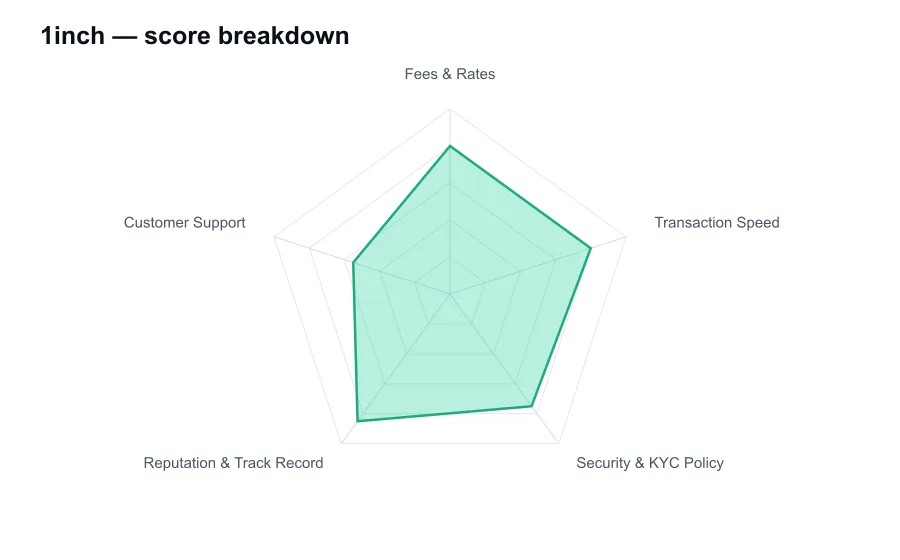
1inch scores 7.7/10 overall in our independent review, measured against every other provider we've compared, strongest on Reputation & Track Record (8.5/10) and weakest on Customer Support (5.5/10).
Score: 7.7 How we score → Status: active (checked 2026-10-13T19:49:14.259Z) Visit official siteEditorial independence: our scores and rankings are produced using the fixed criteria above and are not influenced by advertisers. This is an independent ranking site and is not operated by, or affiliated with, any provider we list.
Affiliate disclosure: some links on this page may earn us a commission at no extra cost to you. This does not affect our rankings.
| Criterion | Score | Note |
|---|---|---|
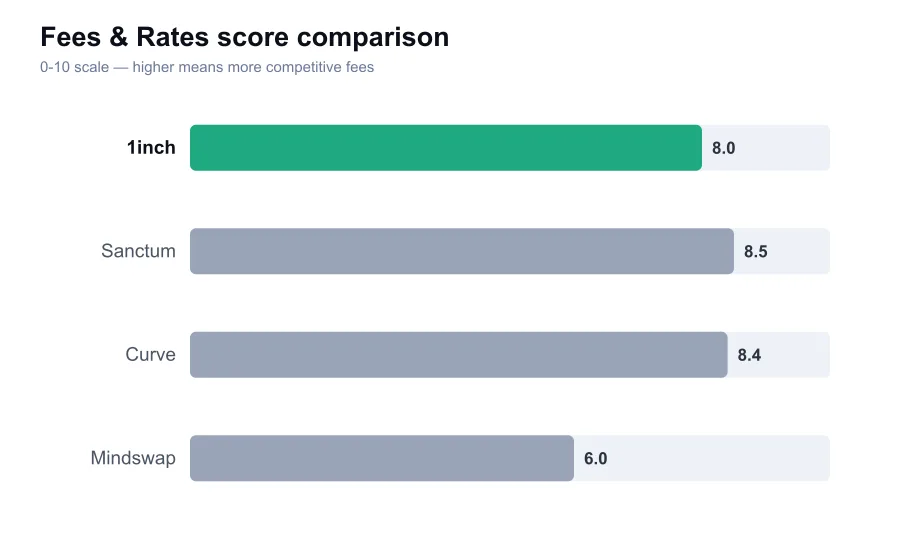
| Fees & Rates | 8.0 | No standard aggregator fee, but gas and pool fees apply |
| Transaction Speed | 8.0 | Settlement follows the chosen network and route |
| Security & KYC Policy | 7.5 | Non-custodial architecture, smart-contract risk remains |
| Reputation & Track Record | 8.5 | Established DeFi project launched in 2020 |
| Customer Support | 5.5 | Good documentation, no reversal of on-chain mistakes |
| Fact | Value |
|---|---|
| Founded | 2020 |
| Custody model | Non-custodial |
| Standard swap fee | No standard 1inch protocol fee |
| Protocol KYC | Not routinely required |
| Fusion execution | Resolver-filled signed orders |
| Governance token | 1INCH |
| Pros | Cons |
|---|---|
| Non-custodial wallet-to-wallet trading | — |
| Aggregates liquidity across decentralised venues | — |
| Fusion can offer gasless order execution | — |
| No routine protocol-level KYC | — |
What is 1inch?
How 1inch Works
- Connect a self-custody wallet
- Select the token pair and network
- Review the route, estimated output, gas, and slippage
- Approve the token if an allowance is required
- Sign and submit the swap, or sign a Fusion order
- Verify the completed transaction in your wallet or a block explorer
KYC
| Requirement | none |
|---|---|
| Notes | The 1inch protocol does not ordinarily require identity verification. Access to third party services, wallet providers, or particular web interfaces can be subject to separate rules. |
Supported Assets
| Notable Coins | Ether, Wrapped Ether, USD Coin, Tether, Dai, Wrapped Bitcoin, 1INCH |
|---|---|
| Networks | Ethereum, Arbitrum, Optimism, Polygon, BNB Chain, Avalanche |
How to Use 1inch Safely
- Use the official 1inch domain and verify wallet prompts
- Check the final output after gas costs
- Use conservative slippage for volatile or thin tokens
- Review and revoke unused token approvals
- Never sign a transaction you do not understand
- Test unfamiliar tokens with a small amount
1inch is one of the best known names in decentralised trading, though calling it simply an exchange misses the point. It is primarily an aggregation and DeFi infrastructure project. Its software searches supported decentralised exchanges and liquidity sources to find routes for a swap, rather than operating a conventional central limit-order exchange that takes custody of customer deposits.
That distinction changes how 1inch should be judged. You connect a self-custody wallet, approve contracts where required, and sign a transaction. The assets stay under your control until the smart contract executes the trade. There is no traditional account balance, no bank-style customer service desk, and generally no identity check imposed by the underlying protocol. For users who understand self-custody, that is the attraction.
The classic 1inch swap interface can split an order across multiple liquidity sources. A route may use one pool, several pools, or a mix of decentralised venues to improve execution. This is particularly useful for liquid pairs where the best price is fragmented. It can also reduce the work of manually comparing Uniswap, Curve, Balancer, Sushi, and other venues, although users should still inspect the quoted route before approving it.
Fees are a genuine strength, but the marketing shorthand needs correction. 1inch generally does not charge a standard protocol trading fee for a normal aggregation swap. That does not mean the trade is free. The user still pays network gas, the liquidity providers' fees embedded in the underlying pools, and any price impact. On Ethereum mainnet, gas can be the largest cost by far, especially for smaller trades.
The right way to assess a 1inch quote is to compare the final estimated output, not merely the displayed token price. A route with a slightly better nominal rate can become worse once gas is included. This is why 1inch is often more attractive for medium or large trades, or on lower-cost supported networks, than for a tiny Ethereum swap. The interface gives useful information, but users need to read it rather than click through it.
1inch Fusion is a different execution path and one of the project's more interesting ideas. Instead of the user submitting the swap transaction in the familiar way, the user signs an order and competing resolvers can fill it. The design aims to offer gasless execution for the user and reduce exposure to some forms of maximal extractable value. The cost is reflected in the quoted execution, so gasless should never be confused with costless.
Speed depends heavily on the chain, liquidity, and route. A standard swap settles once the relevant network confirms it. On Ethereum, that can be quick in normal conditions but expensive, while Layer 2 networks can be cheaper and often feel faster. Fusion orders may take time to be filled by resolvers, particularly for an awkward pair or a quote that is no longer attractive. It is good technology, but it isn't magic.
Slippage settings deserve more attention than most users give them. A loose slippage tolerance increases the risk of receiving less than expected in a volatile or thin market. An overly tight setting can cause a transaction to revert after gas has been spent. 1inch has tools to help users set sensible parameters, yet the final responsibility remains with the wallet owner. That is the trade-off for permissionless access.
Security is strong at the architectural level because 1inch is non-custodial. The protocol cannot behave like a centralised exchange that freezes an account balance because it does not hold a user account balance in the ordinary sense. The project has maintained a substantial public profile since its 2020 launch and has used audits and bug-bounty practices across its contracts. Still, smart-contract use is never risk-free, and an audited protocol can suffer from integration mistakes, oracle issues, or a previously unknown vulnerability.
The more common risk is user-side. A malicious website can imitate 1inch, a fraudulent token can appear in a wallet, and a careless approval can leave a contract able to spend more than intended. Token approvals are not a minor footnote. Users should review allowances, revoke unnecessary permissions, and be wary of importing token addresses from social posts. 1inch's technology cannot protect someone who signs a malicious transaction in a compromised wallet.
There is no routine KYC requirement at the protocol level. A self-custody wallet can interact with decentralised contracts without a conventional account-opening process. Access through particular interfaces, jurisdictions, wallet providers, fiat on-ramps, or third party services can involve their own restrictions. Users should not mistake protocol-level permissionlessness for a guarantee that every web interface is available in every country.
Reputation is one of 1inch's strongest categories. It has been through several difficult market cycles, remains a recognised DeFi brand, and has a visible developer and governance presence. The 1INCH token and DAO governance do not eliminate risk, but they provide a much clearer public footprint than an anonymous swap site. Compared with a new aggregator, 1inch is a serious infrastructure project with a history worth examining.
Support is where the experience becomes less friendly. 1inch provides documentation, community channels, and help material, but it cannot reverse an on-chain trade or recover assets sent to the wrong address. That is not a service failure. It is the nature of self-custody. Users expecting a human agent to undo a confirmed transaction will be disappointed, and that limitation makes 1inch unsuitable for people who are not ready to manage their own wallet security.
I like 1inch for informed DeFi users who want broad liquidity access without depositing assets at a centralised platform. It is especially useful for comparing routes and for trading on networks where gas does not overwhelm the order. It is less attractive for beginners, for fiat buyers, and for anyone who needs phone support or guaranteed trade reversal. Its strengths are real, but they reward competence.
My final view is positive. 1inch earns high marks for non-custodial design, liquidity aggregation, and its established place in DeFi. Its fee story is favourable if users account for gas and pool fees honestly, while Fusion can be a valuable alternative for suitable orders. The weak point is not the protocol's ambition, it is the unavoidable burden placed on the user. If you know how to verify a wallet prompt and manage approvals, 1inch is one of the better tools available. If you don't, a simpler regulated exchange may be safer for your first purchase.
Does 1inch charge a trading fee?
1inch generally does not add a standard fee to a classic aggregation swap. You still pay network gas and the fees charged by the liquidity pools used in the route.
Does 1inch require KYC?
The underlying protocol does not impose routine KYC. A connected wallet can interact with smart contracts, though third party interfaces or services may have their own access restrictions.
What is 1inch Fusion?
Fusion lets a user sign a swap order that resolvers can fill. It can provide gasless execution for the user, with execution costs reflected in the quoted trade.
Can 1inch reverse a completed swap?
No. A confirmed blockchain transaction is normally irreversible. Check the token, network, amount, recipient, and slippage before signing in your wallet.
Why is a 1inch swap expensive on Ethereum?
The cost can be dominated by Ethereum gas, particularly for small trades or complex routes that interact with several liquidity sources. Compare the final output after gas.
Why does 1inch request token approval?
An approval allows a smart contract to spend the specified token from your wallet for a swap. Review the allowance and revoke unused approvals periodically.
Is Fusion always faster than a normal swap?
No. Fusion depends on resolver interest and the quoted order conditions. A normal swap settles with network confirmation, while a Fusion order must first be filled.
Editorial independence: our scores and rankings are produced using the fixed criteria above and are not influenced by advertisers. This is an independent ranking site and is not operated by, or affiliated with, any provider we list.
Affiliate disclosure: some links on this page may earn us a commission at no extra cost to you. This does not affect our rankings.