LetsExchange
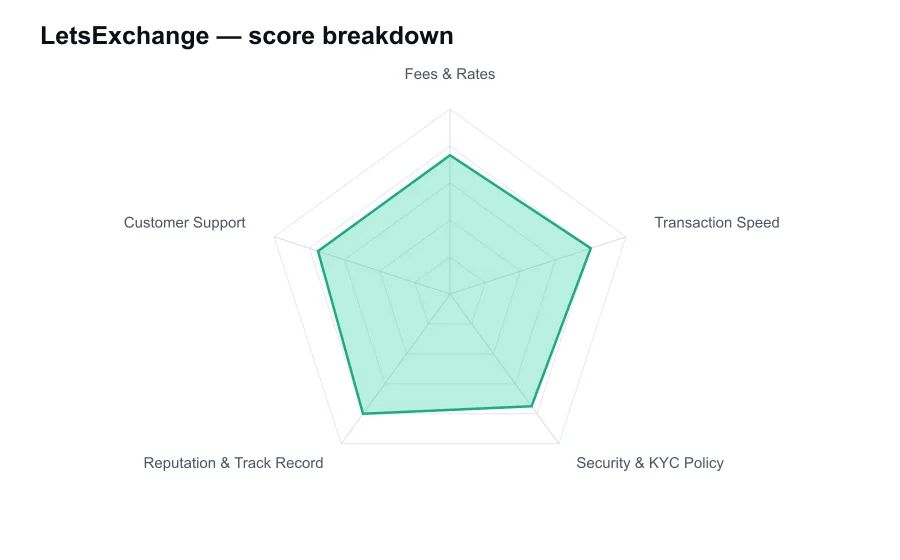
LetsExchange scores 7.7/10 overall in our independent review, measured against every other provider we've compared, strongest on Transaction Speed (8.0/10) and weakest on Customer Support (7.5/10).
Score: 7.7 How we score → Status: active (checked 2026-10-13T19:34:19.294Z) Visit official siteEditorial independence: our scores and rankings are produced using the fixed criteria above and are not influenced by advertisers. This is an independent ranking site and is not operated by, or affiliated with, any provider we list.
Affiliate disclosure: some links on this page may earn us a commission at no extra cost to you. This does not affect our rankings.
| Criterion | Score | Note |
|---|---|---|
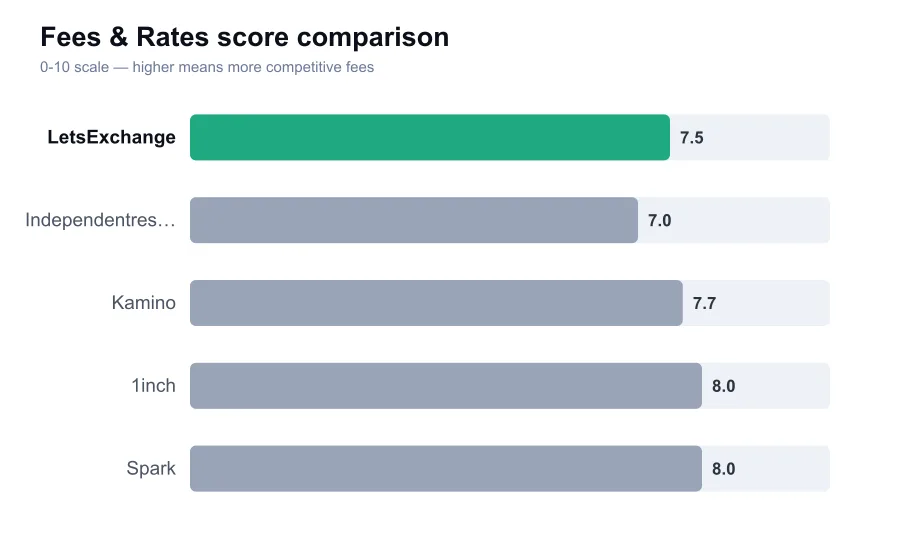
| Fees & Rates | 7.5 | Competitive quotes, but no universal flat fee |
| Transaction Speed | 8.0 | Fast on liquid routes, subject to confirmations |
| Security & KYC Policy | 7.5 | Account-free swaps with AML screening when required |
| Reputation & Track Record | 8.0 | Operating since 2020 with an established public record |
| Customer Support | 7.5 | 24/7 support and order-status tools |
| Fact | Value |
|---|---|
| Founded | 2020 |
| Service model | Instant wallet-to-wallet exchange |
| Rate options | Floating and fixed rates |
| Account requirement | No registration for ordinary swaps |
| Support availability | 24/7 |
| Asset coverage | Thousands of coins and tokens |
| Pros | Cons |
|---|---|
| Broad multi-chain asset selection | — |
| Fixed-rate and floating-rate options | — |
| No account needed for ordinary swaps | — |
| Established since 2020 | — |
| 24/7 support channels | — |
What is LetsExchange?
How LetsExchange Works
- Select the coin you want to send and receive
- Choose a floating or eligible fixed-rate quote
- Enter and verify your receiving wallet address
- Send the deposit to the generated address within the stated conditions
- Track confirmations and order status
- Receive the converted asset in your wallet
KYC
| Requirement | optional |
|---|---|
| Notes | Standard swaps generally start without registration. LetsExchange applies AML and risk checks and may request identity verification for a flagged transaction. |
Supported Assets
| Notable Coins | Bitcoin, Ethereum, Solana, XRP, Litecoin, Dogecoin, USDT, USDC, BNB, Avalanche |
|---|---|
| Networks | Bitcoin, Ethereum, Tron, BNB Smart Chain, Solana, Polygon, Avalanche |
How to Use LetsExchange Safely
- Open letsexchange.io directly rather than through an ad link
- Verify the selected token network and receiving address
- Use a fixed-rate order if you need a precise payout
- Keep the order ID and deposit transaction hash
- Test unfamiliar networks with a small amount first
- Do not send funds that may trigger a review if you cannot complete KYC
LetsExchange is a well-known instant cryptocurrency exchange aggregator, not a conventional centralized trading venue. It lets users convert assets directly from one wallet to another, usually without creating a trading account or leaving a standing balance on the platform. The service has grown into one of the more recognizable names in the no-registration swap category, competing with providers such as ChangeNOW, Changelly, SimpleSwap, and SwapSpace. It is a stronger and more mature option than obscure swap sites, though it is still an instant exchanger with all the limits that implies.
The basic appeal is straightforward. You choose the asset you are sending, the asset you want to receive, the amount, and the destination address. LetsExchange shows a route and estimated payout, then gives you a deposit address. Once the incoming transaction receives sufficient confirmations, the provider and its liquidity partners complete the conversion and send the destination asset. That flow removes the need to manage order books, but it does not remove the need to understand network fees, market movement, and irreversible wallet transactions.
LetsExchange has made a name for broad asset and network coverage. Its site advertises thousands of coins and tokens, including major assets such as Bitcoin, Ethereum, Solana, XRP, Litecoin, Dogecoin, USDT, and USDC. That breadth is genuinely useful for users moving between ecosystems, especially where a centralized exchange does not list a smaller token or a particular chain version of a stablecoin. Still, broad support creates its own risk. Two assets carrying the same ticker can exist on different networks, and sending the wrong version remains one of the easiest ways to create a costly support case.
Fees are not presented as a single simple trading commission. Like many instant exchange services, LetsExchange quotes a payout after incorporating the route, liquidity cost, and relevant network costs. The customer should judge the service by the output amount, not by searching for a universal percentage. This is transparent enough for comparison shopping, though it is less clean than an exchange that lists maker and taker fees separately. For liquid major pairs, LetsExchange is often competitive, but it should never be assumed to be the cheapest route at every moment.
The site offers floating-rate and fixed-rate options on eligible pairs. Floating rate is normally the better choice for users who prioritize price and can accept that the final payout may change while the deposit is confirming. Fixed rate is more appropriate when certainty matters, such as a payment requiring a particular amount, but it can come with a less favorable quote and a strict time window. This is a meaningful feature rather than marketing decoration. People who do not understand the distinction are the ones most likely to be disappointed by an otherwise correctly completed swap.
The cost picture also depends heavily on the blockchain. A LetsExchange quote is not a magic escape from Bitcoin miner fees or expensive Ethereum gas. On small transactions, network costs can dominate the exchange spread. This is especially relevant for ERC-20 transfers, where a cheap-looking token swap may be uneconomic after the destination-chain withdrawal fee. Before confirming an order, compare the payout across networks if the asset is available on more than one chain, but only if your receiving wallet and intended destination truly support that alternative network.
Speed is generally good for an aggregator, but users should keep realistic expectations. LetsExchange can create an order immediately and begins processing once it detects the deposit. A fast network and a liquid pair can result in a completed swap within minutes. Bitcoin deposits, busy Ethereum periods, lower-liquidity tokens, and cross-network routes can take substantially longer. The company cannot bypass confirmation rules set by blockchains, so anyone needing a guaranteed settlement time should use a method that matches that need rather than trusting an instant-exchange label.
The service does better than many smaller rivals on transaction visibility. It provides an order-status flow and support access, which is crucial when a customer wants to see whether a deposit is awaiting confirmations, being exchanged, or has been sent out. That does not mean every issue resolves instantly. A wallet maintenance event at a liquidity provider can still delay a payout, and a wrong network can require manual recovery if recovery is technically possible at all. But LetsExchange has a sufficiently established support operation that these cases are more manageable than they are with an unknown brand.
Its non-custodial framing is useful but needs precision. LetsExchange generally does not operate like an exchange where a user deposits funds into a personal account and leaves them there. The customer sends funds for a specific swap. That reduces exposure to a permanently held platform balance. During the trade, however, the service and its partners still control the conversion process. Users should not confuse non-custodial marketing with a decentralized exchange. LetsExchange is a service intermediary, not a self-executing on-chain protocol.
KYC is similarly more nuanced than the word no-KYC suggests. LetsExchange generally allows swaps without account registration, which is a genuine convenience for ordinary users. It also applies compliance and anti-money-laundering controls and can request verification for transactions flagged by its risk systems. This is standard practice among serious instant exchangers. The practical lesson is to avoid sending funds with an unclear provenance or high-risk history if you cannot complete an identity review, and never assume that an account-free order is beyond compliance checks.
From a security perspective, LetsExchange benefits from its established brand, wallet-to-wallet design, and published policies. It does not have the same custodial attack surface as an exchange maintaining millions of user account balances. Yet the usual crypto threats still apply. Fake clone sites, phishing search ads, clipboard malware, and a wrong recipient address can defeat even a sound exchange service. The most important security control remains the user's own: access the official domain directly, confirm the browser address, and verify every network and wallet address before sending.
Reputation is a real strength. LetsExchange has operated since 2020 and has built a visible presence through partnerships, media coverage, and accumulated customer feedback. It is not immune from complaints, and no exchange handling volatile networks and irreversible transactions will be. Some users report delays or KYC-related frustration, especially when a transaction is flagged. The difference is that LetsExchange has enough scale and public history that those reports can be evaluated in context, rather than forcing a customer to rely on a few anonymous claims.
Support is available around the clock through live chat and email channels, and the company also maintains help material around common order issues. In practical terms, the quality of support is usually strongest for a standard delayed transaction where the customer has an order ID and transaction hash. It is weaker, as with any provider, where a user has sent unsupported assets, entered an incorrect destination address, or refuses a required compliance review. The more precise your records are, the better the chance of a useful response.
LetsExchange is a solid choice for users who want broad token access, a no-account starting point, and the option to compare fixed versus floating rates. It is not the right product for active traders seeking limit orders, deep charting, fiat deposits, or a regulated custodial account. It is also not ideal for a person who cannot tolerate an exceptional KYC request. Those users should choose a regulated centralized platform and complete verification before moving funds.
My judgment is favorable, with conditions. LetsExchange is one of the more credible instant exchangers because it combines wide support, useful rate options, a meaningful public track record, and accessible support. Its pricing is quote-driven rather than perfectly transparent, and compliance holds can be frustrating, so it does not deserve a perfect score. But for a carefully checked wallet-to-wallet swap, it is a much stronger choice than the lightly documented services in this comparison.
Does LetsExchange require an account?
Ordinary swaps generally do not require account registration. LetsExchange can still request verification if its AML and risk controls flag a transaction.
What is the difference between fixed and floating rates?
A floating rate can change while your deposit confirms. A fixed rate aims to preserve the quoted payout for its payment window, usually at a different price.
How long does a LetsExchange swap take?
Liquid routes can finish within minutes, but timing depends on blockchain confirmations, congestion, the selected network, and liquidity-provider processing.
Why did my expected payout change?
With a floating-rate order, the market can move between order creation and deposit confirmation. Use an eligible fixed-rate quote if payout certainty matters more.
Can LetsExchange process swaps across multiple networks?
Yes, it supports major ecosystems including Bitcoin, Ethereum, Tron, BNB Smart Chain, Solana, Polygon, and Avalanche. Always select the exact network supported by your wallet.
What should I provide to support for a delayed swap?
Send the order ID, deposit transaction hash, amount, deposit asset, receiving address, and network. These details let support locate the order quickly.
Is LetsExchange a decentralized exchange?
No. It is an instant exchange intermediary that routes conversions. You receive assets in your own wallet, but the swap is not a self-executing decentralized exchange trade.
Editorial independence: our scores and rankings are produced using the fixed criteria above and are not influenced by advertisers. This is an independent ranking site and is not operated by, or affiliated with, any provider we list.
Affiliate disclosure: some links on this page may earn us a commission at no extra cost to you. This does not affect our rankings.