Defillama
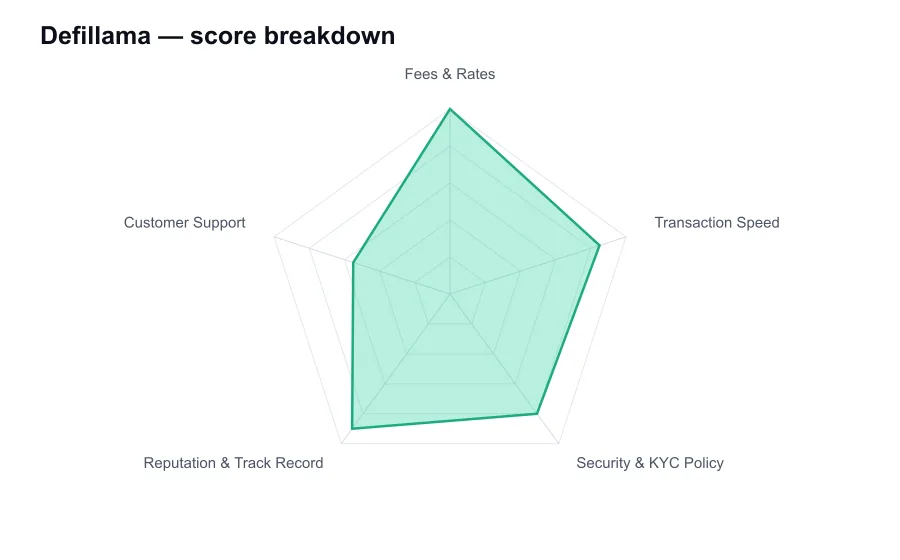
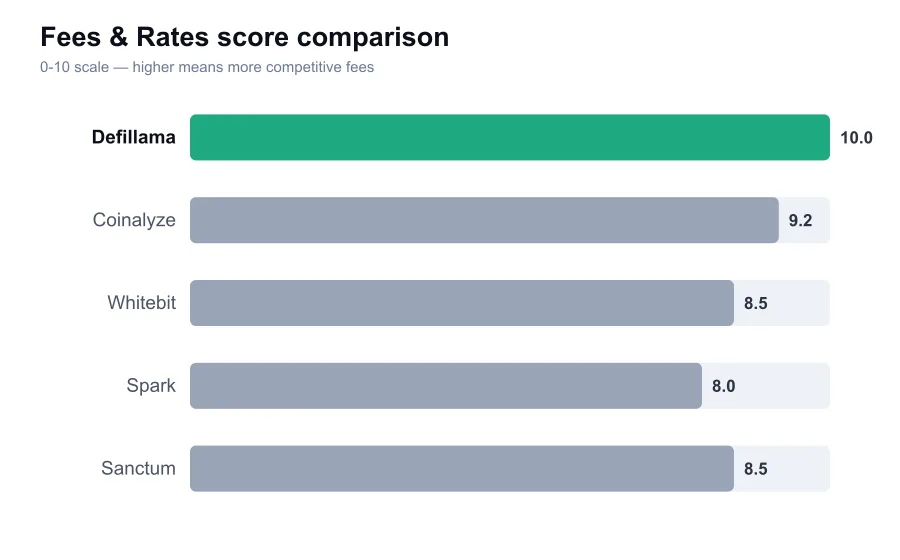
Defillama scores 8.6/10 overall in our independent review, measured against every other provider we've compared, strongest on Fees & Rates (10.0/10) and weakest on Customer Support (5.5/10).
Score: 8.6 How we score → Visit official siteEditorial independence: our scores and rankings are produced using the fixed criteria above and are not influenced by advertisers. This is an independent ranking site and is not operated by, or affiliated with, any provider we list.
Affiliate disclosure: some links on this page may earn us a commission at no extra cost to you. This does not affect our rankings.
| Criterion | Score | Note |
|---|---|---|
| Fees & Rates | 10.0 | Free public DeFi research and analytics access |
| Transaction Speed | 8.5 | Fast dashboards with frequent data updates |
| Security & KYC Policy | 8.0 | No custody or KYC, but external protocol risk |
| Reputation & Track Record | 9.0 | Leading independent source for DeFi metrics |
| Customer Support | 5.5 | Community and public channels, not a help desk |
| Pros | Cons |
|---|---|
| Free and broad multi-chain DeFi data | — |
| No custody, deposits, or standard KYC | — |
| Excellent TVL, yield, and protocol comparisons | — |
| Useful public API and research tools | — |
DefiLlama is not a crypto exchange, broker, wallet, or custodian. It is a data platform for decentralized finance, and that distinction is the starting point for any honest review. The site tracks total value locked, yields, bridges, chains, decentralized exchanges, stablecoins, fees, revenue, token unlocks, governance data, and protocol activity across a broad part of the on-chain market. For DeFi researchers, it has become one of the default places to check whether a protocol is genuinely attracting capital or simply attracting attention.
The platform occupies a useful middle ground between raw blockchain explorers and polished financial terminals. Etherscan can tell you what happened in a transaction, but it will not quickly show how a protocol compares with competitors across multiple chains. A paid data terminal may provide more institutional tooling, but many individual researchers do not need that depth. DefiLlama makes cross-chain DeFi information accessible, often without a login and without a subscription wall.
The cost is one of its biggest strengths. Much of the site is free to browse, and public data access has helped make it a common reference point for journalists, analysts, investors, developers, and protocol teams. There is no exchange commission because DefiLlama does not execute trades. Users must not confuse a zero-cost dashboard with a zero-cost DeFi strategy, though. The real expenses appear later in gas fees, swap fees, bridge costs, slippage, borrowing interest, liquidation risk, and smart-contract losses.
That distinction matters because DeFi marketing often hides costs behind a friendly annual percentage yield. DefiLlama's yield and protocol pages can help compare opportunities, but a high displayed APY is not an endorsement. It may be a temporary incentive, a volatile token reward, or compensation for a risk that is difficult to see from a headline number. The platform is useful precisely because it gives users more context than a protocol's own promotional page, but it cannot turn a risky pool into a safe savings account.
Speed is generally a strong point. Pages load quickly for the amount of information presented, and data refreshes frequently enough for research, portfolio monitoring, and broad market observation. It is especially effective for identifying changes in TVL, stablecoin supply, DEX volume, and bridge activity over hours or days. It should not be mistaken for a tick-perfect execution feed. If a trade depends on a few seconds of price movement, use a live DEX quote and the relevant chain tools, not an analytics dashboard.
DefiLlama's coverage is exceptionally broad, and that is both its advantage and its source of complexity. It tracks an enormous range of chains and protocols, from established names such as Aave, Uniswap, Maker and Lido to newer projects that may have little history. Broad coverage gives researchers a map of the ecosystem. It also means a listing does not equal an audit, a recommendation, or a statement that the underlying project is legitimate.
The site has a particularly good reputation for resisting some of the worst habits of crypto data presentation. Its focus on open methodology, protocol categories, historical charts, and public data has made it more useful than dashboards that only repeat token prices or sponsored rankings. The team and community have also earned attention for taking a relatively independent stance in a sector where data providers are often financially entangled with the projects they cover. That independence is a major part of its value.
Still, users should understand how messy DeFi data can be. TVL can be inflated by recursive borrowing, duplicated collateral, bridged assets, or design choices that make capital appear in more than one place. A sudden rise in TVL can reflect incentives, not product-market fit. A fall can reflect token-price movement rather than a mass user exit. DefiLlama provides metrics, not a substitute for reading documentation, tracing contracts, and asking what economic activity is actually occurring.
Security is unusual to score here because DefiLlama does not normally hold user funds or require users to deposit crypto. Browsing the website does not involve the custodial danger of keeping assets on a centralized exchange. There is usually no ordinary KYC hurdle either, which is helpful for research and protective of privacy. That low-custody model deserves credit. It does not mean that following links from a dashboard, connecting a wallet to an external protocol, or acting on a yield table is risk-free.
The most practical security rule is to separate research from transaction signing. Use DefiLlama to investigate a protocol, then independently verify the official domain, contract address, audit history, team disclosures, admin controls, and wallet permissions before interacting with it. Bookmark important sites instead of trusting search-engine advertisements. A polished protocol page can coexist with an unsafe smart contract, and a familiar name can be impersonated by a phishing site. The dashboard is a starting point, never final due diligence.
The platform's yield tools are helpful but need the harshest reading. A yield table can reveal the underlying chain, pool composition, historical rate, and whether rewards are paid in incentives. That is far better than blindly searching for the highest number. Yet it cannot know whether a stablecoin will hold its peg tomorrow, whether a lending market's oracle will behave during stress, or whether governance will change reward emissions. If an APY looks absurd, the risk is usually hiding in plain sight.
DefiLlama is also valuable for macro DeFi research. Its stablecoin, fees and revenue, DEX volume, and chain comparison pages can show whether on-chain activity is migrating or expanding. This is useful for investors trying to distinguish token excitement from actual usage. It is also useful for builders choosing where to deploy. The catch is that no single metric settles the question. A chain can have high volume because of a short-lived incentive campaign, bots, or one popular application.
Customer support is not comparable with that of a bank or centralized exchange. The project is built around public resources, community channels, GitHub, and social platforms rather than a large call center. Researchers with a data issue may find a route to report it, and technically capable users can often inspect methodologies or raise questions publicly. A retail user hoping for immediate one-to-one help after making a bad DeFi transaction will not find that safety net here, because DefiLlama was never the counterparty to the transaction.
That lack of hand-holding is fair for an open data service, but it does narrow the audience. A beginner can learn a lot from the site, especially by comparing TVL and revenue trends, yet the dense terminology can be intimidating. Categories such as liquid staking, CDP, yield, bridge, and restaking assume some familiarity with DeFi mechanics. The best use for a newcomer is slow research, not clicking through to the newest high-yield pool after fifteen minutes of browsing.
DefiLlama's reputation has become strong enough that people sometimes cite a number from it as though it were an unquestionable fact. That is a mistake. Good data providers can have methodology changes, delayed integrations, classification disagreements, and unavoidable blind spots. The proper use is comparative and skeptical. Look at trends, inspect the methodology where available, compare with the protocol's own analytics, and see whether the claimed story survives more than one source.
For developers and analysts, the API and accessible data ecosystem are major attractions. They make it easier to build dashboards, conduct research, and monitor protocol changes without reinventing broad multi-chain indexing from scratch. As with any public data source, production users should understand limits, attribution, endpoint behavior, and update timing. A trading system or investment report should not rely on one endpoint without validation and fallback logic.
My take is that DefiLlama is one of the most useful public utilities in crypto, but it is useful because it encourages investigation, not because it tells users what to buy. The platform is fast, broad, free, and largely non-custodial. Its risks are interpretive rather than deposit-related, and that distinction matters. Use it as a skeptical map of DeFi, cross-check what it shows, and never let a leaderboard replace understanding the protocol behind the number.
Can I buy crypto on DefiLlama?
No. DefiLlama is an analytics platform, not an exchange or broker. It provides information about DeFi protocols, chains, yields, and market activity.
Does DefiLlama require KYC?
Ordinary browsing does not require exchange-style identity verification. Be careful with external links, because any protocol you later use may have its own requirements.
Is the highest yield on DefiLlama the best investment?
No. High yields can reflect token incentives, impermanent loss, smart-contract risk, borrowing risk, or unstable assets. Research the pool and protocol beyond the displayed APY.
Editorial independence: our scores and rankings are produced using the fixed criteria above and are not influenced by advertisers. This is an independent ranking site and is not operated by, or affiliated with, any provider we list.
Affiliate disclosure: some links on this page may earn us a commission at no extra cost to you. This does not affect our rankings.