Curve
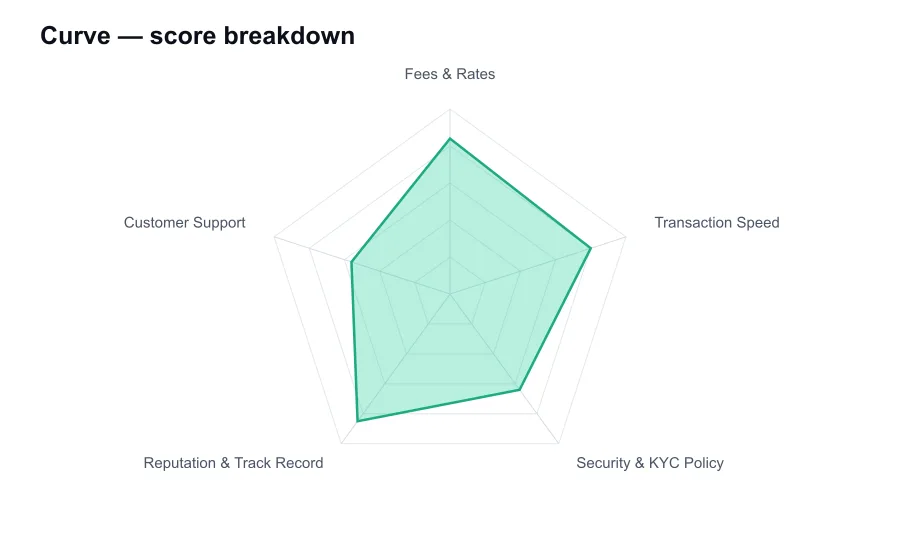
Curve scores 7.6/10 overall in our independent review, measured against every other provider we've compared, strongest on Reputation & Track Record (8.5/10) and weakest on Customer Support (5.6/10).
Score: 7.6 How we score → Status: active (checked 2026-10-13T19:40:42.065Z) Visit official siteEditorial independence: our scores and rankings are produced using the fixed criteria above and are not influenced by advertisers. This is an independent ranking site and is not operated by, or affiliated with, any provider we list.
Affiliate disclosure: some links on this page may earn us a commission at no extra cost to you. This does not affect our rankings.
| Criterion | Score | Note |
|---|---|---|
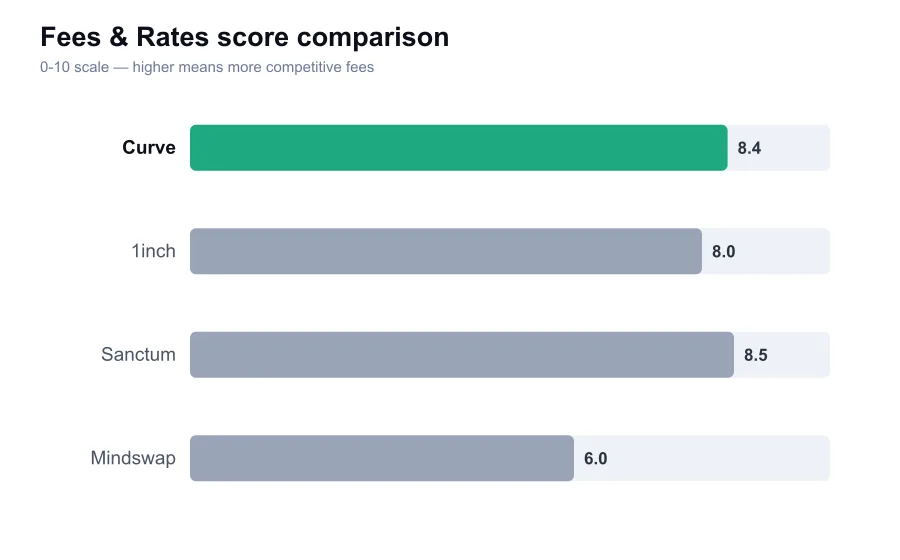
| Fees & Rates | 8.4 | Classic pools often use 0.04%, though dynamic fees and gas vary. |
| Transaction Speed | 8.0 | Direct on-chain execution, limited by the chosen network. |
| Security & KYC Policy | 6.4 | Non-custodial, but the July 2023 Vyper exploit was significant. |
| Reputation & Track Record | 8.5 | A major DeFi protocol since 2020 with deep integrations. |
| Customer Support | 5.6 | Documentation and community help, no transaction reversal desk. |
| Fact | Value |
|---|---|
| Launch year | 2020 |
| Classic pool fee | Often 0.04% |
| Governance token | CRV |
| KYC model | No routine KYC |
| Major exploit | July 2023 Vyper vulnerability |
| Pros | Cons |
|---|---|
| Very efficient liquidity for correlated assets | — |
| Non-custodial swaps with no routine KYC | — |
| Deep DeFi integrations and long operating history | — |
| Available across multiple blockchain networks | — |
What is Curve?
How Curve Works
- Connect a compatible self-custody wallet
- Choose the blockchain network and a Curve pool or route
- Enter the token pair and amount
- Review price impact, fee, output and token approval request
- Sign the approval if needed and confirm the on-chain swap
- Wait for blockchain confirmation
KYC
| Requirement | none |
|---|---|
| Notes | Curve smart contracts do not impose routine KYC. Access through a wallet or interface may still be affected by local law, wallet provider policies or interface restrictions. |
Supported Assets
| Notable Coins | USD Coin, Tether, DAI, crvUSD, Wrapped Bitcoin, Wrapped Ether, FRAX, Lido Staked ETH |
|---|---|
| Networks | Ethereum, Arbitrum, Optimism, Polygon, Base, Avalanche, Fantom |
How to Use Curve Safely
- Use a bookmarked official Curve domain
- Review token approvals and revoke unneeded allowances
- Check the chain and token contract before signing
- Factor gas cost into small swap decisions
- Never share a seed phrase with alleged support staff
- Understand pool composition before supplying liquidity
Curve is one of decentralized finance's most important specialized exchanges. It was built around a simple but powerful idea: stablecoins and closely correlated assets should trade with far less slippage than unrelated assets. Swapping USDC for USDT is not the same economic problem as swapping ETH for a meme token, and Curve's automated market maker design reflects that. The protocol became a core piece of Ethereum DeFi because it gave stablecoin liquidity providers and traders a more efficient venue for those correlated pairs.
The Curve name now covers more than stablecoin swaps. Its pools include wrapped Bitcoin pairs, ETH derivatives, crvUSD markets and a wider selection of assets through permissionless pool creation. Yet the original use case remains its best one. If you need to exchange among deep stablecoin pools, Curve can offer excellent execution. If you are looking for every trending asset or a simple fiat on-ramp, it is the wrong tool. Curve is financial infrastructure, not a beginner-friendly brokerage app.
Fees are often quoted as low as 0.04% for classic Curve pools. That figure helped build Curve's reputation, but it should not be treated as a universal current price. Pool parameters vary, and Curve introduced dynamic fees that can rise as a pool becomes imbalanced. The protocol fee model and liquidity-provider economics also differ by pool. A trader should inspect the actual route and quote before signing. Low nominal fees mean little if price impact, gas and a poor routing path consume the advantage.
For a large stablecoin swap on Ethereum, Curve's pool depth can still be impressive. A $100,000 USDC to USDT conversion may be far more efficient than a thin decentralized exchange pool, particularly in normal market conditions. Gas changes the equation for small trades. Paying $10 or $30 in Ethereum gas to save a few dollars in swap fees makes no sense. Curve deployments and integrations on lower-cost networks can help, but users must confirm which chain they are using and whether the asset is canonical or bridged.
Transaction speed is fundamentally blockchain speed. Curve has no central operations desk that approves a swap. Once you sign from your wallet, the transaction enters the network mempool and settles after block confirmation. On Ethereum that can be seconds to minutes depending on gas pricing and congestion. On Arbitrum, Optimism, Polygon, Base and other supported environments, the user experience can feel faster and cheaper. That directness is a major strength, though a failed transaction still costs gas and cannot be undone.
Curve is non-custodial in the conventional DeFi sense. You connect a wallet such as MetaMask, Rabby, Ledger through a compatible interface, approve a token contract and sign a transaction. There is no Curve account holding your balance and no routine KYC gate. That is a meaningful privacy and control advantage over centralized exchanges. It also moves responsibility squarely to the user. A malicious approval, fake front end or compromised wallet can cost more than any exchange login mistake.
The protocol's security record demands a clear-eyed assessment. In July 2023, several Curve pools using vulnerable versions of the Vyper programming language were exploited through a reentrancy flaw, with losses reported around $70 million. Some funds were recovered through white-hat actions and negotiations, but the incident was serious. It showed that even a mature, heavily used DeFi protocol can inherit risk from tooling and contract dependencies. Curve should never be described as risk-free because it has survived for years.
That event did not destroy Curve, and the protocol remains active and widely integrated. Still, its long history contains other reminders that decentralization does not eliminate operational risk. In 2022, a compromise involving Curve's front-end domain infrastructure led users to be warned against interacting with the site until it was resolved. The smart contracts and web interface are different attack surfaces. A careful user checks the official URL, uses trusted bookmarks and is suspicious of wallet prompts that request unexpected approvals.
Curve's DAO and CRV governance token are central to its identity. Liquidity incentives and voting power, particularly the vote-escrowed veCRV system, turned Curve into a major arena for DeFi governance competition. This can be fascinating for advanced users, but it also makes the protocol more complicated than its clean swap screen suggests. CRV emissions, liquidity incentives and pool rewards are not free yield. They are economic incentives with token price, smart contract and liquidity risks attached.
For liquidity providers, Curve can be rewarding but should not be mistaken for a savings account. Stablecoin pools can lose balance if one asset becomes less trusted than another. The 2023 depegging fears around USDC after Silicon Valley Bank are a useful reminder. A pool's apparent stability can vanish when traders rush to exit one side. LPs may earn fees and incentives while absorbing an unwanted concentration in the asset that other market participants are trying to sell.
Reputation is a relative strength. Curve launched in 2020 and became one of the defining protocols of the DeFi summer era. It has deep integrations across lending protocols, aggregators and stablecoin systems, and it has weathered brutal market conditions that erased many weaker projects. Its founder, Michael Egorov, is also a known public figure in the sector. The protocol's fame cuts both ways. Curve is sufficiently important that its vulnerabilities, governance disputes and CRV-related financial stress receive intense scrutiny.
Customer support is where centralized-exchange users need to reset expectations. Curve has documentation, community channels and developer resources, but no customer-service team can reverse a confirmed swap, restore a lost seed phrase or compensate a bad approval. The official support ecosystem is also a favorite target for scammers posing as admins. Anyone asking for a seed phrase, private key or remote access is trying to steal funds. Real support can explain a transaction. It cannot safely take control of your wallet.
Curve is excellent for sophisticated stablecoin users who can read pool information, understand approvals and assess chain costs. It is less attractive for someone who merely wants to buy Bitcoin with a debit card or trade rapidly from a mobile interface. The protocol's interface has improved, but it still assumes some DeFi literacy. Route through a trusted aggregator if it finds a better execution path, but verify that the transaction actually calls legitimate contracts and that the expected output matches what you approved.
My judgment is that Curve remains indispensable infrastructure, but it is no longer a protocol I would describe with carefree blue-chip language. The trading design is smart, the stablecoin execution can be excellent and the non-custodial model is powerful. The Vyper exploit and web-layer incidents are real marks against its security score, even though recovery work and continued operation show resilience. Use Curve for its specific edge, correlated-asset liquidity, not because a yield screen makes risk look routine.
What fee does Curve charge for swaps?
Many classic Curve pools have historically used a 0.04% trading fee. Actual fees can differ by pool, and dynamic fees can rise when liquidity becomes imbalanced.
Does Curve require KYC?
No routine KYC is required to use Curve's on-chain contracts. You connect a self-custody wallet and pay blockchain gas, though local laws and wallet providers may differ.
What happened in the Curve exploit of July 2023?
Vulnerable Vyper compiler versions enabled reentrancy attacks against several Curve pools. Losses were reported at roughly $70 million, with some funds later recovered.
Why can a Curve stablecoin pool become risky?
If traders lose confidence in one stablecoin, they can drain the preferred asset from a pool. Liquidity providers may be left concentrated in the asset others are selling.
Can Curve reverse a mistaken transaction?
No. Curve transactions are executed on-chain. Once confirmed, the protocol cannot reverse a wrong wallet address, token approval or completed swap.
Why is a Curve trade expensive on Ethereum?
The swap fee may be low, but Ethereum gas is paid separately. Small trades can be uneconomic during congestion even if a pool charges around 0.04%.
How can I avoid fake Curve support?
Use the official site from a saved bookmark and never share a seed phrase or private key. Legitimate support will not need either to investigate a public transaction.
Editorial independence: our scores and rankings are produced using the fixed criteria above and are not influenced by advertisers. This is an independent ranking site and is not operated by, or affiliated with, any provider we list.
Affiliate disclosure: some links on this page may earn us a commission at no extra cost to you. This does not affect our rankings.