Morpho
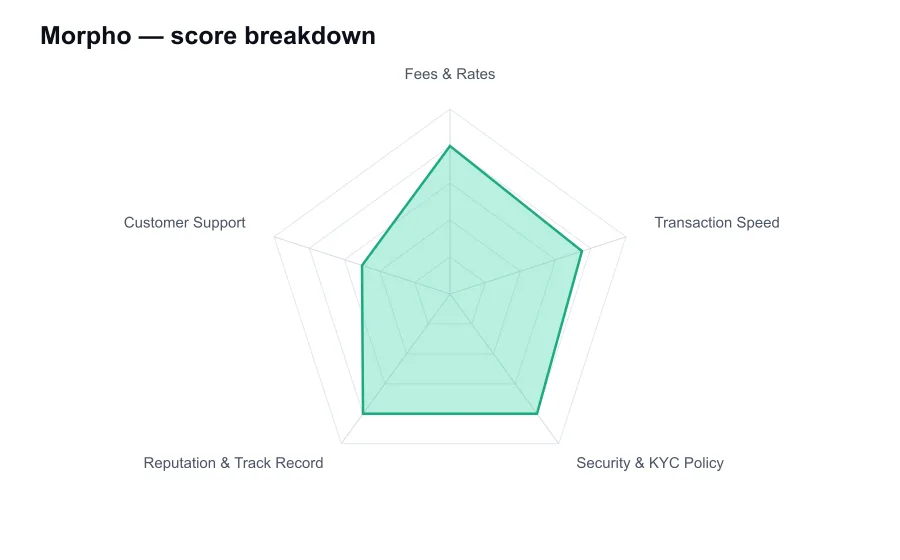
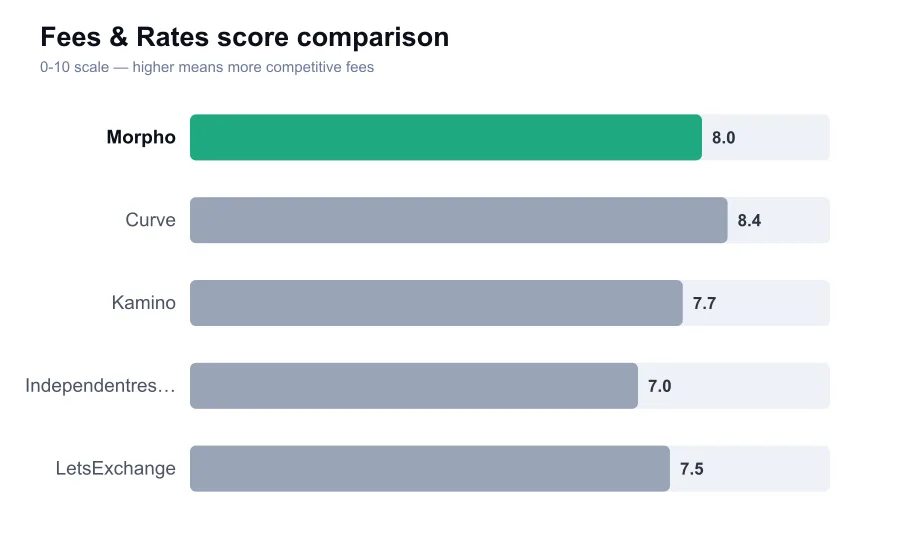
Morpho scores 7.6/10 overall in our independent review, measured against every other provider we've compared, strongest on Fees & Rates (8.0/10) and weakest on Customer Support (5.0/10).
Score: 7.6 How we score → Visit official siteEditorial independence: our scores and rankings are produced using the fixed criteria above and are not influenced by advertisers. This is an independent ranking site and is not operated by, or affiliated with, any provider we list.
Affiliate disclosure: some links on this page may earn us a commission at no extra cost to you. This does not affect our rankings.
| Criterion | Score | Note |
|---|---|---|
| Fees & Rates | 8.0 | Lean protocol costs, but rates and vault fees vary |
| Transaction Speed | 7.5 | Onchain settlement is fast, network dependent |
| Security & KYC Policy | 8.0 | Audited core, but market and oracle risk is user-selected |
| Reputation & Track Record | 8.0 | Widely respected DeFi lending infrastructure |
| Customer Support | 5.0 | Good technical resources, no retail-style intervention |
| Pros | Cons |
|---|---|
| Efficient permissionless lending architecture | — |
| MetaMorpho vaults simplify diversified lending | — |
| No standard KYC for onchain use | — |
| Strong technical reputation and audit focus | — |
Morpho is one of the most important lending protocols in DeFi, though it is easy to misunderstand if you approach it like a normal exchange. It is a permissionless lending layer where users can lend assets for yield or borrow against collateral. Its current Morpho Blue architecture is deliberately minimal, allowing markets to be created around a loan asset, collateral asset, liquidation loan-to-value ratio, oracle, and interest rate model. That design makes it powerful, but it shifts more judgment onto the user.
Earlier versions of Morpho became known for optimizing rates on top of Aave and Compound by matching lenders and borrowers peer-to-peer where possible. Morpho Blue is more ambitious and less protective. Rather than curating a small menu of protocol-owned markets, it provides the rails for permissionless ones. The result is a lending market that feels closer to financial infrastructure than a consumer bank. That is a compliment, but it is also a warning.
Fees are attractive at the protocol level. Morpho Blue itself does not impose a fixed borrowing or lending spread in the way a centralized lender might, and market parameters determine the economic outcome. Vaults can charge performance fees, and users still pay Ethereum or layer two gas. The important cost is the borrow rate shown by the specific market, not a simplistic claim that Morpho is free. Rates can change materially with utilization and the chosen interest rate model.
For lenders, the vault layer is often the sensible entry point. MetaMorpho vaults allocate deposits across selected Morpho markets according to the vault curator's rules and risk caps. That reduces the need to assess every collateral type and oracle yourself. It does not eliminate risk. A curator can make poor allocation choices, an underlying market can experience stress, and a vault's stated strategy should be read rather than assumed to be conservative because its interface looks polished.
Borrowers need to be even more disciplined. A loan is secured by collateral and can be liquidated if the collateral value falls relative to the debt. Morpho's permissionless market structure means parameters vary widely. One market may use a conservative loan-to-value ratio and a highly liquid collateral asset, while another pairs a volatile token with a setup that deserves close scrutiny. A favorable displayed annual percentage rate is not compensation for ignoring liquidation mechanics.
Transaction speed depends mainly on the network. On Ethereum mainnet, deposits, borrowing, repayments, and liquidations settle according to normal block confirmation, usually seconds to minutes depending on conditions. Morpho has expanded across networks such as Base, where the user experience can be much cheaper and faster. The protocol itself does not create banking-style delays. The more relevant speed issue is liquidation, which can occur rapidly in a sharp market move once a position crosses its threshold.
Security is where Morpho's minimalist philosophy cuts both ways. The core protocol has undergone extensive auditing by respected firms, has a public bug bounty program, and has attracted serious technical attention. The Blue codebase aims to be compact, which can reduce unnecessary complexity in the core. Yet a secure core does not make every market safe. Oracles, collateral tokens, interest rate models, vault curators, front ends, and integrations all create distinct risks.
The oracle decision is particularly important. Morpho markets specify their oracle, which means a user should know whether pricing relies on a robust source such as Chainlink, a specialized oracle, or a mechanism they do not fully understand. Bad oracle design can create borrowing or liquidation risk even when the lending contracts work as written. This is not theoretical DeFi pedantry. Lending protocols live or die by accurate collateral pricing during volatile conditions.
Morpho does not generally require KYC for onchain use. You connect a wallet, interact with smart contracts, and retain control of assets until they are supplied or pledged as collateral. That is a major advantage for users who value open access and composability. It also means there is no human credit assessment, no promise of deposit insurance, and no way to complain your way out of a liquidation. Code executes according to parameters, whether or not a user understood them.
Its reputation is very good among technically literate DeFi participants. Morpho has raised its profile through integrations, the adoption of MetaMorpho vaults, and the presence of sophisticated curators and institutional-facing partners. It is not as old as MakerDAO or Aave, so it has less history across multiple full credit cycles. Still, it is not an obscure experiment. The protocol is widely discussed as a serious contender in decentralized money markets, particularly because its design is leaner than older pool-based systems.
The protocol's openness creates a problem for casual users: choice overload can become disguised risk. Seeing many markets is not the same as receiving many safe options. Aave's curated pools can be easier to navigate because its risk framework is more standardized. Morpho rewards users who can distinguish between a high-quality vault with transparent caps and a market that exists merely because permissionless deployment allowed it. That is a meaningful divide between the two products.
Customer support is not a strong point in the retail sense. Morpho provides documentation, governance channels, and community resources, but it cannot offer a traditional lender's customer service. Nobody will manually halt a liquidation because your internet connection failed. Front-end and vault operators may offer their own help, which can make the experience uneven. The best protection is to monitor positions, maintain a comfortable collateral buffer, and use alerts rather than relying on a rescue message.
I would also be cautious about confusing vault yield with a savings rate. Lender returns are compensation for borrowers' demand and credit risk, not a guaranteed coupon. Yield can decline as utilization changes, and a vault allocation can change within its mandate. Borrowers should model the effect of a rate increase and a collateral decline before opening a position. If the plan only works while every chart rises, it is not a lending strategy. It is leverage with optimistic branding.
Morpho is excellent infrastructure for a user willing to do the work. It offers efficient markets, a powerful vault model, and an unusually clean approach to permissionless lending. But it is less forgiving than a curated platform, especially for borrowers chasing high loan-to-value ratios or lenders blindly depositing into the highest yield. My take is positive, with a firm qualification: Morpho is built for informed capital. Treat it like a serious financial protocol, and it can be among the best tools in DeFi. Treat it like a savings app, and it can teach expensive lessons.
Does Morpho require KYC?
Direct interaction with Morpho's onchain protocol generally does not require KYC. You use a self-custody wallet, though third-party front ends and local regulations may differ.
Are MetaMorpho vaults safe?
They can reduce the work of choosing individual markets, but safety depends on the curator, market caps, assets, oracles, and strategy. Vault deposits are not insured and can lose value.
Can I be liquidated on Morpho?
Yes. If collateral value falls or debt grows enough to breach a market's loan-to-value threshold, liquidators can repay debt and seize collateral according to the market's rules.
Editorial independence: our scores and rankings are produced using the fixed criteria above and are not influenced by advertisers. This is an independent ranking site and is not operated by, or affiliated with, any provider we list.
Affiliate disclosure: some links on this page may earn us a commission at no extra cost to you. This does not affect our rankings.